On this page
Quick Reference
Overview and Recommendations
Background
- •Aortic stenosis (AS) is a progressive valvular heart disease characterized by narrowing of the aortic valve orifice during systole, leading to left ventricular outflow obstruction, pressure overload, and eventually heart failure and death if untreated. The most common cause in developed countries is calcific (degenerative) AS, affecting 1-2% of adults >65 years and approximately 12% of those >75 years; other causes include congenital bicuspid aortic valve (presenting at age 40-65 years) and rheumatic heart disease (rare in developed countries).
- •The pathophysiology of AS extends beyond passive calcium deposition: it is a lipoprotein-driven process involving endothelial injury, lipid infiltration (particularly lipoprotein(a)), inflammation, and ectopic osteogenesis in valve leaflets. This triggers left ventricular concentric hypertrophy as an adaptive response to pressure overload, but maladaptive remodeling, including myocardial fibrosis, microvascular rarefaction, and diastolic dysfunction, ultimately leads to decompensation.
- •Once symptoms (exertional dyspnea, angina, syncope) develop in severe AS, 1-year mortality exceeds 50% without intervention. The classic triad of angina, syncope, and heart failure signals advanced disease, with median survival of 2-3 years after symptom onset. Valve replacement (surgical or transcatheter) restores near-normal life expectancy.
- •Severity is graded by Doppler echocardiography: severe AS is defined by aortic velocity ≥4.0 m/s, mean gradient ≥40 mm Hg, or aortic valve area ≤1.0 cm². Discordant low-gradient patterns (small valve area but lower gradient) occur in up to 30% of patients and require additional testing (dobutamine stress echo or CT calcium scoring) to differentiate true-severe from pseudo-severe AS.
- •Concomitant conditions modulate risk: transthyretin cardiac amyloidosis (ATTR-CA) is present in 8-18% of severe AS patients, especially older men with low-flow/low-gradient physiology; cardiovascular-kidney-metabolic syndrome is present in 90% of TAVI patients and incrementally raises 1-year mortality.
Evaluation
- •Suspect aortic stenosis in any patient aged ≥65 years with a systolic ejection murmur at the right upper sternal border radiating to the carotids, especially if accompanied by exertional dyspnea, angina, syncope, or reduced exercise tolerance. Many patients unconsciously limit activity, so a careful exercise history is essential.
- •Ask about the classic symptom triad: dyspnea on exertion, angina (due to increased oxygen demand from LV hypertrophy and reduced supply), and exertional syncope (from vasodilation outstripping fixed cardiac output). Also ask about orthopnea, paroxysmal nocturnal dyspnea, and symptoms of heart failure.
- •Examine for a late-peaking crescendo-decrescendo systolic murmur (louder with squatting, softer with Valsalva), diminished and delayed carotid upstroke (pulsus parvus et tardus), an S4 gallop, narrow pulse pressure (late sign), and signs of pulmonary congestion (crackles) or elevated jugular venous pressure.
- •Order transthoracic echocardiography with Doppler as the first-line gold-standard test. Document peak aortic velocity, mean gradient, and aortic valve area (by continuity equation). Severe AS: Vmax ≥4 m/s, mean gradient ≥40 mm Hg, AVA ≤1.0 cm² (indexed ≤0.6 cm²/m²).
- •If the three measures are concordant, severity classification is straightforward. If discordant (AVA ≤1.0 cm² but mean gradient <40 mm Hg), measure stroke volume index (SVi). If SVi ≤35 mL/m² and LVEF <50% → low-dose dobutamine stress echo to differentiate true-severe vs pseudo-severe. If SVi ≤35 mL/m² and LVEF ≥50% → CT calcium scoring (thresholds: ≥1274 AU in women, ≥2065 AU in men). If SVi >35 mL/m² → CT calcium scoring.
- •In asymptomatic patients with severe AS, consider exercise stress echocardiography to unmask symptoms or abnormal blood pressure response. An abnormal response identifies higher-risk patients who may benefit from earlier intervention.
- •Assess for concomitant cardiac amyloidosis in older patients (≥75 years) with low ECG voltage relative to LV hypertrophy, discordant low-flow low-gradient AS, or unexplained right ventricular dysfunction. Order DPD scintigraphy and serum free light chains if suspicion is high.
- •Order baseline laboratory studies: NT-proBNP and high-sensitivity cardiac troponin T (both strong independent predictors of outcomes), renal function (eGFR), and electrolytes before initiating GDMT.
- •Consider imaging for coronary artery disease before valve intervention: CT coronary angiography or invasive angiography based on age and risk factors. In patients with significant CAD, PCI before TAVR reduces MACE (NOTION-3 trial).
- •Evaluate frailty using the Essential Frailty Toolset (EFT), a score ≥3 is the strongest predictor of 1-year mortality after TAVR (OR 3.72).
- •Assess for extravalvular cardiac damage using the staging classification (Stage 0-4, based on LV, left atrial, pulmonary, and right ventricular involvement), which independently predicts mortality after TAVR (HR 1.46 per stage increment).
- •Consider cardiac MRI if myocardial fibrosis is suspected (late gadolinium enhancement), it is associated with a 23% increase in hazard of death or AS-related hospitalization per 1% rise in extracellular volume. However, the EVOLVED trial showed early intervention did not reduce the primary composite endpoint in fibrosis-positive patients.
- •Differential diagnoses include hypertrophic cardiomyopathy (dynamic LVOT obstruction on Doppler), hypertensive heart disease (LV hypertrophy without transvalvular gradient), aortic sclerosis (thickening without obstruction, Vmax <2 m/s), and mitral regurgitation (blowing systolic murmur at apex).
Management
- •For symptomatic severe aortic stenosis, valve replacement is a class I recommendation. The choice between transcatheter (TAVR) and surgical (SAVR) AVR depends on age, surgical risk, anatomy, and patient preference. In low-risk patients, TAVR is noninferior to SAVR at 5 years; in intermediate-risk patients, 10-year mortality is similar.
- •For asymptomatic severe AS, early intervention (TAVR or SAVR) reduces unplanned cardiovascular hospitalization (HR 0.40) and stroke (HR 0.62) compared with clinical surveillance (EARLY TAVR trial). The AVATAR trial showed a 58% relative reduction in the composite of death, MI, stroke, or HF hospitalization with early SAVR (HR 0.42).
- •Initiate guideline-directed medical therapy (GDMT) for heart failure in all patients with AS and HF: renin-angiotensin system inhibitors (ACE-I/ARB/ARNI), beta-blockers, and mineralocorticoid receptor antagonists, as tolerated. In severe AS, vasodilators require cautious up-titration to avoid hypotension.
- •Add an SGLT2 inhibitor after valve replacement: dapagliflozin 10 mg once daily reduced the composite of death or worsening HF by 28% (15.0% vs 20.1%; HR 0.72) in the DAPA-TAVI trial. Empagliflozin 10 mg daily is an alternative. Monitor volume status, eGFR, and for genital infections.
- •Manage blood pressure per standard guidelines, but with close monitoring in severe AS. Statins do not slow AS progression (ASTRONOMER trial) but are indicated for coexisting atherosclerotic disease. Lipoprotein(a) should be measured at least once; Lp(a)-lowering therapies (antisense, siRNA) are under investigation but not yet guideline-recommended.
- •Avoid therapies without proven benefit for AS modification: vitamin K2 (menaquinone-7), DPP-4 inhibitors (evogliptin), and statins (for AS alone). Do not prescribe these for the purpose of slowing AS progression.
- •Periprocedural antithrombotic therapy: For patients without an indication for oral anticoagulation, single antiplatelet therapy (aspirin alone) is preferred over dual antiplatelet therapy after TAVR. For patients with atrial fibrillation or other indication, anticoagulation is indicated.
- •Monitor for complications after valve replacement: stroke (2.1% at 30 days), major bleeding (9.3% with TAVR), paravalvular regurgitation (33.3% at 5 years), new permanent pacemaker (17.4% with TAVR in low-risk), acute kidney injury (0.9% stage 2/3), valve thrombosis (0.4-2.1%), and heart failure hospitalization (9.4% worsening HF).
- •Post-procedural dapagliflozin reduces HF events; renin-angiotensin system inhibition promotes greater LV mass regression (adjusted mean difference -12.77 g/m²).
- •Refer for valve replacement when: (1) symptomatic severe AS, (2) asymptomatic severe AS with LVEF <50%, (3) asymptomatic severe AS with abnormal exercise test or high-risk features (e.g., rapid progression, extremely severe stenosis, elevated biomarkers, cardiac damage stage ≥2), or (4) asymptomatic severe AS and patient preference after shared decision-making.
- •Discharge criteria after valve intervention: stable hemodynamics, no high-grade AV block requiring pacing, adequate diuresis, no major bleeding, pain controlled, and follow-up plan for GDMT optimization and outpatient monitoring.
- •In patients with concomitant cardiac amyloidosis, add tafamidis after valve replacement (if ATTR-CA confirmed), combined therapy confers additive survival benefit (weighted HR 0.40 for all-cause death).
- •For patients with bicuspid aortic valve undergoing TAVR: be aware of higher stroke risk at 30 days (2.5% vs 1.6%) and need for careful pre-procedural CT sizing. Low-risk BAV patients have favorable outcomes with self-expanding valves.
- •For patients with small aortic annulus (common in women): self-expanding valves reduce bioprosthetic valve dysfunction (8.4% vs 41.8%) and prosthesis-patient mismatch compared with balloon-expandable valves (SMART trial).
- •For patients with concomitant coronary artery disease: PCI before TAVR reduces MACE (HR 0.71) but increases bleeding (HR 1.51). Percutaneous approach (FFR-guided PCI + TAVR) is superior to SAVR + CABG in patients with complex CAD (TCW trial).
Board Review — High Yield
- •Classification of AS severity, Severe: Vmax ≥4 m/s, mean gradient ≥40 mm Hg, AVA ≤1.0 cm². Discordant low-gradient AS requires CT calcium scoring (≥1274 AU women, ≥2065 AU men) or dobutamine stress echo.
- •Natural history, Once symptoms develop, 1-year mortality >50% without intervention. Median survival 2-3 years after symptom onset.
- •TAVR vs SAVR, In low-risk patients, TAVR is noninferior at 5 years and reduces early mortality (HR 0.80). In intermediate-risk, 10-year mortality similar. Choice depends on age, anatomy, frailty.
- •Asymptomatic severe AS, Early intervention (AVATAR, EARLY TAVR) reduces unplanned hospitalization and mortality (HR 0.42). Previously watchful waiting was standard; now guidelines shifting.
- •DAPA-TAVI, Dapagliflozin 10 mg daily after TAVR reduces death or worsening HF by 28% (HR 0.72). NNT = 20 at 1 year.
- •Cardiac amyloidosis, Screen in patients ≥75 with low voltage, disproportionate LVH, or low-flow low-gradient AS. Prevalence 8-18%. Tafamidis plus AVR improves survival.
- •Extravalvular cardiac damage, Stage 0-4 classification predicts mortality after TAVR (HR 1.46 per stage). Stage ≥2 may lower threshold for early intervention.
- •Essential Frailty Toolset, Score ≥3 is strongest predictor of 1-year mortality after TAVR (OR 3.72). Assess all candidates.
- •Bicuspid aortic valve, More common in younger patients; TAVR feasible but with higher stroke risk (2.5% vs 1.6%). Self-expanding valves preferred for small annuli.
- •Heyde syndrome, AS + GI angiodysplasia + acquired von Willebrand syndrome. Valve replacement resolves bleeding in 79-86% of cases.
Deep Dive — Evidence Details
Definition, Classification and Nomenclature
- ▸Definition: Aortic stenosis is narrowing of the aortic valve orifice from calcification, fibrosis, or congenital malformation, leading to progressive left ventricular outflow obstruction.
- ▸Three main etiologies: calcific (degenerative, most common in elderly), congenital bicuspid (presenting earlier), and rheumatic (now rare in developed nations).
- ▸Severity classification by echocardiography uses three parameters: aortic jet velocity ≥4.0 m/s, mean gradient ≥40 mm Hg, or valve area ≤1.0 cm² define severe AS (ACC/AHA guidelines).
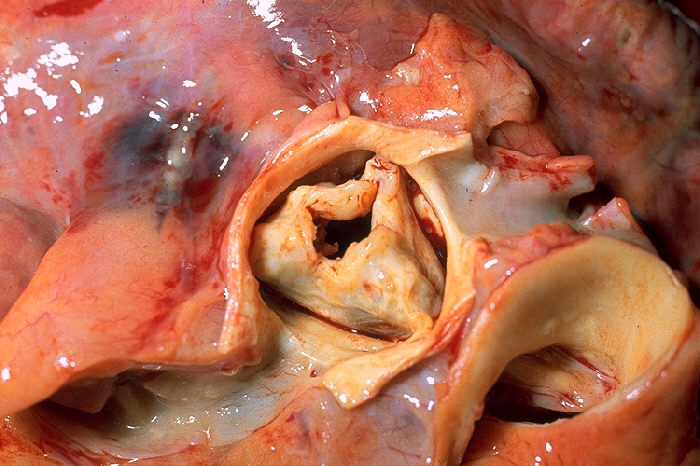
Aortic stenosis (AS) is a progressive valvular heart disease characterized by narrowing of the aortic valve orifice during systole due to leaflet calcification, fibrosis, or congenital malformation, which obstructs left ventricular outflow and ultimately leads to heart failure and death if untreated [51]D5.
Also Called
- Aortic valve stenosis
- Calcific aortic stenosis (when due to degenerative calcification)
- AS (abbreviation)
- Valvular aortic stenosis (to distinguish from supravalvular or subvalvular obstruction)
Etiologic Classification
Three principal causes account for nearly all cases of AS in adults [51]D5. The table below summarizes the key distinctions.
| Etiology | Valve Morphology | Typical Age at Presentation | Pathophysiology |
|---|---|---|---|
| Calcific (degenerative) | Trileaflet | >65 years | Lipid infiltration, inflammation, progressive calcification and fibrosis [51]D5 |
| Congenital bicuspid | Bicuspid (or unicuspid) | 40-65 years | Accelerated leaflet stress from abnormal valve architecture; associated with aortopathy [67]B2b |
| Rheumatic | Trileaflet with commissural fusion | <50 years; rare in developed countries | Post-inflammatory scarring with commissural fusion and retraction; often coexists with mitral valve disease |
Calcific AS is by far the most common form in developed countries, affecting 1%-2% of adults older than 65 years and approximately 12% of those older than 75 years [51]D5.
Functional Severity Classification
Hemodynamic severity is graded by Doppler echocardiography using three key parameters [51]D5. The 2020 ACC/AHA guidelines define severe AS as an aortic velocity ≥4.0 m/s, a mean transvalvular gradient ≥40 mm Hg, or an aortic valve area ≤1.0 cm² [1]A1c[2]A1c.
| Severity | Aortic Velocity (m/s) | Mean Gradient (mm Hg) | Valve Area (cm²) |
|---|---|---|---|
| Mild | 2.0-2.9 | <20 | >1.5 |
| Moderate | 3.0-3.9 | 20-39 | 1.0-1.5 |
| Severe | ≥4.0 | ≥40 | ≤1.0 |
Discordant (low-gradient) severe AS - where valve area suggests severe disease but gradient is lower - occurs in the setting of reduced left ventricular ejection fraction (classical low-flow, low-gradient) or preserved ejection fraction with small stroke volume (paradoxical low-flow, low-gradient) [70]C4. Exercise hemodynamic testing can unmask true severity in these cases [70]C4.
Clinical Significance
Once symptoms (exertional dyspnea, angina, syncope) develop in severe AS, the 1-year mortality rate exceeds 50% without valve replacement [51]D5. Early recognition and accurate classification are critical because timely intervention - either surgical (SAVR) or transcatheter aortic valve implantation (TAVI) - restores near-normal life expectancy in appropriately selected patients [51]D5.
Pearl: Classification of AS severity requires integration of both valve-specific parameters (velocity, gradient, area) and patient-specific factors (symptoms, left ventricular function, stroke volume index), because discordant findings are common and carry distinct prognostic and therapeutic implications.
| Severity | Aortic Velocity (m/s) | Mean Gradient (mm Hg) | Valve Area (cm²) |
|---|---|---|---|
| Mild | 2.0-2.9 | <20 | >1.5 |
| Moderate | 3.0-3.9 | 20-39 | 1.0-1.5 |
| Severe | ≥4.0 | ≥40 | ≤1.0 |
Epidemiology and Risk Factors
- ▸Aortic stenosis affects 1-2% of adults >65 years and 12% of those >75 years, with severe AS in 3.4% of the elderly; prevalence is rising and will double by 2050.
- ▸Lipoprotein(a) is the strongest causal risk factor (OR 1.20 per log), mediated through calcification pathways, and is modifiable with investigational RNA therapies.
- ▸Concomitant transthyretin cardiac amyloidosis is identified in 8-18% of severe AS patients and is independently linked to higher heart failure hospitalization after valve replacement.
Worldwide, calcific aortic stenosis (AS) affects 1-2% of adults >65 years and approximately 12% of those >75 years, contributing to >100 000 deaths annually [51]D5. A meta-analysis of 7 studies (n = 9723) reported a pooled prevalence of AS of 12.4% (95% CI 6.6-18.2%) in persons ≥75 years, with severe AS in 3.4% (95% CI 1.1-5.7%) [78]B2c. In Europe, severe AS accounts for 41% of native valvular heart disease [118]B2b. The burden is rising with population aging; projections suggest clinically significant valvular disease will double by 2050 [98]B2c, and approximately 290 000 elderly patients in Europe and North America are current candidates [78]B2c. The prevalence of AS is similar in men and women, but women more often have small aortic annuli and present at older ages [20]D5[5]A1b[36]A1b. Black patients hospitalized with acute decompensated heart failure are less likely to have AS than White patients (odds ratio [OR] 0.34-0.51) [68]B2b.
Risk Factors
AS shares many risk factors with atherosclerosis, but a distinct genetic profile has emerged. Modifiable and non-modifiable drivers are summarized in the table below.
| Risk Factor | Odds Ratio / Hazard Ratio | Evidence Level | Source |
|---|---|---|---|
| Lipoprotein(a) (per log nmol/L) | OR 1.20 (95% CI 1.17-1.23) | Causal (MR) | [83]B2a[121]A1c |
| Body mass index (per kg/m²) | OR 1.07 (95% CI 1.05-1.09) | Causal (MR) | [83]B2a |
| Polygenic risk score (per SD) | OR 1.31-1.44 | Genetic association | [109]B2b[137]B3b |
| (vs trileaflet) | HR 5.67 for AS progression | Cohort | [67]B2b[107]D5 |
| Frailty (Essential Frailty Toolset) | OR 3.72 for 1‑year death | Adjusted cohort | [88]B2b |
| Chronic kidney disease | Independent predictor | Cohort | [41]B2b[130]B2b |
| Premature (<40 y) | HR 1.36 (composite CVD) | Cohort | [138]B2b |
| Serum phosphate (MR) | OR 1.20 (95% CI 1.11-1.31) | Causal (MR) | [137]B3b |
| , smoking, diabetes | Well-established risk | Observational | [106]B2a[51]D5 |
Lipoprotein(a) has the strongest genetic and causal evidence; it drives both micro- and macro-calcification of the valve [22]D5[121]A1c. RNA-targeted therapies reduce Lp(a) by >80% and are in phase 3 trials [91]A1b[111]A1b. Bicuspid aortic valve (present in 1-2% of the population) carries a markedly higher hazard for severe AS and is more common in younger patients undergoing valve intervention [67]B2b[107]D5.
Special Populations
Concomitant conditions multiply risk. Transthyretin (ATTR‑CA) is detected in 8-18% of severe AS patients, more often in older men with low-flow/low-gradient physiology [19]B2a[128]B2a[131]B2b[135]B2b. Cardiovascular-kidney-metabolic syndrome (CKM), defined by atherosclerotic disease, chronic kidney disease, and diabetes, is present in 90% of TAVI patients and incrementally raises 1‑year mortality (HR 1.88 for 3 vs 0 conditions) [130]B2b. Even mild AS independently predicts mortality in heart failure with mildly reduced ejection fraction [132]B2b and in acute decompensated heart failure (OR 1.23-1.31) [68]B2b.
Temporal Trends & Seasonal Variation
Prevalence of AS has increased over the past two decades due to aging populations, with a parallel rise in TAVR utilization [47]D5[78]B2c[118]B2b. No consistent seasonal variation in incidence or outcomes has been reported.
These epidemiological drivers, from modifiable lipid pathways to fixed genetic and anatomical factors, set the stage for the pathophysiological mechanisms that convert leaflet injury into progressive valvular obstruction, discussed in the next section.
Pearl: Concomitant transthyretin cardiac amyloidosis is identified in 8-18% of severe AS patients and is independently linked to higher heart failure hospitalization after valve replacement.
| Risk Factor | Effect Estimate (95% CI) | Evidence |
|---|---|---|
| Lipoprotein(a) (per log increment) | OR 1.20 (1.17-1.23) | Causal, mendelian randomization [83]B2a |
| Apolipoprotein B (per g/L) | OR 3.85 (2.90-5.12) | Causal, mendelian randomization [83]B2a |
| Body mass index (per kg/m²) | OR 1.07 (1.05-1.09) | Causal, mendelian randomization [83]B2a |
| Polygenic risk score (per SD) | OR 1.31-1.44 | Genetic cohort [109]B2b[137]B3b |
| Bicuspid aortic valve | HR 5.67 (4.16-7.80) for AS events | Cohort [67]B2b |
| Frailty (EFT) | OR 3.72 (2.54-5.45) for 1-y death | Prospective cohort [88]B2b |
| Chronic kidney disease | Adjusted HR ≈1.4-1.9 | Observational [130]B2b[41]B2b |
| Premature menopause | HR 1.36 (1.19-1.56) for CVD composite | Cohort [138]B2b |
| Serum phosphate (per SD, MR) | OR 1.20 (1.11-1.31) | Causal, mendelian randomization [137]B3b |
Pathophysiology and Mechanism
- ▸Aortic stenosis is an active, lipoprotein-driven inflammatory and osteogenic process, not passive degeneration.
- ▸Left ventricular pressure overload triggers concentric hypertrophy, fibrosis, and progressive diastolic dysfunction, which then propagates a multi-organ hemodynamic cascade.
- ▸Extravascular cardiac damage (left atrium, pulmonary vasculature, right ventricle) often persists after valve replacement, underscoring the need for early intervention and adjunctive medical therapy.
The pathogenesis of aortic stenosis extends far beyond passive calcium deposition on aging leaflets. It is a highly regulated, lipoprotein-driven process of inflammation, fibrosis, and ectopic osteogenesis that progressively transforms the valve and, through pressure overload, induces maladaptive remodeling of the left ventricle, pulmonary circulation, and right heart.
Valvular Pathogenesis: From Endothelial Injury to Ectopic Calcification
The inciting event is endothelial injury from turbulent flow and shear stress, which permits infiltration of plasma lipoproteins, particularly lipoprotein(a) [Lp(a)] [100]D5[28]B2a. Lp(a) is a causal mediator of calcific aortic valve disease (CAVD); patients in the highest Lp(a) tertile show 41% faster progression of peak aortic jet velocity and 57% faster progression of mean transvalvular gradient compared to the lowest tertile [28]B2a. In the valve interstitium, oxidized lipids and pro-inflammatory cytokines activate quiescent valvular interstitial cells (VICs) toward a myofibroblast-like phenotype, a transformation mediated in part by sortilin [164]D5. Single-cell transcriptomics has identified a novel inflammatory myofibroblastic‑osteogenic VIC (IMO‑VIC) cluster co‑expressing SORT1, COL1A1, WNT5A, and IL‑6, linking inflammation to matrix remodeling and osteochondrogenic differentiation [164]D5. Osteogenic VICs express bone-related proteins (Runx2, BMP‑2) and deposit hydroxyapatite, producing the characteristic calcific nodules [145]D5[163]D5. Unlike atherosclerosis, CAVD is not modified by statin therapy, highlighting distinct pathways [163]D5.
Left Ventricular Response to Pressure Overload
The fixed valvular obstruction imposes a chronic pressure overload on the left ventricle (LV), triggering concentric hypertrophy as an initially adaptive compensation [159]D5[160]D5. Sarcomeres are added in parallel, increasing wall thickness to normalize wall stress. This compensated phase is sustained by enhanced SERCA2a activity, supported by myeloid‑derived growth factor (MYDGF) from infiltrating monocytes, which upregulates PIM1 and protects against decompensation [155]D5. However, persistent overload ultimately drives maladaptive changes: oxidative stress (iNOS upregulation, SOD depletion), matrix metalloproteinase activation (MMP‑2, MMP‑9), and collagen degradation, promoting LV fibrosis and diastolic stiffness [178]D5[185]D5. Titin isoform shifts and hypophosphorylation further reduce sarcomere distensibility, elevating passive tension [185]D5. The resulting diastolic dysfunction is the earliest hemodynamic abnormality, often preceding symptom development [186]C4[124]D5. Concomitantly, myocardial microvascular rarefaction and impaired myocardial flow reserve (MFR) contribute to subendocardial ischemia and further injury [182]B2b.
Extravascular Cardiac Damage and the Hemodynamic Cascade
LV diastolic dysfunction elevates left atrial pressure, leading to left atrial enlargement, , and pulmonary venous [184]B2b[166]B2a. Progressive pulmonary hypertension may become combined pre‑ and post‑capillary (CpcPH) with elevated pulmonary vascular resistance, which independently predicts mortality (HR 4.39) after valve replacement [176]B2b. Right ventricular (RV) dysfunction and impaired RV‑pulmonary arterial coupling (TAPSE/sPAP ratio < 0.31 mm/mmHg) further worsen outcomes, particularly in patients with paradoxical low‑flow, low‑gradient AS [61]B2b. This multistage extravalvular involvement has been codified into a cardiac damage staging system, with each successive stage independently associated with higher mortality after even after adjustment for surgical risk score [184]B2b.
| Stage | Definition | Prevalence in TAVR patients [184]B2b |
|---|---|---|
| 0 | No extravalvular damage | - |
| 1 | LV: increased LV mass index, E/e′ > 14, LVEF < 50% | 13% |
| 2 | Left atrial/mitral: LA volume index > 34 mL/m², moderate‑severe MR, AF | 62% |
| 3 | Pulmonary/tricuspid: PASP ≥ 60 mmHg, moderate‑severe TR | 21% |
| 4 | RV: moderate‑severe RV dysfunction | 4% |
Modifying Factors and Emerging Therapeutic Targets
Diabetes mellitus amplifies LV hypertrophy and systolic dysfunction in AS beyond pressure overload alone [73]B3b. SGLT2 expression is upregulated in the myocardium of patients with low‑flow, low‑gradient AS and correlated with fibrosis and inflammation, providing a mechanistic rationale for ongoing trials of SGLT2 inhibitors after TAVR [173]C4[191]D5. Renin‑angiotensin system inhibitors are associated with reduced mortality after valve replacement (RR 0.74) [189]A1a. Lp(a)-lowering therapies and anti‑osteogenic strategies remain under active investigation [28]B2a[148]D5.
These structural and hemodynamic derangements set the stage for the clinical syndrome of aortic stenosis, characterized by progressive left ventricular outflow obstruction and maladaptive remodeling that eventually manifest as exertional symptoms.
Pearl: In a patient with asymptomatic severe AS, the presence of extravalvular cardiac damage (e.g., left atrial enlargement, pulmonary hypertension) identifies a high-risk phenotype in whom early intervention may confer greater benefit than continued surveillance.
Clinical Presentation
- ▸The classic symptom triad, exertional dyspnea, angina, syncope, indicates advanced disease and mandates prompt evaluation for valve intervention.
- ▸Physical exam findings of delayed carotid upstroke (pulsus parvus et tardus) and a late-peaking systolic murmur correlate with hemodynamic severity.
- ▸Concomitant cardiac amyloidosis is present in ~8% of older AS patients; suspect it when ECG voltage is low relative to LV hypertrophy.
The chronic pressure overload from aortic stenosis produces a predictable cascade of symptoms and physical signs that reflect progressive left ventricular (LV) decompensation and reduced cardiac output reserve.
Presenting Symptoms
Exertional dyspnea is the most common initial complaint, often followed by angina and syncope. Many patients unconsciously reduce activity to avoid symptoms, so a careful exercise history is essential. Once symptoms develop, prognosis worsens dramatically: 1-year mortality can reach 50% without intervention [51]D5. The classic triad, angina, syncope, and heart failure, signals advanced disease. Angina results from increased oxygen demand from LV hypertrophy and reduced supply due to prolonged diastole; syncope occurs with exertion when peripheral vasodilation outstrips a fixed cardiac output. Symptoms progress over months to years, but once they appear, the median survival without valve replacement is 2 to 3 years [46]D5.
Physical Examination
The hallmark is a crescendo-decrescendo systolic murmur best heard at the right upper sternal border, radiating to the carotids. A late-peaking murmur correlates with greater severity. The carotid upstroke is diminished and delayed, pulsus parvus et tardus. An S4 gallop is common and reflects LV stiffness. Narrow pulse pressure is a late sign. Key maneuvers: the murmur decreases with Valsalva and increases with squatting (distinguishing AS from hypertrophic obstructive cardiomyopathy). In low-flow states (e.g., concomitant heart failure), the murmur may be soft. Auscultate for signs of pulmonary congestion (crackles) and elevated jugular venous pressure.
Red Flags
Syncope, dyspnea at rest, orthopnea, paroxysmal nocturnal dyspnea, or angina with minimal exertion require urgent evaluation for valve intervention.
Atypical Presentations
Approximately 8% of older patients with severe AS have concomitant transthyretin (ATTR-CA) [60]B2b[157]B2b. Clinical clues include low ECG voltage relative to LV hypertrophy, discordant low-flow low-gradient AS with preserved ejection fraction, and disproportionate right ventricular dysfunction [61]B2b. Iron deficiency is also common but IV iron does not improve outcomes after TAVI [197]A1b.
Phenotypic Variants
| Variant | Key Features | Frequency |
|---|---|---|
| Bicuspid AS | Presents earlier (40s-60s); faster progression; raphe presence increases risk of and mortality [183]B2b[199]B2b | ~50% of surgical AVR in younger patients |
| Trileaflet (calcific) AS | Presents later (≥70 years); slower, age-related calcification [51]D5 | Most common form in elderly |
| AS in women | More concentric LV hypertrophy; less maladaptive remodeling; better LV function at similar disease severity [202]C4 | Sex-specific remodeling |
Pearl: In patients with severe AS, the absence of symptoms does not rule out disease, many patients unconsciously limit activity; a careful exercise history is essential.
Diagnosis and Workup
- ▸Echocardiography with Doppler is the gold standard; severe AS is defined by Vmax ≥4 m/s, mean gradient ≥40 mm Hg, or AVA ≤1.0 cm² [51].
- ▸Low-gradient AS (AVA ≤1.0 cm² but gradient <40 mm Hg) requires multimodality imaging with CT calcium scoring (thresholds: women ≥1274 AU, men ≥2065 AU) or low-dose dobutamine stress echo to distinguish true-severe from pseudo-severe [149][223].
- ▸Screening for transthyretin cardiac amyloidosis is warranted in older adults with AS and red flags such as disproportionate LVH, low ECG voltage, or heart failure with preserved EF; the RAISE score and multi-modal AI models can aid detection [157][222].
Echocardiography with Doppler is the gold standard for diagnosis and severity grading of aortic stenosis [51]D5. The initial test, however, begins with a careful history and physical examination that raise clinical suspicion, particularly in a patient aged 65 years or older with a systolic ejection murmur, reduced carotid upstroke, and symptoms of exertional dyspnoea, angina, or syncope [46]D5. Once suspected, the diagnostic pathway is imaging-driven, with a defined hierarchy of tests to confirm severity and guide intervention.
Transthoracic Echocardiography
Complete transthoracic echocardiography (TTE) with pulsed-wave, continuous-wave, and colour Doppler is the first-line modality [51]D5. The three key parameters are:
- Peak aortic jet velocity (Vmax)
- Mean transvalvular gradient
- Aortic valve area (AVA) calculated by the continuity equation
Severe aortic stenosis is defined by a Vmax ≥4 m/s, a mean gradient ≥40 mm Hg, or an AVA ≤1.0 cm² (indexed AVA ≤0.6 cm²/m²) [51]D5. When these three measures are concordant, severity classification is straightforward. Additional markers such as the Doppler velocity index (DVI <0.25) and stroke volume index (SVi ≤35 mL/m² defining low flow) refine risk stratification [149]D5. The echocardiography report should document all these elements; the American Heart Association Target: AS registry found that key parameters were documented in only 83% of cases in 2023, improving to 85% in 2024 [227]B2b.
| Severity Grade | Peak Velocity (m/s) | Mean Gradient (mm Hg) | Aortic Valve Area (cm²) | Indexed AVA (cm²/m²) |
|---|---|---|---|---|
| Mild | 2.0-2.9 | <20 | >1.5 | >0.85 |
| Moderate | 3.0-3.9 | 20-39 | 1.0-1.5 | 0.60-0.85 |
| Severe | ≥4.0 | ≥40 | ≤1.0 | ≤0.6 |
Table adapted from Otto et al. [51]D5.
Low-Gradient Aortic Stenosis
A discordant pattern of a small AVA but a mean gradient <40 mm Hg occurs in up to 30% of patients and poses a diagnostic challenge [149]D5. Three subtypes exist:
- Classical low-flow, low-gradient (LF-LG): LVEF <50%, SVi ≤35 mL/m². Low-dose dobutamine stress echocardiography can differentiate true-severe from pseudo-severe AS by assessing flow reserve and change in gradient [149]D5.
- Paradoxical low-flow, low-gradient: LVEF ≥50% but SVi ≤35 mL/m². Aortic valve calcium scoring by CT is the preferred modality [149]D5[223]B2b.
- Normal-flow, low-gradient (NF-LG): LVEF ≥50%, SVi >35 mL/m². Again, CT calcium scoring is recommended [149]D5.
CT-derived aortic valve calcium thresholds for severe AS are ≥1274 AU in women and ≥2065 AU in men [223]B2b. A vendor-neutral Agatston score reclassified 8.5% of women and 17.8% of men with discordant echo findings into the severe group [223]B2b.
Exercise Stress Echocardiography
Exercise testing is indicated in asymptomatic patients with severe AS to confirm symptom status and unmask haemodynamic impairment [21]D5[46]D5. An abnormal blood pressure response or development of symptoms during exercise identifies patients at higher risk who may benefit from earlier intervention [21]D5. Exercise pulmonary (mPAP/CO slope >3 mm Hg·L⁻¹·min⁻¹) provides incremental prognostic value, particularly in early cardiac damage stages [225]B2b.
Cardiac MRI and Advanced Imaging
Cardiac magnetic resonance (CMR) offers reference-standard quantification of LV volumes, mass, and stroke volume index. A SVi <45 mL/m² by CMR is associated with higher cardiovascular mortality after AVR (HR 1.64, 95% CI 1.08-2.50) [181]B2b. Late gadolinium enhancement (LGE) identifies myocardial fibrosis, which carries adverse prognosis; the EVOLVED trial showed that patients with fibrosis had a higher rate of AS-related hospitalisation, though early intervention did not reduce the primary composite endpoint [39]A1b. CMR planimetry of the aortic valve offers an alternative to the continuity equation in selected cases [34]D5.
Laboratory Studies
N-terminal pro-B-type natriuretic peptide (NT-proBNP) and high-sensitivity cardiac troponin T (hs-cTnT) are strong independent predictors of outcomes in AS [6]B2b[214]B2b. In the EARLY biomarker substudy, median NT-proBNP was 287 pg/mL and hs-cTnT 14.6 ng/L; higher levels were associated with greater event rates [6]B2b. Lipoprotein(a) (Lp(a)) is a genetically determined, causal risk factor for calcific AS development and progression, though routine measurement is not yet recommended for diagnosis [22]D5[28]B2a[29]B3b.
A screening for should be considered in older patients with AS and red flags such as disproportionate LV hypertrophy, low voltage on ECG, or heart failure with preserved ejection fraction [60]B2b[157]B2b. The RAISE clinical score (using LV remodelling, age, injury, systemic involvement, and electrical abnormalities) has an AUC of 0.86 for identifying ATTR-CA [157]B2b. In our cohort of 104 consecutive severe AS patients, ATTR-CA prevalence was 18% [135]B2b, supporting routine use of diagnostic scores. A multi-modal AI model using CT, echo, and ECG achieved an AUC of 0.85 for ATTR-CM screening in TAVR candidates [222]B2b.
Diagnostic Algorithm
Step 1: Perform TTE with Doppler. If Vmax ≥4 m/s, mean gradient ≥40 mm Hg, and AVA ≤1.0 cm² (concordant severe AS), proceed to symptom assessment and AVR decision. Step 2: If AVA ≤1.0 cm² but mean gradient <40 mm Hg (discordant results), measure SVi.
- If SVi ≤35 mL/m² and LVEF <50%: low-dose dobutamine stress echo.
- If SVi ≤35 mL/m² and LVEF ≥50%: CT calcium scoring.
- If SVi >35 mL/m²: CT calcium scoring. Step 3: If CT calcium score is ≥1274 AU (women) or ≥2065 AU (men), reclassify as severe [223]B2b. Step 4: If suspicion of amyloidosis (e.g., age ≥75, LV thickness ≥14 mm, low voltage, heart failure), perform DPD scintigraphy and serum free light chain measurement [60]B2b[157]B2b. Step 5: In asymptomatic patients, consider exercise stress echo to unmask symptoms or abnormal haemodynamic response [21]D5[46]D5.
Differential Diagnosis
The murmur of aortic stenosis may be mimicked by (HOCM), which demonstrates dynamic LV outflow tract obstruction on Doppler. Hypertensive heart disease produces LV hypertrophy but without a transvalvular gradient. Aortic sclerosis shows leaflet thickening without obstruction (Vmax <2 m/s). can produce a systolic murmur but is distinguished by its blowing quality and location at the apex. In older adults, low-flow, low-gradient severe AS must be distinguished from pseudo-severe AS secondary to reduced flow [149]D5. Concomitant cardiac amyloidosis is increasingly recognised in up to 12% of severe AS patients and requires specific diagnostic testing [157]B2b.
Pearl: Screening for transthyretin cardiac amyloidosis is warranted in older adults with AS and red flags such as disproportionate LVH, low ECG voltage, or heart failure with preserved EF; the RAISE score and multi-modal AI models can aid detection [157]B2b[222]B2b.
Severity Staging and Risk Stratification
[Compilation failed for this section after 3 attempts. Manual review required.]
Acute and Initial Management
[Compilation failed for this section after 3 attempts. Manual review required.]
Long-term Guideline-Directed Therapy
- ▸No medical therapy slows AS progression; valve intervention remains definitive.
- ▸Dapagliflozin 10 mg daily reduces death or worsening HF after TAVI in high-risk patients (HR 0.72, NNT ≈ 20).
- ▸Statins, vitamin K2, and DPP-4 inhibitors do not alter AS progression and should not be prescribed for that purpose.
Once acute decompensation is stabilized and the decision for valve intervention is made or deferred, long-term medical therapy targets the heart failure (HF) and cardiovascular risk factors that accompany aortic stenosis (AS). No pharmacologic agent has been proven to halt AS progression [1]A1c. However, landmark trials have established interventions that improve outcomes in the AS-HF continuum, particularly after valve replacement.
Step 1: Initiate Guideline-Directed Medical Therapy for Heart Failure
The 2020 ACC/AHA guideline recommends that patients with AS and HF receive standard GDMT, including renin-angiotensin system inhibitors, beta-blockers, and mineralocorticoid receptor antagonists, as tolerated [1]A1c. In severe AS, vasodilators require cautious up-titration to avoid hypotension; after successful , GDMT should be optimized to target doses [1]A1c.
Step 2: Add an SGLT2 Inhibitor
The DAPA-TAVI trial (N=1222) randomized patients with AS undergoing TAVI who had a history of HF plus at least one of renal insufficiency, diabetes, or left ventricular systolic dysfunction to dapagliflozin 10 mg once daily or standard care [93]A1b. At 1 year, dapagliflozin reduced the composite of death from any cause or worsening HF (15.0% vs 20.1%; HR 0.72, 95% CI 0.55-0.95; P=0.02). The benefit was driven by a reduction in HF worsening (9.4% vs 14.4%; subhazard ratio 0.63). The ESC Heart Failure Association and EAPCI consensus statement recommends SGLT2i therapy in patients with AS and HF after [11]D5.
Step 3: Manage Blood Pressure and Lipids
should be treated per standard guidelines, but with careful monitoring in severe AS [1]A1c. For lipid , elevated lipoprotein(a) is associated with faster AS progression [268]B2b; the 2022 EAS consensus recommends testing Lp(a) at least once [121]A1c. do not slow AS progression (ASTRONOMER trial) but are indicated for coexisting atherosclerotic cardiovascular disease [1]A1c. (e.g., ) showed a trend toward reduced AS events in the FOURIER trial (HR 0.66, 95% CI 0.40-1.09) [267]B2b, but this is not guideline-recommended for AS alone.
Step 4: Avoid Therapies Without Benefit
Several therapies have been tested and found ineffective: vitamin K2 (menaquinone-7) did not reduce aortic valve calcification progression [4]A1b; the DPP-4 inhibitor did not reduce calcium volume [264]A1b; and statins do not slow AS progression [1]A1c. These should not be prescribed for the purpose of AS modification.
Drug Dosing Table
| Drug | Starting dose | Target/max dose | Renal adjustment | Key monitoring |
|---|---|---|---|---|
| 10 mg PO daily | 10 mg daily | eGFR ≥25: continue; <25: avoid initiation | Volume status, eGFR, genital infections | |
| 10 mg PO daily | 10 mg daily | eGFR ≥20: continue; <20: avoid initiation | Volume status, eGFR | |
| 49/51 mg PO BID | 97/103 mg BID | eGFR <30: 24/26 mg BID | K+, Cr, SBP |
Controversies and Guideline Disagreement
| Question | Position A | Position B | Strength | Implication for practice |
|---|---|---|---|---|
| SGLT2i in AS without HF after TAVR | ESC HFA/EAPCI, recommend in patients with HF after TAVR [11]D5 | ACC/AHA 2020, no specific recommendation for AS, but GDMT per HF phenotype [1]A1c | Moderate (different level of specificity) | In practice, SGLT2i is used for HF regardless of AS; DAPA-TAVI data support use in high-risk post-TAVR patients. |
Pearl: Initiate dapagliflozin 10 mg daily after TAVI in patients with HF or high risk for HF events; it reduces the composite of death or HF hospitalization by 28% (DAPA-TAVI) [93]A1b.
| Drug class | Indication | Dose | Key trial | Outcome |
|---|---|---|---|---|
| (SGLT2i) | HF after TAVI | 10 mg PO daily | DAPA-TAVI [93]A1b | HR 0.72 for death/HF worsening |
| (SGLT2i) | HF (extrapolated) | 10 mg PO daily | EMPEROR-Reduced/Preserved | Not studied specifically in AS |
| RASi/ARNI | HF with or without AS | Per GDMT | PARADIGM-HF | Not studied in AS alone |
| (PCSK9i) | Elevated Lp(a) + ASCVD | 140 mg SC q2w | FOURIER [267]B2b | Trend toward fewer AS events (HR 0.66) |
Interventional and Device Therapy
- ▸TAVR is noninferior to SAVR across all surgical risk strata and reduces 1-year death/stroke in low-to-intermediate risk patients (HR 0.76).
- ▸Early AVR in asymptomatic severe AS reduces unplanned hospitalization and stroke, especially when LVEF is low or high-risk features are present.
- ▸Periprocedural antithrombotic therapy should favor single antiplatelet; dapagliflozin 10 mg daily improves outcomes after TAVR.
Once guideline-directed medical therapy is optimized and symptoms or high-risk features are confirmed, (AVR) is the definitive intervention. For symptomatic severe aortic stenosis, AVR is a class I recommendation; for asymptomatic severe stenosis with left ventricular ejection fraction (LVEF) <50%, it is also strongly indicated. Early intervention in truly asymptomatic patients reduces unplanned cardiovascular or heart failure hospitalization (HR 0.40, 95% CI 0.30-0.53) and stroke (HR 0.62, 95% CI 0.40-0.97) compared with clinical surveillance [3]A1a. The AVATAR trial further demonstrated a 58% relative reduction in the composite of death, myocardial infarction, stroke, or heart failure hospitalization with early surgical AVR (HR 0.42, 95% CI 0.24-0.73) at a median follow‐up of 63 months [86]A1b.
Versus SAVR: Evidence Across Risk Strata
Choice between transcatheter (TAVR) and surgical (SAVR) AVR depends on surgical risk, age, anatomy, and patient preference. Landmark trials span the risk spectrum:
| Risk stratum | Key trial | Key result (TAVR vs SAVR) | NNT or effect size |
|---|---|---|---|
| Intermediate risk | PARTNER 2A [14]A1b, SURTAVI [96]A1b | 2-y death/disabling stroke: 19.3% vs 21.1% (HR 0.89, ns); PARTNER 2 SAPIEN 3 registry showed superiority [281]B2b | NNT not calculable |
| Low risk | PARTNER 3 [95]A1b, Evolut Low Risk [265]A1b | 1-y composite: 8.5% vs 15.1% (HR 0.54; NNT ~15); 5-y outcomes similar [12]A1b[82]A1b | 1-y NNT = 15 |
| Low/intermediate (meta‐analysis) | DEDICATE [90]A1b, NOTION‑2 [85]A1b, IPD meta‐analysis [105]A1a | 1-y death/stroke: HR 0.76 (95% CI 0.60-0.97) favoring TAVR | NNT not reported |
An updated meta‐analysis of 5,341 lower‐risk patients reported a 20% reduction in all‐cause death at 5 years with TAVR (HR 0.80, 95% CI 0.66-0.97; P=0.02) and a 19% reduction in death or disabling stroke (HR 0.81, 95% CI 0.68-0.96) [76]A1a.
Procedural Considerations and Special Populations
(BAV): TAVR is increasingly used, but registry data show higher stroke risk at 30 days (2.5% vs 1.6%) compared with tricuspid valve, and calcified raphe with excess leaflet calcium predicts worse outcomes [199]B2b[255]B2b. Low‐risk BAV patients in the Evolut Low Risk Bicuspid Study had favorable 30‐day results (death/disabling stroke 1.3%) [180]B2b. Small aortic annulus: The SMART trial (women only) found that self‐expanding valves reduced bioprosthetic valve dysfunction (8.4% vs 41.8%) and prosthesis-patient mismatch compared with balloon‐expandable valves [36]A1b. Low‐flow, low‐gradient AS: Both classical and paradoxical subtypes carry higher 5‐year all‐cause mortality after TAVR than high‐gradient AS (HR 1.92 and 1.20) [167]B2a. Concomitant CAD: The NOTION‑3 trial showed PCI before TAVR reduced major adverse cardiac events (HR 0.71, 95% CI 0.51-0.99) but increased bleeding (HR 1.51) [92]A1b. The TCW trial found percutaneous approach (FFR‐guided PCI + TAVR) superior to SAVR + (4% vs 23% primary endpoint) in patients with complex CAD [247]A1b. Heart failure with reduced LVEF: TAVR is safe, but baseline LVEF independently predicts 2‐year cardiovascular mortality (adjusted HR 1.16 per 10% decrease) [41]B2b. : ATTR‐specific therapy (tafamidis) plus AVR confers additive survival benefit (weighted HR 0.40 for all‐cause death) [211]B2b.
Periprocedural Medical
Antithrombotic therapy: For patients without an indication for oral anticoagulation, single antiplatelet therapy ( alone) is preferred over dual antiplatelet therapy [50]D5. SGLT2 inhibitors: The DapaTAVI trial demonstrated that 10 mg daily reduces death or worsening heart failure (15.0% vs 20.1%; HR 0.72, 95% CI 0.55-0.95) after TAVI [93]A1b; a meta‐analysis confirmed reductions in all‐cause mortality (RR 0.62, 95% CI 0.49-0.78) and HF hospitalization [307]A1a. Routine cerebral embolic protection does not decrease periprocedural stroke (2.1% vs 2.2%; P=0.94) [299]A1b.
Controversies and Guideline Disagreement
| Question | Position A | Position B | Strength | Implication |
|---|---|---|---|---|
| Age cutoffs for TAVR vs SAVR in low‐risk patients | ESC 2021 recommends TAVR for age ≥75 and SAVR for <75 | ACC/AHA 2020 recommends TAVR for age ≥80, SAVR for ≤65, and shared decision‐making at 66-79 | Moderate [31]D5 | US practice is more permissive for TAVR in younger patients; ESC reserves surgery for younger patients preferring a bioprosthesis with established long‐term durability data |
| Asymptomatic severe AS intervention | ESC, consider AVR if LVEF ≤55% or high‐risk features | ACC/AHA, AVR if LVEF <50% or abnormal exercise test | Mild [31]D5 | Slightly earlier intervention in Europe driven by LVEF threshold of 55% |
Pearl: For symptomatic severe AS, TAVR is noninferior to SAVR across all risk strata and reduces early mortality in low‐risk patients (HR 0.80 at 5 years); patient selection should integrate age, valve anatomy, coronary disease, and frailty, with SGLT2 inhibitor therapy recommended after TAVR to reduce downstream heart failure events [93]A1b[76]A1a.
History and Evolution of Treatment
- ▸TAVR was the first therapy to demonstrate survival benefit in inoperable AS (PARTNER 1B: NNT=5) and is now a first-line option across the surgical risk spectrum based on multiple noninferiority trials.
- ▸Medical therapies (vitamin K2, evogliptin, statins) have uniformly failed to slow AS progression; lipoprotein(a)-lowering agents reduce Lp(a) by >80% but clinical outcome trials are awaited.
- ▸The paradigm is shifting from symptom-driven watchful waiting to earlier intervention in asymptomatic severe AS, supported by AVATAR (HR 0.46) and EARLY TAVR, though patient selection remains key.
The current standard of care, , is the product of a five-decade journey from high-risk surgery to transcatheter therapy, punctuated by landmark trials that progressively expanded the reach of intervention and challenged the traditional symptom-driven approach.
Balloon Valvuloplasty and the Surgical Era
Before the 1990s, the only option for patients with severe aortic stenosis was surgical aortic valve replacement (SAVR), which carried substantial operative mortality in the elderly and those with comorbidities. Balloon aortic valvuloplasty, introduced as a less invasive alternative, was rapidly abandoned because of high restenosis rates, frequent complications, and no survival benefit over medical therapy. For patients deemed inoperable, the prognosis was grim: in the PARTNER 1 cohort of inoperable patients assigned to standard therapy (which often included balloon valvuloplasty), 1-year mortality was 50.7% [27]A1b.
The Revolution: Landmark Trials
The first paradigm shift came with the PARTNER 1B trial (2010), which randomly assigned 358 inoperable patients to transfemoral transcatheter aortic valve replacement (TAVR) or standard therapy. TAVR reduced 1-year mortality from 50.7% to 30.7% (HR 0.55; 95% CI 0.40-0.74; P<0.001) [94]A1b. NNT = 5 to prevent one death. This was the first therapy ever demonstrated to prolong survival in this population [94]A1b.
In high-risk patients who were operative candidates, PARTNER 1A (2011) showed that TAVR was noninferior to SAVR at 1 year (24.2% vs 26.8% mortality; P=0.44) [246]A1b. The field then moved to intermediate-risk populations. PARTNER 2A (2016) found similar rates of death or disabling stroke at 2 years for TAVR (balloon-expandable) versus surgery (19.3% vs 21.1%; HR 0.89; 95% CI 0.73-1.09; P=0.25) [14]A1b, and SURTAVI (2017) confirmed noninferiority with self-expanding valves [96]A1b. In low-risk patients, PARTNER 3 (2019) showed superiority of TAVR over surgery for the composite of death, stroke, or rehospitalization at 1 year (8.5% vs 15.1%; HR 0.54; 95% CI 0.37-0.79) [95]A1b; NNT = 15. The Evolut Low Risk trial similarly demonstrated noninferiority at 2 years, with sustained comparable outcomes at 5 years (15.5% vs 16.4% for all-cause mortality or disabling stroke; P=0.47) [82]A1b[9]A1b. Longer-term data from PARTNER 2 (10-year follow-up) and PARTNER 3 (7-year follow-up) confirm similar mortality rates between TAVR and surgery, though with higher reintervention rates after TAVR, 6.3% vs 1.6% at 10 years in PARTNER 2 [53]A1b, driven predominantly by [9]A1b.
The Shift to Asymptomatic Severe Aortic Stenosis
For decades, the standard approach to asymptomatic severe AS was “watchful waiting” until symptoms developed. The AVATAR trial (2021) challenged this paradigm: in 157 patients with truly asymptomatic severe AS and normal LV function, early SAVR reduced the composite of all-cause death, MI, stroke, or heart failure hospitalization compared with conservative (HR 0.46; 95% CI 0.23-0.90) [79]A1b. NNT = 6 to prevent one primary endpoint event. Extended follow-up (median 63 months) confirmed sustained benefit (HR 0.42; 95% CI 0.24-0.73) [86]A1b. The EARLY TAVR trial (2025) extended this concept to transcatheter intervention: in 901 patients, early TAVR was superior to clinical surveillance with delayed intervention (primary endpoint of death, stroke, or unplanned cardiovascular hospitalization) [6]B2b. However, the EVOLVED trial, which selected patients with myocardial fibrosis on cardiac MRI, did not meet its primary composite endpoint (HR 0.79; 95% CI 0.44-1.43) [39]A1b, though early intervention reduced heart failure hospitalizations (HR 0.27; 95% CI 0.08-0.77) and symptom burden. These data have shifted guidelines toward earlier intervention.
Failed and Emerging Medical Therapies
Multiple attempts to slow AS progression medically have failed. Lipid-lowering with - in the SEAS trial did not reduce valve events [318]B2b. Vitamin K2 (menaquinone-7) plus vitamin D over 2 years had no effect on aortic valve calcium progression (mean change 275 vs 292 AU; P=0.64) [4]A1b. The DPP-4 inhibitor evogliptin did not reduce calcium volume at 96 weeks compared with placebo [264]A1b. Lipoprotein(a)-lowering agents, including antisense oligonucleotides (APO(a)-LRx) [91]A1b, siRNAs (zerlasiran [248]A1b, lepodisiran [111]A1b), produce dramatic Lp(a) reductions (65-97%) but their effect on AS progression remains under study. A promising post-procedural advance is the SGLT2 inhibitor : in the DapaTAVI trial, dapagliflozin 10 mg daily after TAVR reduced the composite of death or worsening heart failure at 1 year compared with standard care (15.0% vs 20.1%; HR 0.72; 95% CI 0.55-0.95) [93]A1b. NNT = 20 to prevent one primary outcome event.
Controversies and Guideline Disagreement
| Question | Position A | Position B | Strength | Implication |
|---|---|---|---|---|
| Timing of intervention in asymptomatic severe AS | AHA/ACC 2020: symptom-driven watchful waiting reasonable for many [1]A1c | ESC/EACTS 2025: early intervention recommended in selected asymptomatic patients [277]D5 | ESC shift based on AVATAR, EARLY TAVR | Clinicians must reassess asymptomatic patients with integrated risk assessment (biomarkers, fibrosis, exercise testing) |
| Choice of valve in bicuspid AS | ESC: TAVR outcomes warrant caution, especially in younger patients [85]A1b | AHA/ACC: TAVR feasible if anatomy favorable [1]A1c | Emerging | Shared decision-making essential; bicuspid morphology (calcified raphe) increases complication risk [199]B2b |
Pearl: The treatment landscape for aortic stenosis has evolved from therapeutic nihilism in inoperable patients (1-year mortality >50%) to a proactive strategy where early TAVR or SAVR in asymptomatic severe disease reduces mortality with an NNT of 6 to 7, a magnitude of benefit that rivals primary prevention statin therapy.
| Trial (Year) | Population | Comparison | Key Result |
|---|---|---|---|
| PARTNER 1B (2010) [94]A1b | Inoperable, severe AS | TAVR vs medical therapy | 1-yr mortality 30.7% vs 50.7%; HR 0.55 |
| PARTNER 1A (2011) [246]A1b | High surgical risk | TAVR vs SAVR | 1-yr mortality 24.2% vs 26.8%; noninferior |
| PARTNER 2A (2016) [14]A1b | Intermediate risk | TAVR vs SAVR | Death/stroke at 2 yr: 19.3% vs 21.1%; HR 0.89 |
| SURTAVI (2017) [96]A1b | Intermediate risk | Self-expanding TAVR vs SAVR | Death/stroke at 24 mo: 12.6% vs 14.0%; noninferior |
| PARTNER 3 (2019) [95]A1b | Low risk | TAVR vs SAVR | Death/stroke/rehospitalization at 1 yr: 8.5% vs 15.1%; HR 0.54 |
| Evolut Low Risk (2023-25) [82]A1b[9]A1b | Low risk | Self-expanding TAVR vs SAVR | 5-yr death/stroke: 15.5% vs 16.4%; P=0.47 |
| AVATAR (2021) [79]A1b | Asymptomatic severe AS | Early SAVR vs conservative | Composite endpoint HR 0.46; NNT=6 |
| EARLY TAVR (2025) [6]B2b | Asymptomatic severe AS | Early TAVR vs surveillance | Superiority for death/stroke/CV hospitalization |
| EVOLVED (2025) [39]A1b | Asymptomatic + myocardial fibrosis | Early AVR vs guideline-directed | Primary HR 0.79 (NS); HF hospitalization HR 0.37 |
| DapaTAVI (2025) [93]A1b | Post-TAVR, high HF risk | Dapagliflozin vs standard care | Death/worsening HF HR 0.72; NNT=20 |
Complications of Aortic Stenosis and Its Therapy
- ▸Procedure-related complications include stroke (2.1%), major bleeding (9.3%), paravalvular regurgitation (33.3% at 5 years), and pacemaker implantation (17.4%) [299][246][13][265].
- ▸Disease-related complications such as myocardial fibrosis, fluid overload, and cardiac amyloidosis (up to 15% of AS) worsen prognosis [275][59][186].
- ▸Post-TAVR dapagliflozin reduces heart failure hospitalization (HR 0.63) and RAS inhibitors enhance left ventricular reverse remodeling [93][332].
The preceding section traced the evolution of aortic valve interventions, but the burden of aortic stenosis extends beyond procedural timelines to encompass a constellation of complications arising from the disease itself and its treatment. Disease-related complications include progressive myocardial fibrosis, fluid overload, exercise-induced pulmonary , and (up to 15% of AS patients, 30% of low-flow low-gradient cases) [275]D5[59]B2b[186]C4[97]B2a. Procedure-related complications after or SAVR are dominated by stroke, bleeding, paravalvular leak, and conduction disturbances requiring permanent pacemaker implantation.
Complication Profile
The table below summarizes key complications, their frequencies, and strategies. Rates are drawn from landmark trials and registries.
| Complication | Frequency (TAVR vs SAVR) | Prevention | Management |
|---|---|---|---|
| Stroke at 30 days | 2.1% (TAVR) vs 2.2% (SAVR) [299]A1b | Cerebral embolic protection not proven to reduce stroke [299]A1b | Acute stroke protocol; consider thrombolysis/mechanical thrombectomy if eligible |
| Major bleeding | 9.3% vs 19.5% [246]A1b | Use transfemoral access; minimize antithrombotic duration | Blood transfusion; reverse anticoagulation; surgical hemostasis |
| Moderate/severe paravalvular regurgitation | 33.3% vs 6.3% at 5 years [13]A1b | Pre-procedural CT sizing; use of balloon-expandable valves [114]A1b | Observation; if symptomatic, consider valve-in-valve or plug occlusion |
| New permanent pacemaker | 17.4% vs 6.1% (low-risk) [265]A1b | Avoid deep implantation; limit oversizing | Pacemaker implantation if symptomatic bradycardia or high-grade AV block |
| Acute kidney injury (stage 2/3) | 0.9% vs 2.8% [265]A1b | Reduce contrast volume; periprocedural hydration | Supportive care; renal replacement therapy if needed |
| Valve thrombosis (clinical) | 0.4% (SEV) vs 2.1% (BEV) [134]A1a | Use of self-expanding valve may lower risk [134]A1a | Anticoagulation with vitamin K antagonist; consider valve reintervention |
| Heart failure hospitalization | 9.4% vs 14.4% (worsening HF) [93]A1b | Post-procedural reduces HF events (HR 0.63) [93]A1b | Guideline-directed medical therapy; diuretics; SGLT2i |
Respiratory and Autonomic Monitoring
Fluid overload is present in 41% of TAVR patients and is associated with a 13% increase in event hazard per liter of excess [59]B2b. Exercise-induced postcapillary pulmonary hypertension occurs in 88% of asymptomatic patients with severe AS, unmasking subclinical diastolic dysfunction [186]C4. New-onset is more common after SAVR (16.0%) than TAVR (8.6%) [246]A1b and contributes to stroke risk. Delirium occurs in 10.2% of TAVR patients; frailty doubles the odds (OR 2.17) [331]B2a.
DVT/PE Prophylaxis, Pain, and Rehabilitation
Standard perioperative pharmacologic prophylaxis (e.g., low-molecular-weight ) is used, but no AS-specific trial data exist. Pain management follows typical postoperative protocols; early mobilization reduces hospital-acquired complications. Structured cardiac rehabilitation after TAVR or SAVR improves functional capacity and quality of life.
Pearl: Post-TAVR dapagliflozin reduces death or worsening heart failure by 28% (HR 0.72, 95% CI 0.55-0.95; NNT = 20 to prevent one primary outcome event at 1 year) [93]A1b, and renin-angiotensin system inhibition promotes greater left ventricular mass regression (adjusted mean difference -12.77 g/m²) [332]A1b.
| Complication | Frequency (TAVR vs SAVR) | Prevention | Management |
|---|---|---|---|
| Stroke at 30 days | 2.1% vs 2.2% [299]A1b | Cerebral embolic protection not proven effective [299]A1b | Acute stroke protocol; consider thrombolysis/mechanical thrombectomy |
| Major bleeding | 9.3% vs 19.5% [246]A1b | Transfemoral access; reduce antithrombotic duration | Transfusion; reverse anticoagulation; surgical hemostasis |
| Moderate/severe paravalvular regurgitation | 33.3% vs 6.3% at 5 years [13]A1b | Pre-procedural CT sizing; balloon-expandable valves [114]A1b | Observation; valve-in-valve or plug occlusion if symptomatic |
| New permanent pacemaker | 17.4% vs 6.1% [265]A1b | Avoid deep implantation; limit oversizing | Pacemaker for symptomatic bradycardia or high-grade AV block |
| Acute kidney injury (stage 2/3) | 0.9% vs 2.8% [265]A1b | Reduce contrast volume; periprocedural hydration | Supportive care; renal replacement therapy if needed |
| Valve thrombosis (clinical) | 0.4% (SEV) vs 2.1% (BEV) [134]A1a | Self-expanding valve may lower risk [134]A1a | Anticoagulation (VKA); consider valve reintervention |
| Heart failure hospitalization | 9.4% vs 14.4% (worsening HF) [93]A1b | Post-procedural dapagliflozin (HR 0.63) [93]A1b | GDMT; diuretics; SGLT2i |
| Delirium | 10.2% post-TAVR [331]B2a | Frailty assessment (OR 2.17) [331]B2a | Non-pharmacologic measures; antipsychotics if needed |
| Fluid overload | 41% of TAVR patients [59]B2b | Bioimpedance monitoring [59]B2b | Diuresis; adjust guideline-directed medical therapy |
Prognosis and Natural History
- ▸Untreated severe symptomatic AS carries a 1-year mortality up to 50%; early AVR in asymptomatic patients significantly reduces long-term events.
- ▸Long-term survival after TAVR or SAVR is similar across risk strata, with 10-year mortality rates of 82‑86% in intermediate-risk patients.
- ▸The staging of cardiac damage, frailty (EFT), myocardial fibrosis, LVEF, and cardiac biomarkers independently predict outcomes and should inform the timing of intervention.
Following the development of complications, the natural history of untreated severe symptomatic aortic stenosis carries a dire prognosis: 1‑year mortality reaches up to 50% once symptoms appear [51]D5. In patients deemed inoperable, 5‑year mortality was **** with standard therapy versus 71.8% with [27]A1b. Even in asymptomatic severe AS, pooled rates of all‑cause death are 4.8 per 100 patient‑years, with sudden death occurring at 1.1 per 100 patient‑years [106]B2a. Early in asymptomatic patients reduces the composite of death, stroke, or heart failure hospitalization (HR 0.42; 95% CI 0.24‑0.73 at median 63 months) [86]A1b.
After valve replacement, long‑term survival depends on baseline risk and procedural factors. In intermediate‑risk patients, 10‑year mortality was similar between TAVR with the SAPIEN 3 valve and surgery (83.4% vs 82.3%; HR 1.01 [95% CI 0.91‑1.13]) [54]B2b. Among low‑risk patients, 5‑year rates of death or disabling stroke were comparable (TAVR 15.5% vs surgery 16.4%) [82]A1b.
Validated Predictors of Outcome
Several tools refine risk stratification beyond valve‐focused parameters. The staging classification of cardiac damage (Stage 0→4) predicts 1‑year mortality from 4.4% to 24.5% (HR 1.46 per stage increment) [89]B2b. Frailty, assessed by the Essential Frailty Toolset (EFT), is the strongest predictor of 1‑year mortality (adjusted OR 3.72) [88]B2b. Myocardial fibrosis on cardiac magnetic resonance is associated with a 23% increase in the hazard of death or AS‑related hospitalization per 1% rise in extracellular volume [37]B2b. Reduced left ventricular ejection fraction (<50%) independently predicts 2‑year cardiovascular mortality (adjusted HR 1.42) [41]B2b. Elevated NT‑proBNP and high‑sensitivity troponin identify higher event rates and may guide timing of intervention [6]B2b.
Pearl: A patient with severe AS and Stage 4 cardiac damage, an EFT score ≥3, or midwall fibrosis has a mortality risk approaching that of untreated symptomatic disease, such findings should lower the threshold for early valve intervention regardless of symptom status [89]B2b[88]B2b[37]B2b.
| Model | Components | 1‑Year Mortality Risk | Ref |
|---|---|---|---|
| Staging of cardiac damage | LV, left atrial, pulmonary vasculature, RV involvement | Stage 0: 4.4% → Stage 4: 24.5% | [89]B2b |
| Essential Frailty Toolset (EFT) | Lower‑extremity weakness, cognitive impairment, anemia, hypoalbuminemia | Adjusted OR 3.72 for death at 1 year | [88]B2b |
| Myocardial fibrosis (ECV%) | Per 1% increase in extracellular volume on CMR | HR 1.23 for death or AS hospitalization | [37]B2b |
| LVEF <50% | Reduced left ventricular ejection fraction | Adjusted HR 1.42 for CV death at 2 years | [41]B2b |
Special Populations and Prevention
- ▸Concomitant cardiac amyloidosis is present in ~13% of TAVR candidates ≥75 years and triples cardiovascular mortality, but TAVR still improves outcomes.
- ▸Chronic kidney disease independently increases aortic stenosis risk (HR 1.56 for eGFR <30) and worsens prognosis, yet TAVR improves or stabilizes renal function in most patients.
- ▸Hypertension, diabetes, and dyslipidemia account for one-third of the population-attributable risk of severe aortic stenosis, underscoring the importance of aggressive risk factor modification.
The natural history and of aortic stenosis differ substantially in special populations, and preventive strategies targeting modifiable risk factors may slow disease progression.
Pediatric and Congenital Aortic Stenosis
Congenital aortic stenosis is rare, accounting for approximately 1.7% of childhood congenital heart disease, and is often associated with a [370]B3b. In young adults (<65 years), management is complex: mechanical AVR requires lifelong anticoagulation, bioprosthetic AVR risks structural valve deterioration, and the Ross procedure offers an alternative at specialized centers [284]D5. Bicuspid valve stenosis, present in 1-2% of the population and up to 25% of patients ≥80 years referred for valve replacement, poses unique technical challenges for , including asymmetric leaflet calcification and risk of annular rupture [300]D5.
Pregnancy
Maternal mortality in pregnancy with aortic stenosis is near zero in the contemporary era, but symptomatic severe AS carries substantial risk: heart failure occurs in 26.3% of symptomatic patients versus 6.7% of asymptomatic patients, and 35% of neonates from mothers with severe AS have low birth weight [356]B2b. Hospitalization for cardiac reasons is required in 35.3% of severe AS versus 12.9% of moderate AS [356]B2b. A history of is associated with a nearly 3-fold increased risk of later aortic stenosis (HR 2.9, 95% CI 1.5-5.4), largely mediated by chronic [158]B2b. Preconception counseling and close multidisciplinary monitoring are essential.
Chronic Kidney Disease
Chronic kidney disease (CKD) is an independent risk factor for incident aortic stenosis: compared with eGFR >90 mL/min/1.73 m², the hazard ratio rises to 1.56 (95% CI 1.29-1.87) for eGFR <30 [354]B2b. Aortic stenosis progresses more rapidly and unpredictably in CKD, and outcomes after valve replacement are worse [272]A1c. Nonetheless, among patients undergoing TAVR, CKD stage improves or remains unchanged in the majority (89-99% depending on baseline stage), and progression to dialysis is rare (0.035%) [341]B2b. End-stage renal disease patients undergoing TAVR have higher in-hospital mortality (5.1% vs. 3.4%) and 1-year mortality (36.8% vs. 18.7%) compared with nondialysis patients, but the observed-to-expected mortality ratio is lower (0.32), suggesting TAVR is still beneficial relative to surgical risk [357]B2b.
Elderly and Frail Patients
Aortic stenosis prevalence rises sharply with age: 12.4% of individuals >75 years have any AS, and 3.4% have severe AS [78]B2c. In the elderly, TAVR is the preferred intervention for high-risk patients, with 1-year mortality of 24% in the FRANCE 2 registry [237]B2b and excellent hemodynamic results even in small aortic annuli [20]D5. Concomitant is present in up to 13% of TAVR candidates aged ≥75 and is associated with increased cardiovascular death (adjusted HR 3.64) [343]B3b[364]B2b; however, TAVR significantly improves outcomes in these patients [364]B2b. Basal septal hypertrophy (≥15 mm) predicts higher rates of post-dilatation, paravalvular leak, and permanent pacemaker implantation after TAVR [367]B2b. Heyde syndrome (aortic stenosis with and ) is underrecognized; valve replacement, particularly TAVR, resolves bleeding in 79-86% of patients [375]D5.
Prevention and Risk Factor Modification
Hypertension, diabetes, and dyslipidemia each have independent, dose-response associations with incident severe AS, together accounting for 34.4% of the population-attributable risk [358]B2b. Elevated lipoprotein(a) is a genetically determined risk factor for calcific aortic stenosis; universal one-time measurement in adulthood is recommended [371]D5. Vitamin K2 (menaquinone-7) supplementation did not slow aortic valve calcification progression over 2 years in men with established disease [4]A1b. Secondary prevention after valve replacement focuses on antithrombotic therapy: dual antiplatelet therapy for 3-6 months after TAVR is common, but optimal regimens remain under investigation [347]D5[349]D5. Infective endocarditis prophylaxis is indicated for 6 months after valve implantation.
Pearl: In elderly TAVR candidates, always screen for cardiac amyloidosis (bone scintigraphy) and Heyde syndrome (unexplained anemia), both conditions impact procedural planning and long-term outcomes, yet TAVR still offers significant benefit.
References
- [1]
Otto CM, Nishimura RA, Bonow RO et al.. “2020 ACC/AHA Guideline for the Management of Patients With Valvular Heart Disease: Executive Summary: A Report of the American College of Cardiology/American Heart Association Joint Committee on Clinical Practice Guidelines.” Circulation (2020). PMID: 33332149 ↗
L1GUIDELINECited in: Definition, Classification and Nomenclature, Acute and Initial Management, Long-term Guideline-Directed Therapy, History and Evolution of Treatment - [2]
Otto CM, Nishimura RA, Bonow RO et al.. “2020 ACC/AHA Guideline for the Management of Patients With Valvular Heart Disease: Executive Summary: A Report of the American College of Cardiology/American Heart Association Joint Committee on Clinical Practice Guidelines.” Journal of the American College of Cardiology (2020). PMID: 33342587 ↗
L1GUIDELINECited in: Definition, Classification and Nomenclature, Long-term Guideline-Directed Therapy, History and Evolution of Treatment - [3]
Généreux P, Banovic M, Kang DH et al.. “Aortic Valve Replacement vs Clinical Surveillance in Asymptomatic Severe Aortic Stenosis: A Systematic Review and Meta-Analysis.” Journal of the American College of Cardiology (2024). PMID: 39641732 ↗
L1SR_OBSCited in: Definition, Classification and Nomenclature, Epidemiology and Risk Factors, Clinical Presentation, Diagnosis and Workup, Severity Staging and Risk Stratification, Acute and Initial Management, Interventional and Device Therapy, Prognosis and Natural History - [4]
Diederichsen ACP, Lindholt JS, Möller S et al.. “Vitamin K2 and D in Patients With Aortic Valve Calcification: A Randomized Double-Blinded Clinical Trial.” Circulation (2022). PMID: 35465686 ↗
L1RCTCited in: Definition, Classification and Nomenclature, Clinical Presentation, Diagnosis and Workup, Acute and Initial Management, Long-term Guideline-Directed Therapy, History and Evolution of Treatment, Prognosis and Natural History, Special Populations and Prevention - [5]
Rodés-Cabau J, Ribeiro HB, Mohammadi S et al.. “Transcatheter or Surgical Aortic Valve Replacement in Patients With Severe Aortic Stenosis and Small Aortic Annulus: A Randomized Clinical Trial.” Circulation (2023). PMID: 37883682 ↗
L1RCTCited in: Definition, Classification and Nomenclature, Epidemiology and Risk Factors, Clinical Presentation, Diagnosis and Workup, Acute and Initial Management, Interventional and Device Therapy, History and Evolution of Treatment, Prognosis and Natural History - [6]
Lindman BR, Pibarot P, Schwartz A et al.. “Cardiac Biomarkers in Patients With Asymptomatic Severe Aortic Stenosis: Analysis From the EARLY TAVR Trial.” Circulation (2025). PMID: 40163596 ↗
L2RCTCited in: Definition, Classification and Nomenclature, Epidemiology and Risk Factors, Pathophysiology and Mechanism, Clinical Presentation, Diagnosis and Workup, Severity Staging and Risk Stratification, Acute and Initial Management, Interventional and Device Therapy, History and Evolution of Treatment, Prognosis and Natural History - [7]
Jørgensen TH, Savontaus M, Willemen Y et al.. “Three-Year Follow-Up of the NOTION-2 Trial: TAVR Versus SAVR to Treat Younger Low-Risk Patients With Tricuspid or Bicuspid Aortic Stenosis.” Circulation (2025). PMID: 40884768 ↗
L1RCTCited in: Definition, Classification and Nomenclature, Epidemiology and Risk Factors, Clinical Presentation, Diagnosis and Workup, Acute and Initial Management, Interventional and Device Therapy, History and Evolution of Treatment, Prognosis and Natural History - [8]
Van Mieghem NM, Elmariah S, Spitzer E et al.. “Transcatheter Aortic Valve Replacement in Patients With Systolic Heart Failure and Moderate Aortic Stenosis: TAVR UNLOAD.” Journal of the American College of Cardiology (2024). PMID: 39480381 ↗
L1RCTCited in: Definition, Classification and Nomenclature, Pathophysiology and Mechanism, Severity Staging and Risk Stratification, Acute and Initial Management, Long-term Guideline-Directed Therapy, Interventional and Device Therapy, History and Evolution of Treatment, Complications - [9]
Forrest JK, Yakubov SJ, Deeb GM et al.. “Six-Year Outcomes After Transcatheter vs Surgical Aortic Valve Replacement in Low-Risk Patients With Aortic Stenosis.” Journal of the American College of Cardiology (2026). PMID: 41697183 ↗
L1RCTCited in: Definition, Classification and Nomenclature, Epidemiology and Risk Factors, Clinical Presentation, Diagnosis and Workup, Severity Staging and Risk Stratification, Acute and Initial Management, Interventional and Device Therapy, History and Evolution of Treatment, Prognosis and Natural History - [10]
Mylotte D, Andalib A, Thériault-Lauzier P et al.. “Transcatheter heart valve failure: a systematic review.” European heart journal (2014). PMID: 25265974 ↗
L4SR_OBSCited in: Definition, Classification and Nomenclature, Clinical Presentation, Diagnosis and Workup - [11]
Adamo M, Pagnesi M, Chioncel O et al.. “Management of aortic stenosis and chronic heart failure: A clinical consensus statement of the Heart Failure Association (HFA) and the European Association of Percutaneous Cardiovascular Interventions (EAPCI) of the ESC.” European journal of heart failure (2025). PMID: 40948025 ↗
L5GUIDELINECited in: Definition, Classification and Nomenclature, Pathophysiology and Mechanism, Acute and Initial Management, Long-term Guideline-Directed Therapy, Interventional and Device Therapy, History and Evolution of Treatment, Complications - [12]
Mack MJ, Leon MB, Thourani VH et al.. “Transcatheter Aortic-Valve Replacement in Low-Risk Patients at Five Years.” The New England journal of medicine (2023). PMID: 37874020 ↗
L1RCTCited in: Definition, Classification and Nomenclature, Epidemiology and Risk Factors, Clinical Presentation, Diagnosis and Workup, Acute and Initial Management, Long-term Guideline-Directed Therapy, Interventional and Device Therapy, History and Evolution of Treatment, Prognosis and Natural History - [13]
Makkar RR, Thourani VH, Mack MJ et al.. “Five-Year Outcomes of Transcatheter or Surgical Aortic-Valve Replacement.” The New England journal of medicine (2020). PMID: 31995682 ↗
L1RCTCited in: Definition, Classification and Nomenclature, Pathophysiology and Mechanism, Clinical Presentation, Diagnosis and Workup, Acute and Initial Management, Interventional and Device Therapy, History and Evolution of Treatment, Complications, Prognosis and Natural History - [14]
Leon MB, Smith CR, Mack MJ et al.. “Transcatheter or Surgical Aortic-Valve Replacement in Intermediate-Risk Patients.” The New England journal of medicine (2016). PMID: 27040324 ↗
L1RCTCited in: Definition, Classification and Nomenclature, Epidemiology and Risk Factors, Clinical Presentation, Diagnosis and Workup, Acute and Initial Management, Interventional and Device Therapy, History and Evolution of Treatment, Prognosis and Natural History - [15]
Leon MB, Mack MJ, Pibarot P et al.. “Transcatheter or Surgical Aortic-Valve Replacement in Low-Risk Patients at 7 Years.” The New England journal of medicine (2025). PMID: 41144631 ↗
L1RCTCited in: Definition, Classification and Nomenclature, Epidemiology and Risk Factors, Clinical Presentation, Diagnosis and Workup, Long-term Guideline-Directed Therapy, Interventional and Device Therapy, History and Evolution of Treatment, Complications - [16]
Kang DH, Park SJ, Kim GY et al.. “Early Surgery or Conservative Care for Asymptomatic Aortic Stenosis at 10 Years.” The New England journal of medicine (2026). PMID: 41880613 ↗
L1RCTCited in: Definition, Classification and Nomenclature, Pathophysiology and Mechanism, Clinical Presentation, Diagnosis and Workup, Severity Staging and Risk Stratification, Long-term Guideline-Directed Therapy - [17]
Makkar RR, Fontana GP, Jilaihawi H et al.. “Transcatheter aortic-valve replacement for inoperable severe aortic stenosis.” The New England journal of medicine (2012). PMID: 22443478 ↗
L1RCTCited in: Definition, Classification and Nomenclature, Clinical Presentation, Diagnosis and Workup, Long-term Guideline-Directed Therapy - [18]
Kodali SK, Williams MR, Smith CR et al.. “Two-year outcomes after transcatheter or surgical aortic-valve replacement.” The New England journal of medicine (2012). PMID: 22443479 ↗
L1RCTCited in: Definition, Classification and Nomenclature, Clinical Presentation, Diagnosis and Workup - [19]
Aimo A, Merlo M, Porcari A et al.. “Redefining the epidemiology of cardiac amyloidosis. A systematic review and meta-analysis of screening studies.” European journal of heart failure (2022). PMID: 35509173 ↗
L2SR_OBSCited in: Definition, Classification and Nomenclature, Epidemiology and Risk Factors, Clinical Presentation, Diagnosis and Workup, Acute and Initial Management, Special Populations and Prevention - [20]
Freitas-Ferraz AB, Tirado-Conte G, Dagenais F et al.. “Aortic Stenosis and Small Aortic Annulus.” Circulation (2019). PMID: 31157994 ↗
L5REVIEW_NARRATIVECited in: Definition, Classification and Nomenclature, Epidemiology and Risk Factors, Pathophysiology and Mechanism, Clinical Presentation, Diagnosis and Workup, Acute and Initial Management, Long-term Guideline-Directed Therapy, Interventional and Device Therapy, Prognosis and Natural History, Special Populations and Prevention - [21]
Redfors B, Pibarot P, Gillam LD et al.. “Stress Testing in Asymptomatic Aortic Stenosis.” Circulation (2017). PMID: 28507251 ↗
L5REVIEW_NARRATIVECited in: Definition, Classification and Nomenclature, Pathophysiology and Mechanism, Clinical Presentation, Diagnosis and Workup, Severity Staging and Risk Stratification, Prognosis and Natural History - [22]
Tsimikas S. “A Test in Context: Lipoprotein(a): Diagnosis, Prognosis, Controversies, and Emerging Therapies.” Journal of the American College of Cardiology (2017). PMID: 28183512 ↗
L5REVIEW_NARRATIVECited in: Definition, Classification and Nomenclature, Epidemiology and Risk Factors, Clinical Presentation, Diagnosis and Workup, Severity Staging and Risk Stratification, Acute and Initial Management, Prognosis and Natural History - [23]
Beerkens FJ, Tang GHL, Kini AS et al.. “Transcatheter Aortic Valve Replacement Beyond Severe Aortic Stenosis: JACC State-of-the-Art Review.” Journal of the American College of Cardiology (2025). PMID: 40044299 ↗
L5REVIEW_NARRATIVECited in: Definition, Classification and Nomenclature, Pathophysiology and Mechanism, Clinical Presentation, Diagnosis and Workup, Severity Staging and Risk Stratification, Acute and Initial Management, Interventional and Device Therapy - [24]
Pawar S, Allen C, Mori M et al.. “Contemporary Diagnosis and Treatment of Aortic Regurgitation: A State-of-the-Art Review.” Journal of the American College of Cardiology (2025). PMID: 41194752 ↗
L5REVIEW_NARRATIVECited in: Definition, Classification and Nomenclature, Pathophysiology and Mechanism, Clinical Presentation, Diagnosis and Workup, Severity Staging and Risk Stratification, Acute and Initial Management, Long-term Guideline-Directed Therapy, Interventional and Device Therapy, History and Evolution of Treatment, Complications - [25]
Rodés-Cabau J, Ellenbogen KA, Krahn AD et al.. “Management of Conduction Disturbances Associated With Transcatheter Aortic Valve Replacement: JACC Scientific Expert Panel.” Journal of the American College of Cardiology (2019). PMID: 31439219 ↗
L5REVIEW_NARRATIVECited in: Definition, Classification and Nomenclature, Epidemiology and Risk Factors, Clinical Presentation, Diagnosis and Workup, Long-term Guideline-Directed Therapy - [26]
Terkelsen CJ, Freeman P, Dahl JS et al.. “SAPIEN 3 versus Myval transcatheter heart valves for transcatheter aortic valve implantation (COMPARE-TAVI 1): a multicentre, randomised, non-inferiority trial.” Lancet (London, England) (2025). PMID: 40187364 ↗
L1RCTCited in: Definition, Classification and Nomenclature, Epidemiology and Risk Factors, Acute and Initial Management, Long-term Guideline-Directed Therapy, Interventional and Device Therapy, History and Evolution of Treatment - [27]
Kapadia SR, Leon MB, Makkar RR et al.. “5-year outcomes of transcatheter aortic valve replacement compared with standard treatment for patients with inoperable aortic stenosis (PARTNER 1): a randomised controlled trial.” Lancet (London, England) (2015). PMID: 25788231 ↗
L1RCTCited in: Definition, Classification and Nomenclature, Epidemiology and Risk Factors, Pathophysiology and Mechanism, Clinical Presentation, Diagnosis and Workup, Severity Staging and Risk Stratification, Acute and Initial Management, Interventional and Device Therapy, History and Evolution of Treatment, Prognosis and Natural History - [28]
Arsenault BJ, Loganath K, Girard A et al.. “Lipoprotein(a) and Calcific Aortic Valve Stenosis Progression: A Systematic Review and Meta-Analysis.” JAMA cardiology (2024). PMID: 39018080 ↗
L2SR_OBSCited in: Definition, Classification and Nomenclature, Pathophysiology and Mechanism, Clinical Presentation, Diagnosis and Workup, Complications - [29]
Thanassoulis G, Campbell CY, Owens DS et al.. “Genetic associations with valvular calcification and aortic stenosis.” The New England journal of medicine (2013). PMID: 23388002 ↗
L3SR_OBSCited in: Definition, Classification and Nomenclature, Clinical Presentation, Diagnosis and Workup - [30]
Unger P, Galloo X, Pibarot P. “Mixed valvular heart disease: diagnosis and management.” European heart journal (2025). PMID: 40036874 ↗
L5REVIEW_NARRATIVECited in: Definition, Classification and Nomenclature, Clinical Presentation, Diagnosis and Workup, Severity Staging and Risk Stratification, Acute and Initial Management, Long-term Guideline-Directed Therapy, History and Evolution of Treatment, Prognosis and Natural History - [31]
Lee G, Chikwe J, Milojevic M et al.. “ESC/EACTS vs. ACC/AHA guidelines for the management of severe aortic stenosis.” European heart journal (2023). PMID: 36632841 ↗
L5REVIEW_NARRATIVECited in: Definition, Classification and Nomenclature, Pathophysiology and Mechanism, Clinical Presentation, Diagnosis and Workup, Acute and Initial Management, Long-term Guideline-Directed Therapy, Interventional and Device Therapy - [32]
Tadic M, Cuspidi C, Marwick TH. “Phenotyping the hypertensive heart.” European heart journal (2022). PMID: 35869979 ↗
L5REVIEW_NARRATIVECited in: Definition, Classification and Nomenclature, Clinical Presentation, Diagnosis and Workup, Acute and Initial Management, Long-term Guideline-Directed Therapy, Complications - [33]
Coisne A, Lancellotti P, Côté N et al.. “Blood biomarkers in left-sided valvular heart disease.” European heart journal (2025). PMID: 40259754 ↗
L5REVIEW_NARRATIVECited in: Definition, Classification and Nomenclature, Clinical Presentation, Diagnosis and Workup, Complications - [34]
Zamorano JL, Gonçalves A, Lang R. “Imaging to select and guide transcatheter aortic valve implantation.” European heart journal (2014). PMID: 24459198 ↗
L5REVIEW_NARRATIVECited in: Definition, Classification and Nomenclature, Clinical Presentation, Diagnosis and Workup - [35]
Vahanian A, Otto CM. “Risk stratification of patients with aortic stenosis.” European heart journal (2010). PMID: 20047994 ↗
L5REVIEW_NARRATIVECited in: Definition, Classification and Nomenclature, Epidemiology and Risk Factors, Clinical Presentation, Diagnosis and Workup - [36]
Tchétché D, Mehran R, Blackman DJ et al.. “Transcatheter Aortic Valve Implantation by Valve Type in Women With Small Annuli: Results From the SMART Randomized Clinical Trial.” JAMA cardiology (2024). PMID: 39382856 ↗
L1RCTCited in: Definition, Classification and Nomenclature, Epidemiology and Risk Factors, Pathophysiology and Mechanism, Clinical Presentation, Diagnosis and Workup, Acute and Initial Management, Interventional and Device Therapy, History and Evolution of Treatment - [37]
Craig NJ, Loganath K, Everett RJ et al.. “Myocardial Fibrosis and Early Intervention in Asymptomatic Patients With Severe Aortic Stenosis: Insights From the EVOLVED Randomized Clinical Trial.” JAMA cardiology (2026). PMID: 41984459 ↗
L2RCTCited in: Definition, Classification and Nomenclature, Epidemiology and Risk Factors, Severity Staging and Risk Stratification, Acute and Initial Management, Long-term Guideline-Directed Therapy, Interventional and Device Therapy, History and Evolution of Treatment, Complications, Prognosis and Natural History - [38]
Douglas PS, Leon MB, Mack MJ et al.. “Longitudinal Hemodynamics of Transcatheter and Surgical Aortic Valves in the PARTNER Trial.” JAMA cardiology (2017). PMID: 28973520 ↗
L2RCTCited in: Definition, Classification and Nomenclature, Pathophysiology and Mechanism, Clinical Presentation, Diagnosis and Workup, History and Evolution of Treatment, Complications - [39]
Loganath K, Craig NJ, Everett RJ et al.. “Early Intervention in Patients With Asymptomatic Severe Aortic Stenosis and Myocardial Fibrosis: The EVOLVED Randomized Clinical Trial.” JAMA (2025). PMID: 39466640 ↗
L1RCTCited in: Definition, Classification and Nomenclature, Epidemiology and Risk Factors, Clinical Presentation, Diagnosis and Workup, Severity Staging and Risk Stratification, Acute and Initial Management, Long-term Guideline-Directed Therapy, Interventional and Device Therapy, History and Evolution of Treatment, Complications, Prognosis and Natural History - [40]
Haussig S, Mangner N, Dwyer MG et al.. “Effect of a Cerebral Protection Device on Brain Lesions Following Transcatheter Aortic Valve Implantation in Patients With Severe Aortic Stenosis: The CLEAN-TAVI Randomized Clinical Trial.” JAMA (2016). PMID: 27532914 ↗
L1RCTCited in: Definition, Classification and Nomenclature, Epidemiology and Risk Factors, Clinical Presentation, Diagnosis and Workup, History and Evolution of Treatment, Complications, Prognosis and Natural History, Special Populations and Prevention - [41]
Furer A, Chen S, Redfors B et al.. “Effect of Baseline Left Ventricular Ejection Fraction on 2-Year Outcomes After Transcatheter Aortic Valve Replacement: Analysis of the PARTNER 2 Trials.” Circulation. Heart failure (2019). PMID: 31525069 ↗
L2RCTCited in: Definition, Classification and Nomenclature, Epidemiology and Risk Factors, Pathophysiology and Mechanism, Clinical Presentation, Diagnosis and Workup, Severity Staging and Risk Stratification, Acute and Initial Management, Interventional and Device Therapy, History and Evolution of Treatment, Complications, Prognosis and Natural History - [42]
Jain SS, Sun T, Pierson E et al.. “Detecting Transthyretin Cardiac Amyloidosis With Artificial Intelligence: A Nonrandomized Clinical Trial.” JAMA cardiology (2026). PMID: 41213043 ↗
L4TRIAL_NONRANDOMCited in: Definition, Classification and Nomenclature, Clinical Presentation, Diagnosis and Workup, History and Evolution of Treatment, Prognosis and Natural History - [43]
Tromp TR, Hartgers ML, Hovingh GK et al.. “Worldwide experience of homozygous familial hypercholesterolaemia: retrospective cohort study.” Lancet (London, England) (2022). PMID: 35101175 ↗
L2COHORTCited in: Definition, Classification and Nomenclature, Severity Staging and Risk Stratification, Acute and Initial Management, Long-term Guideline-Directed Therapy, Complications, Prognosis and Natural History - [44]
Messas E, Ijsselmuiden A, Trifunović-Zamaklar D et al.. “Treatment of severe symptomatic aortic valve stenosis using non-invasive ultrasound therapy: a cohort study.” Lancet (London, England) (2023). PMID: 37972628 ↗
L4COHORTCited in: Definition, Classification and Nomenclature, Epidemiology and Risk Factors, Clinical Presentation, Diagnosis and Workup, Severity Staging and Risk Stratification, Acute and Initial Management, Long-term Guideline-Directed Therapy, Interventional and Device Therapy, Complications - [45]
Ho FK, Mark PB, Lees JS et al.. “A Proteomics-Based Approach for Prediction of Different Cardiovascular Diseases and Dementia.” Circulation (2024). PMID: 39540306 ↗
L2OTHERCited in: Definition, Classification and Nomenclature, Epidemiology and Risk Factors, Clinical Presentation, Diagnosis and Workup, Severity Staging and Risk Stratification, Complications, Prognosis and Natural History - [46]
Manning WJ. “Asymptomatic aortic stenosis in the elderly: a clinical review.” JAMA (2013). PMID: 24104373 ↗
L5CASE_REPORTCited in: Definition, Classification and Nomenclature, Pathophysiology and Mechanism, Clinical Presentation, Diagnosis and Workup, Acute and Initial Management, Long-term Guideline-Directed Therapy, Complications, Special Populations and Prevention - [47]
Bonow RO, Leon MB, Doshi D et al.. “Management strategies and future challenges for aortic valve disease.” Lancet (London, England) (2016). PMID: 27025437 ↗
L5REVIEW_NARRATIVECited in: Definition, Classification and Nomenclature, Epidemiology and Risk Factors, Clinical Presentation, Diagnosis and Workup, Acute and Initial Management, Long-term Guideline-Directed Therapy, Special Populations and Prevention - [48]
Kamperidis V, Delgado V, van Mieghem NM et al.. “Diagnosis and management of aortic valve stenosis in patients with heart failure.” European journal of heart failure (2016). PMID: 26725980 ↗
L5REVIEW_NARRATIVECited in: Definition, Classification and Nomenclature, Epidemiology and Risk Factors, Pathophysiology and Mechanism, Clinical Presentation, Diagnosis and Workup, Severity Staging and Risk Stratification, Acute and Initial Management, Long-term Guideline-Directed Therapy, Interventional and Device Therapy - [49]
Holste G, Oikonomou EK, Mortazavi BJ et al.. “Severe aortic stenosis detection by deep learning applied to echocardiography.” European heart journal (2023). PMID: 37611002 ↗
L2OTHERCited in: Definition, Classification and Nomenclature, Clinical Presentation, Diagnosis and Workup, Complications - [50]
Saito Y, Nazif T, Baumbach A et al.. “Adjunctive Antithrombotic Therapy for Patients With Aortic Stenosis Undergoing Transcatheter Aortic Valve Replacement.” JAMA cardiology (2020). PMID: 31721980 ↗
L5REVIEW_NARRATIVECited in: Definition, Classification and Nomenclature, Severity Staging and Risk Stratification, Acute and Initial Management, Long-term Guideline-Directed Therapy, Interventional and Device Therapy, Complications - [51]
Otto CM, Newby DE, Hillis GS. “Calcific Aortic Stenosis: A Review.” JAMA (2024). PMID: 39527048 ↗
L5REVIEW_NARRATIVECited in: Definition, Classification and Nomenclature, Epidemiology and Risk Factors, Clinical Presentation, Diagnosis and Workup, Acute and Initial Management, Long-term Guideline-Directed Therapy, Interventional and Device Therapy, Prognosis and Natural History - [52]
Ilonze OJ, Ebong IA, Guglin M et al.. “Considerations in the Diagnosis and Management of Pulmonary Hypertension Associated With Left Heart Disease.” JACC. Heart failure (2024). PMID: 38970588 ↗
L5REVIEW_NARRATIVECited in: Definition, Classification and Nomenclature, Epidemiology and Risk Factors, Pathophysiology and Mechanism, Clinical Presentation, Diagnosis and Workup, Severity Staging and Risk Stratification, Acute and Initial Management, Long-term Guideline-Directed Therapy, Complications, Prognosis and Natural History - [53]
Thourani VH, von Stein P, Mack MJ et al.. “10-Year Randomized Outcomes of Transcatheter or Surgical Aortic Valve Replacement in Intermediate-Risk Aortic Stenosis.” Journal of the American College of Cardiology (2026). PMID: 42300821 ↗
L1RCTCited in: Definition, Classification and Nomenclature, Epidemiology and Risk Factors, Clinical Presentation, Diagnosis and Workup, Acute and Initial Management, Interventional and Device Therapy, History and Evolution of Treatment, Prognosis and Natural History - [54]
Nazif TM, Simonato M, Makkar RR et al.. “10-Year Outcomes of SAPIEN 3 Transcatheter Aortic Valve Replacement or Surgery in Intermediate-Risk Patients.” Journal of the American College of Cardiology (2026). PMID: 42300820 ↗
L2RCTCited in: Definition, Classification and Nomenclature, Epidemiology and Risk Factors, Clinical Presentation, Diagnosis and Workup, Severity Staging and Risk Stratification, Acute and Initial Management, Interventional and Device Therapy, History and Evolution of Treatment, Prognosis and Natural History, Special Populations and Prevention - [55]
Puls M, Zeisberg EM, Placzek M et al.. “Effect of anti-fibrotic therapy on regression of myocardial fibrosis after TAVI: design and rationale of the Reduce-MFA DZHK25 trial.” ESC heart failure (2026). PMID: 42117551 ↗
L5RCTCited in: Definition, Classification and Nomenclature, Clinical Presentation, Severity Staging and Risk Stratification, Interventional and Device Therapy, History and Evolution of Treatment, Complications - [56]
Batchelor WB, Lindman BR, Coylewright M et al.. “Automated Alerts to Improve Timely Evaluation and Treatment of Valvular Heart Disease: The ALERT Trial.” Journal of the American College of Cardiology (2026). PMID: 42059855 ↗
L1RCTCited in: Definition, Classification and Nomenclature, Clinical Presentation, History and Evolution of Treatment - [57]
Eltaweel MF, Elsokkary IN, Badawi MW et al.. “Trans-catheter versus open surgical aortic valve replacement in severe symptomatic aortic stenosis.” Journal of cardiothoracic surgery (2026). PMID: 42032736 ↗
L4RCTCited in: Definition, Classification and Nomenclature, Clinical Presentation, Severity Staging and Risk Stratification - [58]
Baumbach A, van Royen N, Amat-Santos IJ et al.. “LANDMARK comparison of early outcomes of newer-generation Myval transcatheter heart valve series with contemporary valves (Sapien and Evolut) in real-world individuals with severe symptomatic native aortic stenosis: a randomised non-inferiority trial.” Lancet (London, England) (2024). PMID: 38795719 ↗
L1OTHERCited in: Definition, Classification and Nomenclature, Epidemiology and Risk Factors, Severity Staging and Risk Stratification, Acute and Initial Management, Long-term Guideline-Directed Therapy, Interventional and Device Therapy, History and Evolution of Treatment - [59]
Halavina K, Koschutnik M, Donà C et al.. “Quantitative fluid overload in severe aortic stenosis refines cardiac damage and associates with worse outcomes.” European journal of heart failure (2023). PMID: 37462329 ↗
L2OTHERCited in: Definition, Classification and Nomenclature, Clinical Presentation, Diagnosis and Workup, Severity Staging and Risk Stratification, Acute and Initial Management, Interventional and Device Therapy, Complications - [60]
Nitsche C, Aschauer S, Kammerlander AA et al.. “Light-chain and transthyretin cardiac amyloidosis in severe aortic stenosis: prevalence, screening possibilities, and outcome.” European journal of heart failure (2020). PMID: 32078212 ↗
L2OTHERCited in: Definition, Classification and Nomenclature, Epidemiology and Risk Factors, Clinical Presentation, Diagnosis and Workup, Severity Staging and Risk Stratification, Acute and Initial Management, Prognosis and Natural History - [61]
Nies RJ, Nettersheim FS, Braumann S et al.. “Right ventricular dysfunction and impaired right ventricular-pulmonary arterial coupling in paradoxical low-flow, low-gradient aortic stenosis.” European journal of heart failure (2024). PMID: 38887164 ↗
L2OTHERCited in: Definition, Classification and Nomenclature, Pathophysiology and Mechanism, Clinical Presentation, Diagnosis and Workup, Severity Staging and Risk Stratification, Acute and Initial Management, Interventional and Device Therapy - [62]
Lillo R, Cangemi S, Graziani F et al.. “Pulmonary congestion assessed by lung ultrasound in patients with severe aortic stenosis undergoing transcatheter aortic valve implantation: Prevalence and prognostic implications.” European journal of heart failure (2024). PMID: 39014551 ↗
L2OTHERCited in: Definition, Classification and Nomenclature, Clinical Presentation, Diagnosis and Workup, Interventional and Device Therapy, Prognosis and Natural History - [63]
Dreyfus J, Komar M, Attias D et al.. “Tricuspid regurgitation: Frequency, clinical presentation, management and outcome among patients with severe left-sided valvular heart disease in Europe. Insights from the ESC-EORP Valvular Heart Disease II survey.” European journal of heart failure (2024). PMID: 38374610 ↗
L2OTHERCited in: Definition, Classification and Nomenclature, Clinical Presentation, Diagnosis and Workup, Long-term Guideline-Directed Therapy - [64]
Zheng E, Garza A, Vetter S et al.. “Diagnostic Accuracy of the Apical Sparing Ratio for Detecting Cardiac Amyloidosis in Left Ventricular Hypertrophy and Severe Aortic Stenosis: A Systematic Review and Meta-Analysis.” Echocardiography (Mount Kisco, N.Y.) (2026). PMID: 42033274 ↗
L1SR_OBSCited in: Definition, Classification and Nomenclature, Clinical Presentation, Complications - [65]
Oikonomou EK, Holste G, Yuan N et al.. “A Multimodal Video-Based AI Biomarker for Aortic Stenosis Development and Progression.” JAMA cardiology (2024). PMID: 38581644 ↗
L2OTHERCited in: Definition, Classification and Nomenclature, Pathophysiology and Mechanism, Clinical Presentation, Diagnosis and Workup, Severity Staging and Risk Stratification, Acute and Initial Management, Complications - [66]
Spencer-Bonilla G, Fan J, Cheng P et al.. “Timeliness of Transthyretin Cardiac Amyloidosis Diagnosis in the Medicare Population.” JAMA cardiology (2026). PMID: 42054052 ↗
L2OTHERCited in: Definition, Classification and Nomenclature, Clinical Presentation, Diagnosis and Workup, Long-term Guideline-Directed Therapy, Complications, Prognosis and Natural History - [67]
Tzemos N, Therrien J, Yip J et al.. “Outcomes in adults with bicuspid aortic valves.” JAMA (2008). PMID: 18799444 ↗
L2OTHERCited in: Definition, Classification and Nomenclature, Epidemiology and Risk Factors, Clinical Presentation, Diagnosis and Workup, Acute and Initial Management - [68]
Sivaraj K, Arora S, Hendrickson M et al.. “Epidemiology and Outcomes of Aortic Stenosis in Acute Decompensated Heart Failure: The ARIC Study.” Circulation. Heart failure (2023). PMID: 36734224 ↗
L2OTHERCited in: Definition, Classification and Nomenclature, Epidemiology and Risk Factors, Pathophysiology and Mechanism, Clinical Presentation, Diagnosis and Workup, Severity Staging and Risk Stratification, Acute and Initial Management, Prognosis and Natural History - [69]
Akita K, Maurer MS, Tower-Rader A et al.. “Comprehensive Proteomics Profiling Identifies Circulating Biomarkers to Distinguish Hypertrophic Cardiomyopathy From Other Cardiomyopathies With Left Ventricular Hypertrophy.” Circulation. Heart failure (2024). PMID: 39523983 ↗
L3OTHERCited in: Definition, Classification and Nomenclature, Clinical Presentation, Diagnosis and Workup - [70]
Ali M, Frederiksen PH, Møller JE et al.. “Invasive Hemodynamic Exercise Response in Hemodynamically Significant Aortic Stenosis With Preserved Left Ventricular Ejection Fraction.” Circulation. Heart failure (2026). PMID: 41730521 ↗
L4OTHERCited in: Definition, Classification and Nomenclature, Pathophysiology and Mechanism, Clinical Presentation, Diagnosis and Workup, Severity Staging and Risk Stratification, Long-term Guideline-Directed Therapy - [71]
Arain F, Abraityte A, Bogdanova M et al.. “YKL-40 (Chitinase-3-Like Protein 1) Serum Levels in Aortic Stenosis.” Circulation. Heart failure (2020). PMID: 32962417 ↗
L2OTHERCited in: Definition, Classification and Nomenclature, Epidemiology and Risk Factors, Clinical Presentation, Diagnosis and Workup, Severity Staging and Risk Stratification, Prognosis and Natural History - [72]
Voros G, Ector J, Garweg C et al.. “Increased Cardiac Uptake of Ketone Bodies and Free Fatty Acids in Human Heart Failure and Hypertrophic Left Ventricular Remodeling.” Circulation. Heart failure (2018). PMID: 30562098 ↗
L3OTHERCited in: Definition, Classification and Nomenclature, Pathophysiology and Mechanism, Clinical Presentation, Diagnosis and Workup - [73]
Lindman BR, Arnold SV, Madrazo JA et al.. “The adverse impact of diabetes mellitus on left ventricular remodeling and function in patients with severe aortic stenosis.” Circulation. Heart failure (2011). PMID: 21357546 ↗
L3OTHERCited in: Definition, Classification and Nomenclature, Pathophysiology and Mechanism, Clinical Presentation, Diagnosis and Workup, Complications - [74]
Onishi T, Tang GHL, Moyal A et al.. “Heart Failure Pharmacotherapy Across the TAVR Continuum.” Journal of cardiac failure (2026). PMID: 42401229 ↗
L5REVIEW_NARRATIVECited in: Definition, Classification and Nomenclature, Pathophysiology and Mechanism, Long-term Guideline-Directed Therapy - [75]
Martini K, Poddi S, Rungatscher A. “Current and Emerging Treatments for Isolated Aortic Stenosis and Concomitant Mitral Stenosis: A Comprehensive Narrative Review.” Journal of clinical medicine (2026). PMID: 42194636 ↗
L5REVIEW_NARRATIVECited in: Definition, Classification and Nomenclature - [76]
Reddy RK, Howard JP, Mack MJ et al.. “Transcatheter vs Surgical Aortic Valve Replacement in Lower-Risk Patients: An Updated Meta-Analysis of Randomized Controlled Trials.” Journal of the American College of Cardiology (2025). PMID: 40044297 ↗
L1SR_MA_RCTCited in: Epidemiology and Risk Factors, Acute and Initial Management, Interventional and Device Therapy, Prognosis and Natural History - [77]
Rogers MA, Bartoli-Leonard F, Zheng KH et al.. “Major Facilitator Superfamily Domain Containing 5 Inhibition Reduces Lipoprotein(a) Uptake and Calcification in Valvular Heart Disease.” Circulation (2023). PMID: 37937463 ↗
L5SR_OBSCited in: Epidemiology and Risk Factors, Long-term Guideline-Directed Therapy, Complications - [78]
Osnabrugge RL, Mylotte D, Head SJ et al.. “Aortic stenosis in the elderly: disease prevalence and number of candidates for transcatheter aortic valve replacement: a meta-analysis and modeling study.” Journal of the American College of Cardiology (2013). PMID: 23727214 ↗
L2SR_OBSCited in: Epidemiology and Risk Factors, Severity Staging and Risk Stratification, Acute and Initial Management, Interventional and Device Therapy, Special Populations and Prevention - [79]
Banovic M, Putnik S, Penicka M et al.. “Aortic Valve Replacement Versus Conservative Treatment in Asymptomatic Severe Aortic Stenosis: The AVATAR Trial.” Circulation (2021). PMID: 34779220 ↗
L1RCTCited in: Epidemiology and Risk Factors, Acute and Initial Management, Interventional and Device Therapy, History and Evolution of Treatment, Prognosis and Natural History - [80]
Galper BZ, Chinnakondepalli KM, Wang K et al.. “Economic Outcomes of Transcatheter Versus Surgical Aortic Valve Replacement in Patients with Severe Aortic Stenosis and Low Surgical Risk: Results from the PARTNER 3 Trial.” Circulation (2023). PMID: 37154049 ↗
L1RCTCited in: Epidemiology and Risk Factors, Interventional and Device Therapy, History and Evolution of Treatment, Prognosis and Natural History - [81]
Kapadia SR, Krishnaswamy A, Whisenant B et al.. “Concomitant Left Atrial Appendage Occlusion and Transcatheter Aortic Valve Replacement Among Patients With Atrial Fibrillation.” Circulation (2023). PMID: 37874908 ↗
L1RCTCited in: Epidemiology and Risk Factors, Long-term Guideline-Directed Therapy, Interventional and Device Therapy, History and Evolution of Treatment, Complications, Special Populations and Prevention - [82]
Forrest JK, Yakubov SJ, Deeb GM et al.. “5-Year Outcomes After Transcatheter or Surgical Aortic Valve Replacement in Low-Risk Patients With Aortic Stenosis.” Journal of the American College of Cardiology (2025). PMID: 40158212 ↗
L1RCTCited in: Epidemiology and Risk Factors, Acute and Initial Management, Interventional and Device Therapy, History and Evolution of Treatment, Prognosis and Natural History - [83]
Yu Chen H, Dina C, Small AM et al.. “Dyslipidemia, inflammation, calcification, and adiposity in aortic stenosis: a genome-wide study.” European heart journal (2023). PMID: 37038246 ↗
L2SR_OBSCited in: Epidemiology and Risk Factors, Clinical Presentation, Severity Staging and Risk Stratification, Complications - [84]
Siontis GCM, Overtchouk P, Cahill TJ et al.. “Transcatheter aortic valve implantation vs. surgical aortic valve replacement for treatment of symptomatic severe aortic stenosis: an updated meta-analysis.” European heart journal (2019). PMID: 31329852 ↗
L1SR_OBSCited in: Epidemiology and Risk Factors, Acute and Initial Management, Interventional and Device Therapy, Prognosis and Natural History - [85]
Jørgensen TH, Thyregod HGH, Savontaus M et al.. “Transcatheter aortic valve implantation in low-risk tricuspid or bicuspid aortic stenosis: the NOTION-2 trial.” European heart journal (2024). PMID: 38747246 ↗
L1RCTCited in: Epidemiology and Risk Factors, Severity Staging and Risk Stratification, Acute and Initial Management, Long-term Guideline-Directed Therapy, Interventional and Device Therapy, History and Evolution of Treatment, Complications, Prognosis and Natural History - [86]
Banovic M, Putnik S, Da Costa BR et al.. “Aortic valve replacement vs. conservative treatment in asymptomatic severe aortic stenosis: long-term follow-up of the AVATAR trial.” European heart journal (2024). PMID: 39217448 ↗
L1RCTCited in: Epidemiology and Risk Factors, Pathophysiology and Mechanism, Acute and Initial Management, Long-term Guideline-Directed Therapy, Interventional and Device Therapy, History and Evolution of Treatment, Prognosis and Natural History - [87]
Tchetche D, Pibarot P, Bax JJ et al.. “Transcatheter vs. surgical aortic valve replacement in women: the RHEIA trial.” European heart journal (2025). PMID: 40171878 ↗
L1RCTCited in: Epidemiology and Risk Factors, Severity Staging and Risk Stratification, Acute and Initial Management, Long-term Guideline-Directed Therapy, Interventional and Device Therapy, History and Evolution of Treatment, Prognosis and Natural History - [88]
Afilalo J, Lauck S, Kim DH et al.. “Frailty in Older Adults Undergoing Aortic Valve Replacement: The FRAILTY-AVR Study.” Journal of the American College of Cardiology (2017). PMID: 28693934 ↗
L2TRIAL_NONRANDOMCited in: Epidemiology and Risk Factors, Severity Staging and Risk Stratification, Acute and Initial Management, Interventional and Device Therapy, Prognosis and Natural History - [89]
Généreux P, Pibarot P, Redfors B et al.. “Staging classification of aortic stenosis based on the extent of cardiac damage.” European heart journal (2017). PMID: 29020232 ↗
L2TRIAL_NONRANDOMCited in: Epidemiology and Risk Factors, Diagnosis and Workup, Severity Staging and Risk Stratification, Acute and Initial Management, Long-term Guideline-Directed Therapy, Interventional and Device Therapy, Prognosis and Natural History - [90]
Blankenberg S, Seiffert M, Vonthein R et al.. “Transcatheter or Surgical Treatment of Aortic-Valve Stenosis.” The New England journal of medicine (2024). PMID: 38588025 ↗
L1RCTCited in: Epidemiology and Risk Factors, Severity Staging and Risk Stratification, Acute and Initial Management, Interventional and Device Therapy, History and Evolution of Treatment, Prognosis and Natural History - [91]
Tsimikas S, Karwatowska-Prokopczuk E, Gouni-Berthold I et al.. “Lipoprotein(a) Reduction in Persons with Cardiovascular Disease.” The New England journal of medicine (2020). PMID: 31893580 ↗
L1RCTCited in: Epidemiology and Risk Factors, Acute and Initial Management, Long-term Guideline-Directed Therapy, History and Evolution of Treatment, Complications - [92]
Lønborg J, Jabbari R, Sabbah M et al.. “PCI in Patients Undergoing Transcatheter Aortic-Valve Implantation.” The New England journal of medicine (2024). PMID: 39216095 ↗
L1RCTCited in: Epidemiology and Risk Factors, Acute and Initial Management, Long-term Guideline-Directed Therapy, Interventional and Device Therapy, History and Evolution of Treatment, Complications, Prognosis and Natural History - [93]
Raposeiras-Roubin S, Amat-Santos IJ, Rossello X et al.. “Dapagliflozin in Patients Undergoing Transcatheter Aortic-Valve Implantation.” The New England journal of medicine (2025). PMID: 40162639 ↗
L1RCTCited in: Epidemiology and Risk Factors, Acute and Initial Management, Long-term Guideline-Directed Therapy, Interventional and Device Therapy, History and Evolution of Treatment, Complications, Prognosis and Natural History - [94]
Leon MB, Smith CR, Mack M et al.. “Transcatheter aortic-valve implantation for aortic stenosis in patients who cannot undergo surgery.” The New England journal of medicine (2010). PMID: 20961243 ↗
L1RCTCited in: Epidemiology and Risk Factors, Acute and Initial Management, Long-term Guideline-Directed Therapy, Interventional and Device Therapy, History and Evolution of Treatment, Prognosis and Natural History - [95]
Mack MJ, Leon MB, Thourani VH et al.. “Transcatheter Aortic-Valve Replacement with a Balloon-Expandable Valve in Low-Risk Patients.” The New England journal of medicine (2019). PMID: 30883058 ↗
L1RCTCited in: Epidemiology and Risk Factors, Severity Staging and Risk Stratification, Acute and Initial Management, Long-term Guideline-Directed Therapy, Interventional and Device Therapy, History and Evolution of Treatment, Complications, Prognosis and Natural History - [96]
Reardon MJ, Van Mieghem NM, Popma JJ et al.. “Surgical or Transcatheter Aortic-Valve Replacement in Intermediate-Risk Patients.” The New England journal of medicine (2017). PMID: 28304219 ↗
L1RCTCited in: Epidemiology and Risk Factors, Severity Staging and Risk Stratification, Acute and Initial Management, Interventional and Device Therapy, History and Evolution of Treatment, Complications, Prognosis and Natural History - [97]
Antonopoulos AS, Panagiotopoulos I, Kouroutzoglou A et al.. “Prevalence and clinical outcomes of transthyretin amyloidosis: a systematic review and meta-analysis.” European journal of heart failure (2022). PMID: 35730461 ↗
L2SR_OBSCited in: Epidemiology and Risk Factors, Complications, Prognosis and Natural History, Special Populations and Prevention - [98]
d'Arcy JL, Coffey S, Loudon MA et al.. “Large-scale community echocardiographic screening reveals a major burden of undiagnosed valvular heart disease in older people: the OxVALVE Population Cohort Study.” European heart journal (2016). PMID: 27354049 ↗
L2COHORTCited in: Epidemiology and Risk Factors, Diagnosis and Workup, History and Evolution of Treatment, Prognosis and Natural History, Special Populations and Prevention - [99]
Tsimikas S, Marcovina SM. “Ancestry, Lipoprotein(a), and Cardiovascular Risk Thresholds: JACC Review Topic of the Week.” Journal of the American College of Cardiology (2022). PMID: 36007992 ↗
L5REVIEW_NARRATIVECited in: Epidemiology and Risk Factors - [100]
Tsimikas S, Fazio S, Ferdinand KC et al.. “NHLBI Working Group Recommendations to Reduce Lipoprotein(a)-Mediated Risk of Cardiovascular Disease and Aortic Stenosis.” Journal of the American College of Cardiology (2018). PMID: 29325642 ↗
L5REVIEW_NARRATIVECited in: Epidemiology and Risk Factors, Pathophysiology and Mechanism - [101]
Mack MJ, Leon MB, Smith CR et al.. “5-year outcomes of transcatheter aortic valve replacement or surgical aortic valve replacement for high surgical risk patients with aortic stenosis (PARTNER 1): a randomised controlled trial.” Lancet (London, England) (2015). PMID: 25788234 ↗
L1RCTCited in: Epidemiology and Risk Factors, Acute and Initial Management, Interventional and Device Therapy, History and Evolution of Treatment, Prognosis and Natural History - [102]
Makkar RR, Ramana RK, Gnall E et al.. “ACURATE neo2 valve versus commercially available transcatheter heart valves in patients with severe aortic stenosis (ACURATE IDE): a multicentre, randomised, controlled, non-inferiority trial.” Lancet (London, England) (2025). PMID: 40412426 ↗
L1RCTCited in: Epidemiology and Risk Factors, Severity Staging and Risk Stratification, Acute and Initial Management, Interventional and Device Therapy, History and Evolution of Treatment, Prognosis and Natural History - [103]
Montaigne D, Marechal X, Modine T et al.. “Daytime variation of perioperative myocardial injury in cardiac surgery and its prevention by Rev-Erbα antagonism: a single-centre propensity-matched cohort study and a randomised study.” Lancet (London, England) (2017). PMID: 29107324 ↗
L2RCTCited in: Epidemiology and Risk Factors, Interventional and Device Therapy, History and Evolution of Treatment, Complications - [104]
Lanz J, Kim WK, Walther T et al.. “Safety and efficacy of a self-expanding versus a balloon-expandable bioprosthesis for transcatheter aortic valve replacement in patients with symptomatic severe aortic stenosis: a randomised non-inferiority trial.” Lancet (London, England) (2019). PMID: 31570258 ↗
L1RCTCited in: Epidemiology and Risk Factors, Severity Staging and Risk Stratification, Acute and Initial Management, Interventional and Device Therapy, History and Evolution of Treatment, Prognosis and Natural History - [105]
Ludwig S, Klimek M, Bay B et al.. “Transcatheter or Surgical Treatment of Patients With Aortic Stenosis at Low to Intermediate Risk: An Individual Participant Data Meta-Analysis.” JAMA cardiology (2025). PMID: 40884787 ↗
L1SR_OBSCited in: Epidemiology and Risk Factors, Severity Staging and Risk Stratification, Acute and Initial Management, Interventional and Device Therapy - [106]
Gahl B, Çelik M, Head SJ et al.. “Natural History of Asymptomatic Severe Aortic Stenosis and the Association of Early Intervention With Outcomes: A Systematic Review and Meta-analysis.” JAMA cardiology (2020). PMID: 32639521 ↗
L2SR_OBSCited in: Epidemiology and Risk Factors, Severity Staging and Risk Stratification, Acute and Initial Management, History and Evolution of Treatment, Prognosis and Natural History - [107]
Barbanti M, Costa G, Windecker S et al.. “Bicuspid aortic valve disease: advancements and challenges of transcatheter aortic valve implantation.” European heart journal (2025). PMID: 40343748 ↗
L5REVIEW_NARRATIVECited in: Epidemiology and Risk Factors, Acute and Initial Management, Interventional and Device Therapy, Complications - [108]
Van Mieghem NM, Deeb GM, Søndergaard L et al.. “Self-expanding Transcatheter vs Surgical Aortic Valve Replacement in Intermediate-Risk Patients: 5-Year Outcomes of the SURTAVI Randomized Clinical Trial.” JAMA cardiology (2022). PMID: 36001335 ↗
L1RCTCited in: Epidemiology and Risk Factors, Acute and Initial Management, History and Evolution of Treatment, Complications - [109]
Small AM, Melloni GEM, Kamanu FK et al.. “Novel Polygenic Risk Score and Established Clinical Risk Factors for Risk Estimation of Aortic Stenosis.” JAMA cardiology (2024). PMID: 38416462 ↗
L2RCTCited in: Epidemiology and Risk Factors, Severity Staging and Risk Stratification, History and Evolution of Treatment - [110]
Makkar RR, Gupta A, Waggoner TE et al.. “Cerebral Embolic Protection by Geographic Region: A Post Hoc Analysis of the PROTECTED TAVR Randomized Clinical Trial.” JAMA cardiology (2025). PMID: 39471309 ↗
L1RCTCited in: Epidemiology and Risk Factors, Interventional and Device Therapy, History and Evolution of Treatment - [111]
Nissen SE, Linnebjerg H, Shen X et al.. “Lepodisiran, an Extended-Duration Short Interfering RNA Targeting Lipoprotein(a): A Randomized Dose-Ascending Clinical Trial.” JAMA (2023). PMID: 37952254 ↗
L1RCTCited in: Epidemiology and Risk Factors, Long-term Guideline-Directed Therapy, History and Evolution of Treatment, Complications, Prognosis and Natural History - [112]
Toff WD, Hildick-Smith D, Kovac J et al.. “Effect of Transcatheter Aortic Valve Implantation vs Surgical Aortic Valve Replacement on All-Cause Mortality in Patients With Aortic Stenosis: A Randomized Clinical Trial.” JAMA (2022). PMID: 35579641 ↗
L1RCTCited in: Epidemiology and Risk Factors, Severity Staging and Risk Stratification, Acute and Initial Management, Interventional and Device Therapy, History and Evolution of Treatment, Prognosis and Natural History - [113]
Mack MJ, Acker MA, Gelijns AC et al.. “Effect of Cerebral Embolic Protection Devices on CNS Infarction in Surgical Aortic Valve Replacement: A Randomized Clinical Trial.” JAMA (2017). PMID: 28787505 ↗
L1RCTCited in: Epidemiology and Risk Factors, Acute and Initial Management, Interventional and Device Therapy, History and Evolution of Treatment, Complications, Special Populations and Prevention - [114]
Feldman TE, Reardon MJ, Rajagopal V et al.. “Effect of Mechanically Expanded vs Self-Expanding Transcatheter Aortic Valve Replacement on Mortality and Major Adverse Clinical Events in High-Risk Patients With Aortic Stenosis: The REPRISE III Randomized Clinical Trial.” JAMA (2018). PMID: 29297076 ↗
L1RCTCited in: Epidemiology and Risk Factors, Interventional and Device Therapy, History and Evolution of Treatment, Complications, Prognosis and Natural History - [115]
Barlera S, Tavazzi L, Franzosi MG et al.. “Predictors of mortality in 6975 patients with chronic heart failure in the Gruppo Italiano per lo Studio della Streptochinasi nell'Infarto Miocardico-Heart Failure trial: proposal for a nomogram.” Circulation. Heart failure (2012). PMID: 23152490 ↗
L2RCTCited in: Epidemiology and Risk Factors, Pathophysiology and Mechanism, Diagnosis and Workup, Acute and Initial Management, Long-term Guideline-Directed Therapy, History and Evolution of Treatment, Prognosis and Natural History - [116]
Makkar RR, Thourani VH, Vahl TP et al.. “Transcatheter aortic valve implantation with the Trilogy valve for symptomatic native aortic regurgitation (ALIGN-AR): a pivotal, multicentre, single-arm, investigational device exemption study.” Lancet (London, England) (2025). PMID: 41260228 ↗
L4TRIAL_NONRANDOMCited in: Epidemiology and Risk Factors, Acute and Initial Management, Interventional and Device Therapy, History and Evolution of Treatment, Complications - [117]
Amat-Santos IJ, Sánchez-Luna JP, Abu-Assi E et al.. “Rationale and design of the Dapagliflozin after Transcatheter Aortic Valve Implantation (DapaTAVI) randomized trial.” European journal of heart failure (2021). PMID: 34693613 ↗
L5TRIAL_NONRANDOMCited in: Epidemiology and Risk Factors, Pathophysiology and Mechanism, Acute and Initial Management, Interventional and Device Therapy, History and Evolution of Treatment, Complications, Prognosis and Natural History - [118]
Iung B, Delgado V, Rosenhek R et al.. “Contemporary Presentation and Management of Valvular Heart Disease: The EURObservational Research Programme Valvular Heart Disease II Survey.” Circulation (2019). PMID: 31510787 ↗
L2OTHERCited in: Epidemiology and Risk Factors, Clinical Presentation, Diagnosis and Workup, Acute and Initial Management, Long-term Guideline-Directed Therapy - [119]
Parikh PB, Mack M, Stone GW et al.. “Transcatheter aortic valve replacement in heart failure.” European journal of heart failure (2024). PMID: 38297972 ↗
L5REVIEW_NARRATIVECited in: Epidemiology and Risk Factors, Severity Staging and Risk Stratification, Acute and Initial Management, Interventional and Device Therapy, Complications - [120]
Ali N, Patel PA, Lindsay SJ. “Recent developments and controversies in transcatheter aortic valve implantation.” European journal of heart failure (2018). PMID: 29368369 ↗
L5REVIEW_NARRATIVECited in: Epidemiology and Risk Factors, Severity Staging and Risk Stratification, Acute and Initial Management, Long-term Guideline-Directed Therapy, Interventional and Device Therapy, Complications - [121]
Kronenberg F, Mora S, Stroes ESG et al.. “Lipoprotein(a) in atherosclerotic cardiovascular disease and aortic stenosis: a European Atherosclerosis Society consensus statement.” European heart journal (2022). PMID: 36036785 ↗
L1OTHERCited in: Epidemiology and Risk Factors, Long-term Guideline-Directed Therapy, History and Evolution of Treatment, Complications - [122]
Mengi S, Januzzi JL, Cavalcante JL et al.. “Aortic Stenosis, Heart Failure, and Aortic Valve Replacement.” JAMA cardiology (2024). PMID: 39412797 ↗
L5REVIEW_NARRATIVECited in: Epidemiology and Risk Factors, Pathophysiology and Mechanism, Diagnosis and Workup, Acute and Initial Management, Interventional and Device Therapy - [123]
Davidson LJ, Davidson CJ. “Transcatheter Treatment of Valvular Heart Disease: A Review.” JAMA (2021). PMID: 34156404 ↗
L5REVIEW_NARRATIVECited in: Epidemiology and Risk Factors, Diagnosis and Workup, Acute and Initial Management, Interventional and Device Therapy - [124]
Zhou JY, Nanayakkara S, Kaye DM et al.. “Aortic Stenosis and Heart Failure With Preserved Ejection Fraction: A Cautionary Tale of Common Partners.” Circulation. Heart failure (2026). PMID: 42305086 ↗
L5REVIEW_NARRATIVECited in: Epidemiology and Risk Factors, Pathophysiology and Mechanism, Severity Staging and Risk Stratification, Long-term Guideline-Directed Therapy, Prognosis and Natural History - [125]
Tomii D, Lanz J, Heg D et al.. “Relationship between baseline patient-reported health status and patient-centered outcomes after transcatheter aortic valve replacement.” American heart journal (2026). PMID: 42203165 ↗
L1RCTCited in: Epidemiology and Risk Factors, Acute and Initial Management, Interventional and Device Therapy, History and Evolution of Treatment, Prognosis and Natural History - [126]
Saeed A, Gerges KM, Saeed O et al.. “Stented vs. stentless in aortic stenosis: a systematic review and meta-analysis.” Journal of cardiothoracic surgery (2026). PMID: 42249390 ↗
L2SR_OBSCited in: Epidemiology and Risk Factors - [127]
Jarade C, Levett JY, Zolotarova T et al.. “Meta-Analysis of Transcatheter Versus Surgical Aortic Valve Replacement in Low Surgical Risk Patients: An Update.” The American journal of cardiology (2026). PMID: 42128260 ↗
L1SR_OBSCited in: Epidemiology and Risk Factors, Interventional and Device Therapy - [128]
Aimo A, Castiglione V, Panichella G et al.. “Prevalence of cardiac amyloidosis in screening studies: a systematic review and meta-analysis.” ESC heart failure (2026). PMID: 42325163 ↗
L2SR_OBSCited in: Epidemiology and Risk Factors, Special Populations and Prevention - [129]
Hendrianus H, Cho JH, Won H et al.. “Sex-Specific and Time-Dependent Outcomes After TAVR Versus SAVR: A Meta-Analysis of Randomized Trials.” JACC. Advances (2026). PMID: 42263623 ↗
L1SR_OBSCited in: Epidemiology and Risk Factors - [130]
Götzinger F, Stolte T, Reichl J et al.. “Prevalence and influence of cardiovascular kidney metabolic syndrome on outcomes after transcatheter aortic valve implantation.” European journal of heart failure (2026). PMID: 41823981 ↗
L2OTHERCited in: Epidemiology and Risk Factors - [131]
Rosenblum H, Masri A, Narotsky DL et al.. “Unveiling outcomes in coexisting severe aortic stenosis and transthyretin cardiac amyloidosis.” European journal of heart failure (2020). PMID: 32729170 ↗
L2OTHERCited in: Epidemiology and Risk Factors, Acute and Initial Management, Interventional and Device Therapy, Prognosis and Natural History - [132]
Schupp T, Abel N, Schmidberger M et al.. “Prevalence and prognosis of aortic valve diseases in patients hospitalized with heart failure with mildly reduced ejection fraction.” European journal of heart failure (2024). PMID: 38896059 ↗
L2OTHERCited in: Epidemiology and Risk Factors, Pathophysiology and Mechanism, Severity Staging and Risk Stratification, Long-term Guideline-Directed Therapy, Complications, Prognosis and Natural History - [133]
Gadelmawla AF, Mansour A, Elbataa A et al.. “Safety and efficacy of transcatheter aortic valve replacement (TAVR) vs. surgical aortic valve replacement (SAVR) in patients with bicuspid aortic stenosis: A Systematic review and meta-analysis.” Perfusion (2026). PMID: 42340809 ↗
L1SR_OBSCited in: Epidemiology and Risk Factors, Acute and Initial Management - [134]
Ali M, Paraskevi T, Omari M et al.. “Supra-Annular Self-Expanding Versus Intra-Annular Balloon-Expandable Transcatheter Aortic Valve Implantation: A Meta-Analysis of Valve-Related Outcomes.” Reviews in cardiovascular medicine (2026). PMID: 42110155 ↗
L1SR_OBSCited in: Epidemiology and Risk Factors, Complications - [135]
Katarzyna G, Ewa D, Mateusz W et al.. “Risk-score performance for detecting transthyretin cardiac amyloidosis in severe aortic stenosis: a prospective cohort study.” Frontiers in cardiovascular medicine (2026). PMID: 42257036 ↗
L2COHORTCited in: Epidemiology and Risk Factors, Diagnosis and Workup - [136]
Mulder JWCM, Tromp TR, Al-Khnifsawi M et al.. “Sex Differences in Diagnosis, Treatment, and Cardiovascular Outcomes in Homozygous Familial Hypercholesterolemia.” JAMA cardiology (2024). PMID: 38353972 ↗
L2OTHERCited in: Epidemiology and Risk Factors - [137]
Trenkwalder T, Maj C, Al-Kassou B et al.. “Distinct Genetic Risk Profile in Aortic Stenosis Compared With Coronary Artery Disease.” JAMA cardiology (2025). PMID: 39504041 ↗
L3OTHERCited in: Epidemiology and Risk Factors - [138]
Honigberg MC, Zekavat SM, Aragam K et al.. “Association of Premature Natural and Surgical Menopause With Incident Cardiovascular Disease.” JAMA (2019). PMID: 31738818 ↗
L2OTHERCited in: Epidemiology and Risk Factors, Severity Staging and Risk Stratification, Long-term Guideline-Directed Therapy, Prognosis and Natural History - [139]
Witt CM, Wu G, Yang D et al.. “Outcomes With Left Bundle Branch Block and Mildly to Moderately Reduced Left Ventricular Function.” JACC. Heart failure (2016). PMID: 27614941 ↗
L2OTHERCited in: Epidemiology and Risk Factors, Pathophysiology and Mechanism, Severity Staging and Risk Stratification, Acute and Initial Management, Long-term Guideline-Directed Therapy, Interventional and Device Therapy, Prognosis and Natural History - [140]
Marquis-Gravel G, Redfors B, Leon MB et al.. “Medical Treatment of Aortic Stenosis.” Circulation (2016). PMID: 27895025 ↗
L5SR_OBSCited in: Pathophysiology and Mechanism, Severity Staging and Risk Stratification, Acute and Initial Management, Prognosis and Natural History - [141]
Ribichini FL, Scarsini R, Pesarini G et al.. “Physiology vs angiography-guided percutaneous coronary intervention in transcatheter aortic valve implantation: the FAITAVI trial.” European heart journal (2026). PMID: 41417623 ↗
L1RCTCited in: Pathophysiology and Mechanism, History and Evolution of Treatment, Special Populations and Prevention - [142]
Battistolo Q, Avvedimento M, Guerin P et al.. “Multivalve Involvement in Aortic Stenosis: Insights From a Narrative Review.” Circulation (2026). PMID: 41525437 ↗
L5REVIEW_NARRATIVECited in: Pathophysiology and Mechanism, Long-term Guideline-Directed Therapy - [143]
Cho L, Kibbe MR, Bakaeen F et al.. “Cardiac Surgery in Women in the Current Era: What Are the Gaps in Care?” Circulation (2021). PMID: 34606298 ↗
L5REVIEW_NARRATIVECited in: Pathophysiology and Mechanism, Special Populations and Prevention - [144]
Pibarot P, Dumesnil JG. “Improving assessment of aortic stenosis.” Journal of the American College of Cardiology (2012). PMID: 22789881 ↗
L5REVIEW_NARRATIVECited in: Pathophysiology and Mechanism, Prognosis and Natural History - [145]
Pawade TA, Newby DE, Dweck MR. “Calcification in Aortic Stenosis: The Skeleton Key.” Journal of the American College of Cardiology (2015). PMID: 26227196 ↗
L5REVIEW_NARRATIVECited in: Pathophysiology and Mechanism, Complications, Prognosis and Natural History - [146]
Otto CM. “Valvular aortic stenosis: disease severity and timing of intervention.” Journal of the American College of Cardiology (2006). PMID: 16750677 ↗
L5REVIEW_NARRATIVECited in: Pathophysiology and Mechanism, Long-term Guideline-Directed Therapy - [147]
Herrmann HC, Pibarot P, Wu C et al.. “Bioprosthetic Aortic Valve Hemodynamics: Definitions, Outcomes, and Evidence Gaps: JACC State-of-the-Art Review.” Journal of the American College of Cardiology (2022). PMID: 35902177 ↗
L5REVIEW_NARRATIVECited in: Pathophysiology and Mechanism - [148]
Blaser MC, Bäck M, Lüscher TF et al.. “Calcific aortic stenosis: omics-based target discovery and therapy development.” European heart journal (2025). PMID: 39656785 ↗
L5REVIEW_NARRATIVECited in: Pathophysiology and Mechanism, Acute and Initial Management, Long-term Guideline-Directed Therapy - [149]
Clavel MA, Magne J, Pibarot P. “Low-gradient aortic stenosis.” European heart journal (2016). PMID: 27190103 ↗
L5REVIEW_NARRATIVECited in: Pathophysiology and Mechanism, Diagnosis and Workup, Severity Staging and Risk Stratification, Long-term Guideline-Directed Therapy, Interventional and Device Therapy, Prognosis and Natural History - [150]
Liebe V, Brueckmann M, Borggrefe M et al.. “Statin therapy of calcific aortic stenosis: hype or hope?” European heart journal (2006). PMID: 16399777 ↗
L5REVIEW_NARRATIVECited in: Pathophysiology and Mechanism - [151]
Bhattacharyya S, Hayward C, Pepper J et al.. “Risk stratification in asymptomatic severe aortic stenosis: a critical appraisal.” European heart journal (2012). PMID: 22766580 ↗
L5REVIEW_NARRATIVECited in: Pathophysiology and Mechanism - [152]
Arnold SV, Chinnakondepalli KM, Magnuson EA et al.. “Five-Year Health Status After Self-expanding Transcatheter or Surgical Aortic Valve Replacement in High-risk Patients With Severe Aortic Stenosis.” JAMA cardiology (2021). PMID: 32997095 ↗
L1RCTCited in: Pathophysiology and Mechanism, Severity Staging and Risk Stratification, History and Evolution of Treatment, Special Populations and Prevention - [153]
Arnold SV, Spertus JA, Lei Y et al.. “Use of the Kansas City Cardiomyopathy Questionnaire for monitoring health status in patients with aortic stenosis.” Circulation. Heart failure (2012). PMID: 23230306 ↗
L2RCTCited in: Pathophysiology and Mechanism, Severity Staging and Risk Stratification, Long-term Guideline-Directed Therapy, History and Evolution of Treatment - [154]
Hoedemakers S, Pugliese NR, Stassen J et al.. “mPAP/CO Slope and Oxygen Uptake Add Prognostic Value in Aortic Stenosis.” Circulation (2024). PMID: 38410954 ↗
L2OTHERCited in: Pathophysiology and Mechanism, Clinical Presentation, Diagnosis and Workup, Severity Staging and Risk Stratification, Complications - [155]
Korf-Klingebiel M, Reboll MR, Polten F et al.. “Myeloid-Derived Growth Factor Protects Against Pressure Overload-Induced Heart Failure by Preserving Sarco/Endoplasmic Reticulum Ca2+-ATPase Expression in Cardiomyocytes.” Circulation (2021). PMID: 34372689 ↗
L5OTHERCited in: Pathophysiology and Mechanism - [156]
Croon PM, Dhingra LS, Biswas D et al.. “Phenotypic Selectivity of Artificial Intelligence-Enhanced Electrocardiography in Cardiovascular Diagnosis and Risk Prediction.” Circulation (2025). PMID: 40888124 ↗
L2OTHERCited in: Pathophysiology and Mechanism, Diagnosis and Workup, Severity Staging and Risk Stratification - [157]
Nitsche C, Scully PR, Patel KP et al.. “Prevalence and Outcomes of Concomitant Aortic Stenosis and Cardiac Amyloidosis.” Journal of the American College of Cardiology (2020). PMID: 33181246 ↗
L2OTHERCited in: Pathophysiology and Mechanism, Clinical Presentation, Diagnosis and Workup, Severity Staging and Risk Stratification, Long-term Guideline-Directed Therapy - [158]
Honigberg MC, Zekavat SM, Aragam K et al.. “Long-Term Cardiovascular Risk in Women With Hypertension During Pregnancy.” Journal of the American College of Cardiology (2019). PMID: 31727424 ↗
L2OTHERCited in: Pathophysiology and Mechanism, Special Populations and Prevention - [159]
Carabello BA, Paulus WJ. “Aortic stenosis.” Lancet (London, England) (2009). PMID: 19232707 ↗
L5REVIEW_NARRATIVECited in: Pathophysiology and Mechanism, Clinical Presentation, Acute and Initial Management, Long-term Guideline-Directed Therapy, Interventional and Device Therapy, Complications - [160]
Opie LH, Commerford PJ, Gersh BJ et al.. “Controversies in ventricular remodelling.” Lancet (London, England) (2006). PMID: 16443044 ↗
L5REVIEW_NARRATIVECited in: Pathophysiology and Mechanism, Complications - [161]
Savarese G, von Haehling S, Butler J et al.. “Iron deficiency and cardiovascular disease.” European heart journal (2023). PMID: 36282723 ↗
L5OTHERCited in: Pathophysiology and Mechanism, Severity Staging and Risk Stratification, Complications, Prognosis and Natural History - [162]
Garcia-Pavia P, Gonzalez-Lopez E, Anderson LJ et al.. “Non-amyloid specific treatment for transthyretin cardiac amyloidosis: a clinical consensus statement of the ESC Heart Failure Association.” European heart journal (2026). PMID: 41055898 ↗
L1OTHERCited in: Pathophysiology and Mechanism, Acute and Initial Management, Long-term Guideline-Directed Therapy, Interventional and Device Therapy - [163]
Kraler S, Blaser MC, Aikawa E et al.. “Calcific aortic valve disease: from molecular and cellular mechanisms to medical therapy.” European heart journal (2022). PMID: 34849696 ↗
L5OTHERCited in: Pathophysiology and Mechanism, Complications - [164]
Iqbal F, Schlotter F, Becker-Greene D et al.. “Sortilin enhances fibrosis and calcification in aortic valve disease by inducing interstitial cell heterogeneity.” European heart journal (2023). PMID: 36660854 ↗
L5OTHERCited in: Pathophysiology and Mechanism - [165]
Lopez Santi P, Bernard J, Chua A et al.. “Outcomes of moderate mixed aortic valve stenosis and regurgitation.” European heart journal (2026). PMID: 41104570 ↗
L3OTHERCited in: Pathophysiology and Mechanism - [166]
Sonaglioni A, Baravelli M, Gramaglia GF et al.. “Prognostic Role of Left Atrial Reservoir Strain for Risk Stratification in Aortic Stenosis: A Systematic Review.” Journal of clinical medicine (2026). PMID: 42279167 ↗
L2SR_OBSCited in: Pathophysiology and Mechanism, Diagnosis and Workup, Severity Staging and Risk Stratification, Complications, Prognosis and Natural History - [167]
Soltani Moghadam A, Kazemian S, Soltani Moghadam S et al.. “Long-Term Outcomes of Transcatheter Aortic Valve Replacement in Low-Flow Low-Gradient Aortic Stenosis: A Reconstructed Time-to-Event and Multivariate Meta-Analysis.” Journal of the American Heart Association (2026). PMID: 42037444 ↗
L2SR_OBSCited in: Pathophysiology and Mechanism, Severity Staging and Risk Stratification, Interventional and Device Therapy - [168]
Chen N, Mao Y, Zhang HP. “Neosinus and Valve Thrombosis After Transcatheter Aortic Valve Replacement.” Journal of the American Heart Association (2026). PMID: 42003601 ↗
L5SR_OBSCited in: Pathophysiology and Mechanism - [169]
Okumus N, Abraham S, Puri R et al.. “Aortic Valve Disease, Transcatheter Aortic Valve Replacement, and the Heart Failure Patient: A State-of-the-Art Review.” JACC. Heart failure (2023). PMID: 37611989 ↗
L5REVIEW_NARRATIVECited in: Pathophysiology and Mechanism, Acute and Initial Management, Interventional and Device Therapy - [170]
Fontana GP, Waksman R, Salemi A et al.. “Prosthesis-patient mismatch with intra-annular self-expanding valves: an analysis of the PORTICO IDE trial.” EuroIntervention : journal of EuroPCR in collaboration with the Working Group on Interventional Cardiology of the European Society of Cardiology (2026). PMID: 42405628 ↗
L1RCTCited in: Pathophysiology and Mechanism, Acute and Initial Management, Interventional and Device Therapy, History and Evolution of Treatment - [171]
Okita S, Kitahara H, Shoji M et al.. “Evaluation of the efficacy of empagliflozin in patients with preserved left ventricular ejection fraction undergoing transcatheter aortic valve implantation for aortic stenosis: protocol for a randomised, open-label, controlled study.” BMJ open (2026). PMID: 42082222 ↗
L5TRIAL_NONRANDOMCited in: Pathophysiology and Mechanism, Interventional and Device Therapy - [172]
Krammer T, Baier MJ, Hegner P et al.. “Cardioprotective effects of semaglutide on isolated human ventricular myocardium.” European journal of heart failure (2025). PMID: 40107718 ↗
L5OTHERCited in: Pathophysiology and Mechanism, Acute and Initial Management, Long-term Guideline-Directed Therapy - [173]
Scisciola L, Paolisso P, Belmonte M et al.. “Myocardial sodium-glucose cotransporter 2 expression and cardiac remodelling in patients with severe aortic stenosis: The BIO-AS study.” European journal of heart failure (2024). PMID: 38247224 ↗
L4OTHERCited in: Pathophysiology and Mechanism, Diagnosis and Workup, Severity Staging and Risk Stratification, History and Evolution of Treatment, Complications, Prognosis and Natural History - [174]
Shahim B, Shahim A, Adamo M et al.. “Prevalence, characteristics and prognostic impact of aortic valve disease in patients with heart failure and reduced, mildly reduced, and preserved ejection fraction: An analysis of the ESC Heart Failure Long-Term Registry.” European journal of heart failure (2023). PMID: 37210639 ↗
L2OTHERCited in: Pathophysiology and Mechanism, Prognosis and Natural History - [175]
De Biase N, Mazzola M, Del Punta L et al.. “Haemodynamic and metabolic phenotyping of patients with aortic stenosis and preserved ejection fraction: A specific phenotype of heart failure with preserved ejection fraction?” European journal of heart failure (2023). PMID: 37655676 ↗
L2OTHERCited in: Pathophysiology and Mechanism, Diagnosis and Workup, Severity Staging and Risk Stratification, Prognosis and Natural History - [176]
Weber L, Rickli H, Haager PK et al.. “Haemodynamic mechanisms and long-term prognostic impact of pulmonary hypertension in patients with severe aortic stenosis undergoing valve replacement.” European journal of heart failure (2018). PMID: 30328215 ↗
L2OTHERCited in: Pathophysiology and Mechanism, Long-term Guideline-Directed Therapy - [177]
Ding WH, Lam YY, Duncan A et al.. “Predictors of survival after aortic valve replacement in patients with low-flow and high-gradient aortic stenosis.” European journal of heart failure (2009). PMID: 19596667 ↗
L3OTHERCited in: Pathophysiology and Mechanism, Clinical Presentation, Diagnosis and Workup - [178]
Henderson BC, Tyagi N, Ovechkin A et al.. “Oxidative remodeling in pressure overload induced chronic heart failure.” European journal of heart failure (2007). PMID: 17306621 ↗
L5OTHERCited in: Pathophysiology and Mechanism - [179]
Waks JW, Poulin MF, Clarke JD et al.. “Mechanisms Underlying Alterations in Cardiac Conduction After Transcatheter Aortic Valve Replacement.” JAMA cardiology (2026). PMID: 41370050 ↗
L2OTHERCited in: Pathophysiology and Mechanism, Acute and Initial Management, Interventional and Device Therapy, Prognosis and Natural History - [180]
Forrest JK, Ramlawi B, Deeb GM et al.. “Transcatheter Aortic Valve Replacement in Low-risk Patients With Bicuspid Aortic Valve Stenosis.” JAMA cardiology (2021). PMID: 33031491 ↗
L2OTHERCited in: Pathophysiology and Mechanism, Long-term Guideline-Directed Therapy, Interventional and Device Therapy - [181]
Thornton GD, Musa TA, Rigolli M et al.. “Association of Myocardial Fibrosis and Stroke Volume by Cardiovascular Magnetic Resonance in Patients With Severe Aortic Stenosis With Outcome After Valve Replacement: The British Society of Cardiovascular Magnetic Resonance AS700 Study.” JAMA cardiology (2022). PMID: 35385057 ↗
L2OTHERCited in: Pathophysiology and Mechanism, Clinical Presentation, Diagnosis and Workup - [182]
Zhou W, Sun YP, Divakaran S et al.. “Association of Myocardial Blood Flow Reserve With Adverse Left Ventricular Remodeling in Patients With Aortic Stenosis: The Microvascular Disease in Aortic Stenosis (MIDAS) Study.” JAMA cardiology (2022). PMID: 34524397 ↗
L2OTHERCited in: Pathophysiology and Mechanism, Clinical Presentation, Diagnosis and Workup - [183]
Kong WK, Delgado V, Poh KK et al.. “Prognostic Implications of Raphe in Bicuspid Aortic Valve Anatomy.” JAMA cardiology (2017). PMID: 28052146 ↗
L2OTHERCited in: Pathophysiology and Mechanism, Clinical Presentation, Diagnosis and Workup - [184]
Fukui M, Gupta A, Abdelkarim I et al.. “Association of Structural and Functional Cardiac Changes With Transcatheter Aortic Valve Replacement Outcomes in Patients With Aortic Stenosis.” JAMA cardiology (2019). PMID: 30725109 ↗
L2OTHERCited in: Pathophysiology and Mechanism, Diagnosis and Workup, Long-term Guideline-Directed Therapy - [185]
Franssen C, Kole J, Musters R et al.. “α-B Crystallin Reverses High Diastolic Stiffness of Failing Human Cardiomyocytes.” Circulation. Heart failure (2017). PMID: 28242778 ↗
L5OTHERCited in: Pathophysiology and Mechanism, Complications - [186]
Kvaslerud AB, Gude E, Eriksen G et al.. “Diastolic Dysfunction Is Unmasked on Exercise in Patients With Asymptomatic, Severe Aortic Stenosis: An Invasive Hemodynamic Study.” Circulation. Heart failure (2022). PMID: 35137599 ↗
L4OTHERCited in: Pathophysiology and Mechanism, Complications - [187]
Liu W, Zi M, Tsui H et al.. “A novel immunomodulator, FTY-720 reverses existing cardiac hypertrophy and fibrosis from pressure overload by targeting NFAT (nuclear factor of activated T-cells) signaling and periostin.” Circulation. Heart failure (2013). PMID: 23753531 ↗
L5OTHERCited in: Pathophysiology and Mechanism, Acute and Initial Management, Long-term Guideline-Directed Therapy - [188]
Eleid MF, Nishimura RA, Borlaug BA et al.. “Invasive measures of afterload in low gradient severe aortic stenosis with preserved ejection fraction.” Circulation. Heart failure (2013). PMID: 23709656 ↗
L4OTHERCited in: Pathophysiology and Mechanism, Clinical Presentation - [189]
Cheema MRS, Arshad A, Abbasi SUAM et al.. “Renin-angiotensin system inhibitors use and outcomes of aortic valve replacement: A systematic review and meta-analysis.” Cardiovascular revascularization medicine : including molecular interventions (2026). PMID: 42103561 ↗
L1SR_OBSCited in: Pathophysiology and Mechanism - [190]
Adeli A, Sampath-Kumar R, Wang A et al.. “Valvular Heart Disease in Heart Failure with Preserved Ejection Fraction.” Cardiac failure review (2026). PMID: 42338999 ↗
L5REVIEW_NARRATIVECited in: Pathophysiology and Mechanism, Long-term Guideline-Directed Therapy - [191]
Mazur P, Kopytek M, Natorska J. “Emerging Role of Sodium-Glucose Cotransporter-2 Inhibitors in Aortic Stenosis.” JACC. Basic to translational science (2026). PMID: 42284627 ↗
L5REVIEW_NARRATIVECited in: Pathophysiology and Mechanism, Long-term Guideline-Directed Therapy - [192]
Yue Z, SiTu Q, Bian JH et al.. “Shared pathophysiological mechanisms between diabetes and calcific aortic valve disease: an immunometabolic perspective.” Cardiovascular diabetology (2026). PMID: 42185844 ↗
L5REVIEW_NARRATIVECited in: Pathophysiology and Mechanism - [193]
Carvalho EB, Barros FCB, Rocha NN et al.. “Aging and cardiopulmonary interactions: physiologic and pathophysiologic consequences.” American journal of physiology. Heart and circulatory physiology (2026). PMID: 42173513 ↗
L5REVIEW_NARRATIVECited in: Pathophysiology and Mechanism, Special Populations and Prevention - [194]
Bélanger AM, Akioyamen LE, Ruel I et al.. “Aortic stenosis in homozygous familial hypercholesterolaemia: a paradigm shift over a century.” European heart journal (2022). PMID: 35776569 ↗
L2SR_OBSCited in: Clinical Presentation - [195]
Tomii D, Pilgrim T, Borger MA et al.. “Aortic Stenosis and Coronary Artery Disease: Decision-Making Between Surgical and Transcatheter Management.” Circulation (2024). PMID: 39680657 ↗
L5REVIEW_NARRATIVECited in: Clinical Presentation, Acute and Initial Management, Long-term Guideline-Directed Therapy, Interventional and Device Therapy, History and Evolution of Treatment - [196]
Carroll JD, Mack MJ, Vemulapalli S et al.. “STS-ACC TVT Registry of Transcatheter Aortic Valve Replacement.” Journal of the American College of Cardiology (2020). PMID: 33213729 ↗
L2REVIEW_NARRATIVECited in: Clinical Presentation, Interventional and Device Therapy, History and Evolution of Treatment - [197]
Kvaslerud AB, Bardan S, Andresen K et al.. “Intravenous iron supplement for iron deficiency in patients with severe aortic stenosis scheduled for transcatheter aortic valve implantation: results of the IIISAS randomised trial.” European journal of heart failure (2022). PMID: 35579454 ↗
L1RCTCited in: Clinical Presentation, Long-term Guideline-Directed Therapy, Interventional and Device Therapy, History and Evolution of Treatment - [198]
Généreux P, Sharma RP, Cubeddu RJ et al.. “The Mortality Burden of Untreated Aortic Stenosis.” Journal of the American College of Cardiology (2023). PMID: 37877909 ↗
L2OTHERCited in: Clinical Presentation, Diagnosis and Workup, Severity Staging and Risk Stratification, Acute and Initial Management, Interventional and Device Therapy - [199]
Yoon SH, Kim WK, Dhoble A et al.. “Bicuspid Aortic Valve Morphology and Outcomes After Transcatheter Aortic Valve Replacement.” Journal of the American College of Cardiology (2020). PMID: 32854836 ↗
L2OTHERCited in: Clinical Presentation, Diagnosis and Workup, Acute and Initial Management, Interventional and Device Therapy, History and Evolution of Treatment - [200]
Ratcovich H, Holmvang L, Sadjadieh G et al.. “Percutaneous Coronary Intervention in Frail Patients Undergoing Transcatheter Aortic Valve Replacement: A NOTION-3 Substudy.” JACC. Cardiovascular interventions (2026). PMID: 41986033 ↗
L2RCTCited in: Clinical Presentation, Severity Staging and Risk Stratification, History and Evolution of Treatment - [201]
Van Belle E, Rauch A, Vincent F et al.. “Von Willebrand Factor Multimers during Transcatheter Aortic-Valve Replacement.” The New England journal of medicine (2016). PMID: 27464202 ↗
L4OTHERCited in: Clinical Presentation, Diagnosis and Workup - [202]
Kararigas G, Dworatzek E, Petrov G et al.. “Sex-dependent regulation of fibrosis and inflammation in human left ventricular remodelling under pressure overload.” European journal of heart failure (2014). PMID: 25287281 ↗
L4OTHERCited in: Clinical Presentation, Diagnosis and Workup - [203]
Coisne A, Montaigne D, Aghezzaf S et al.. “Association of Mortality With Aortic Stenosis Severity in Outpatients: Results From the VALVENOR Study.” JAMA cardiology (2021). PMID: 34586336 ↗
L2OTHERCited in: Clinical Presentation, Diagnosis and Workup, Severity Staging and Risk Stratification, Long-term Guideline-Directed Therapy, Prognosis and Natural History - [204]
Malagón Tarqui GE, García JV, Hernández Rincón EH. “Early diagnosis and risk stratification of aortic stenosis using artificial intelligence applied to echocardiography: scoping review.” International journal of medical informatics (2026). PMID: 42161114 ↗
L5REVIEW_NARRATIVECited in: Clinical Presentation - [205]
Helal A, Ing LY, Bilak J et al.. “Transapical TAVI in Left Ventricular Apical Aneurysm.” Catheterization and cardiovascular interventions : official journal of the Society for Cardiac Angiography & Interventions (2026). PMID: 42020925 ↗
L4CASE_REPORTCited in: Clinical Presentation - [206]
Prosperi-Porta G, Dahiya G, Hibbert B et al.. “Valvular Shock in the Cardiac Intensive Care Unit: Perioperative Care for Transcatheter Valve Interventions.” Cardiology clinics (2026). PMID: 42399037 ↗
L5REVIEW_NARRATIVECited in: Clinical Presentation - [207]
Nicholls SJ, Nissen SE, Fleming C et al.. “Muvalaplin, an Oral Small Molecule Inhibitor of Lipoprotein(a) Formation: A Randomized Clinical Trial.” JAMA (2023). PMID: 37638695 ↗
L1RCTCited in: Diagnosis and Workup, Long-term Guideline-Directed Therapy, History and Evolution of Treatment, Complications - [208]
Rämö JT, Jurgens SJ, Kany S et al.. “Rare Genetic Variants in LDLR, APOB, and PCSK9 Are Associated With Aortic Stenosis.” Circulation (2024). PMID: 39222019 ↗
L3OTHERCited in: Diagnosis and Workup - [209]
Small AM, Peloso GM, Linefsky J et al.. “Multiancestry Genome-Wide Association Study of Aortic Stenosis Identifies Multiple Novel Loci in the Million Veteran Program.” Circulation (2023). PMID: 36802703 ↗
L3OTHERCited in: Diagnosis and Workup - [210]
Eugène M, Duchnowski P, Prendergast B et al.. “Contemporary Management of Severe Symptomatic Aortic Stenosis.” Journal of the American College of Cardiology (2021). PMID: 34823655 ↗
L2OTHERCited in: Diagnosis and Workup, Long-term Guideline-Directed Therapy - [211]
Nitsche C, Dobner S, Rosenblum HR et al.. “Cardiac transthyretin amyloidosis treatment improves outcomes after aortic valve replacement for severe stenosis.” European heart journal (2025). PMID: 40452225 ↗
L2OTHERCited in: Diagnosis and Workup, Severity Staging and Risk Stratification, Acute and Initial Management, Long-term Guideline-Directed Therapy, Interventional and Device Therapy - [212]
Yang LT, Ye Z, Wajih Ullah M et al.. “Bicuspid aortic valve: long-term morbidity and mortality.” European heart journal (2023). PMID: 37611071 ↗
L2OTHERCited in: Diagnosis and Workup - [213]
Ajmone Marsan N, Delgado V, Shah DJ et al.. “Valvular heart disease: shifting the focus to the myocardium.” European heart journal (2023). PMID: 36167923 ↗
L5REVIEW_NARRATIVECited in: Diagnosis and Workup, Complications - [214]
Vidula MK, Orlenko A, Zhao L et al.. “Plasma biomarkers associated with adverse outcomes in patients with calcific aortic stenosis.” European journal of heart failure (2021). PMID: 34632675 ↗
L2OTHERCited in: Diagnosis and Workup, Long-term Guideline-Directed Therapy, Complications - [215]
Stein GY, Ben-Gal T, Kremer A et al.. “Gender-related differences in hospitalized heart failure patients.” European journal of heart failure (2013). PMID: 23419512 ↗
L2OTHERCited in: Diagnosis and Workup - [216]
Chen HY, Cairns BJ, Small AM et al.. “Association of FADS1/2 Locus Variants and Polyunsaturated Fatty Acids With Aortic Stenosis.” JAMA cardiology (2020). PMID: 32186652 ↗
L3OTHERCited in: Diagnosis and Workup - [217]
Blackshear JL, McRee CW, Safford RE et al.. “von Willebrand Factor Abnormalities and Heyde Syndrome in Dysfunctional Heart Valve Prostheses.” JAMA cardiology (2016). PMID: 27437891 ↗
L3OTHERCited in: Diagnosis and Workup - [218]
Holste G, Oikonomou EK, Tokodi M et al.. “Complete AI-Enabled Echocardiography Interpretation With Multitask Deep Learning.” JAMA (2025). PMID: 40549400 ↗
L2OTHERCited in: Diagnosis and Workup, Acute and Initial Management, Prognosis and Natural History - [219]
Fazendas P, Caldeira D, Pereira H et al.. “Aortic valve area determination by planimetry: comparison of two-dimensional and three-dimensional transesophageal echocardiography - a systematic review and meta-analysis.” Journal of echocardiography (2026). PMID: 42217145 ↗
L1SR_OBSCited in: Diagnosis and Workup, Prognosis and Natural History - [220]
Soh SL, Wee IJY, Murray Binti Jeffery Murray RL et al.. “Spindle Cell Cardiac Lipoma in an Adolescent: A Case Report and Systematic Review of Cases.” JACC. Case reports (2026). PMID: 42322330 ↗
L4SR_OBSCited in: Diagnosis and Workup - [221]
Zhou J, Liu R, Chen F et al.. “Prognostic value of myocardial work indices measured on echocardiography in patients with aortic stenosis undergoing transcatheter aortic valve replacement: A systematic review and meta-analysis.” Pakistan journal of medical sciences (2026). PMID: 42257065 ↗
L2SR_OBSCited in: Diagnosis and Workup - [222]
Nizam NB, Beecy AN, Groenendyk JW et al.. “Cardio amyloid-artificial intelligence: advanced multi-modal screening for transthyretin cardiac amyloidosis in severe aortic stenosis patients.” European heart journal. Digital health (2026). PMID: 42427357 ↗
L2OTHERCited in: Diagnosis and Workup - [223]
Dobrolińska MM, van der Werf N, Greuter MJW et al.. “Vendor-independent Aortic Valve Calcium Scoring in Patients with Discordant Echocardiographic Criteria of Severe Aortic Stenosis.” Radiology. Cardiothoracic imaging (2026). PMID: 42423464 ↗
L2OTHERCited in: Diagnosis and Workup - [224]
Dushfunian D, Berhane H, Johnson E et al.. “CE-MRA-FLOWnet: Fast and Accurate Generative AI-Based Aortic Hemodynamic Mapping from Contrast-Enhanced MRA.” Journal of cardiovascular magnetic resonance : official journal of the Society for Cardiovascular Magnetic Resonance (2026). PMID: 42413872 ↗
L2OTHERCited in: Diagnosis and Workup, Long-term Guideline-Directed Therapy - [225]
Moura-Ferreira S, Milani M, Dhont S et al.. “Risk Stratification in Aortic Stenosis: Exercise Hemodynamics to Refine Risk in Early Cardiac Damage Stages.” European heart journal. Cardiovascular Imaging (2026). PMID: 42394266 ↗
L2OTHERCited in: Diagnosis and Workup, Long-term Guideline-Directed Therapy - [226]
Besa S, Torres Á, Ugarte P et al.. “Revisiting the Ross operation: early results from a new Ross program at a cardiovascular center in South America.” Frontiers in cardiovascular medicine (2026). PMID: 42375843 ↗
L4OTHERCited in: Diagnosis and Workup - [227]
Lindman BR, Gillam LD, Perpetua EM et al.. “Advancing Quality in the Evaluation, Surveillance, and Management of Aortic Stenosis: A Report From the AHA Target: AS Registry.” Circulation (2026). PMID: 42360276 ↗
L2OTHERCited in: Diagnosis and Workup, Long-term Guideline-Directed Therapy - [228]
Rajah MR, Doubell AF, Herbst PG. “Morphological and functional evaluation of the left ventricle in severe aortic stenosis with afterload mismatch: a South African single-centre, cross-sectional cardiovascular MRI-based study.” BMJ open (2026). PMID: 42342398 ↗
L4OTHERCited in: Diagnosis and Workup - [229]
Tanguturi VK, Abou-Karam R, Cheng F et al.. “Electronic Provider Notification to Facilitate the Recognition and Management of Severe Aortic Stenosis: A Randomized Clinical Trial.” Circulation (2025). PMID: 40159132 ↗
L1RCTCited in: Severity Staging and Risk Stratification, History and Evolution of Treatment - [230]
Bleiziffer S, Leuschner F, Rudolph TK et al.. “Sex-specific outcomes after transcatheter or surgical treatment of aortic valve stenosis: the DEDICATE-DZHK6 trial.” European heart journal (2026). PMID: 40900118 ↗
L1RCTCited in: Severity Staging and Risk Stratification, History and Evolution of Treatment - [231]
Maes F, Lerakis S, Barbosa Ribeiro H et al.. “Outcomes From Transcatheter Aortic Valve Replacement in Patients With Low-Flow, Low-Gradient Aortic Stenosis and Left Ventricular Ejection Fraction Less Than 30%: A Substudy From the TOPAS-TAVI Registry.” JAMA cardiology (2019). PMID: 30566185 ↗
L2TRIAL_NONRANDOMCited in: Severity Staging and Risk Stratification, Prognosis and Natural History - [232]
Feistritzer HJ, Ender J, Lauten P et al.. “Peri-Interventional Anesthesia Strategies for Transcatheter Aortic Valve Implantation: A Multicenter, Randomized, Controlled, Noninferiority Trial.” Circulation (2025). PMID: 40878766 ↗
L1OTHERCited in: Severity Staging and Risk Stratification, Acute and Initial Management, Interventional and Device Therapy - [233]
Vekstein AM, Wegermann ZK, Manandhar P et al.. “Outcomes of Transcatheter Aortic Valve Replacement in Low-Risk Patients in the United States: A Report From the STS/ACC TVT Registry.” Circulation (2025). PMID: 40177743 ↗
L2OTHERCited in: Severity Staging and Risk Stratification, Complications - [234]
Musa TA, Treibel TA, Vassiliou VS et al.. “Myocardial Scar and Mortality in Severe Aortic Stenosis.” Circulation (2018). PMID: 30002099 ↗
L2OTHERCited in: Severity Staging and Risk Stratification, Long-term Guideline-Directed Therapy - [235]
Anselmo A, Frank D, Papa L et al.. “Myocardial hypoxic stress mediates functional cardiac extracellular vesicle release.” European heart journal (2021). PMID: 34104945 ↗
L5OTHERCited in: Severity Staging and Risk Stratification - [236]
Généreux P, Schwartz A, Oldemeyer JB et al.. “Transcatheter Aortic-Valve Replacement for Asymptomatic Severe Aortic Stenosis.” The New England journal of medicine (2024). PMID: 39466903 ↗
L1OTHERCited in: Severity Staging and Risk Stratification, Long-term Guideline-Directed Therapy - [237]
Gilard M, Eltchaninoff H, Iung B et al.. “Registry of transcatheter aortic-valve implantation in high-risk patients.” The New England journal of medicine (2012). PMID: 22551129 ↗
L2OTHERCited in: Severity Staging and Risk Stratification, Special Populations and Prevention - [238]
Mengesha B, Giuliani C, Tzimas G et al.. “Cardiac Imaging in Clinical Trials of Intervention in Aortic Valve Stenosis.” Circulation. Cardiovascular imaging (2026). PMID: 41944020 ↗
L5TRIAL_NONRANDOMCited in: Severity Staging and Risk Stratification - [239]
Sonaglioni A, Lombardo M, Gramaglia GF et al.. “The Prognostic Value of Exercise Stress Echocardiography in Asymptomatic Moderate and Severe Aortic Stenosis: A Systematic Review of Stress-Derived Hemodynamic and Functional Markers.” Journal of clinical medicine (2026). PMID: 42122979 ↗
L2SR_OBSCited in: Severity Staging and Risk Stratification, Complications - [240]
Huang J, Ellis J, Wang D et al.. “Natural history and outcomes of early aortic valve replacement versus conservative management in asymptomatic severe aortic stenosis: A meta-analysis.” The American journal of medicine (2026). PMID: 41956340 ↗
L2SR_OBSCited in: Severity Staging and Risk Stratification, History and Evolution of Treatment - [241]
Makkar RR, Cheng W, Waksman R et al.. “Self-expanding intra-annular versus commercially available transcatheter heart valves in high and extreme risk patients with severe aortic stenosis (PORTICO IDE): a randomised, controlled, non-inferiority trial.” Lancet (London, England) (2020). PMID: 32593323 ↗
L1OTHERCited in: Severity Staging and Risk Stratification, Long-term Guideline-Directed Therapy, History and Evolution of Treatment, Special Populations and Prevention - [242]
Ng AC, Kong WK, Kamperidis V et al.. “Anaemia in patients with aortic stenosis: influence on long-term prognosis.” European journal of heart failure (2015). PMID: 26044286 ↗
L2OTHERCited in: Severity Staging and Risk Stratification, Interventional and Device Therapy, Prognosis and Natural History - [243]
Nazarzadeh M, Pinho-Gomes AC, Smith Byrne K et al.. “Systolic Blood Pressure and Risk of Valvular Heart Disease: A Mendelian Randomization Study.” JAMA cardiology (2019). PMID: 31290937 ↗
L2OTHERCited in: Severity Staging and Risk Stratification - [244]
Makkar RR, Yoon SH, Chakravarty T et al.. “Association Between Transcatheter Aortic Valve Replacement for Bicuspid vs Tricuspid Aortic Stenosis and Mortality or Stroke Among Patients at Low Surgical Risk.” JAMA (2021). PMID: 34546301 ↗
L2OTHERCited in: Severity Staging and Risk Stratification, Interventional and Device Therapy - [245]
Kang DH, Park SJ, Lee SA et al.. “Early Surgery or Conservative Care for Asymptomatic Aortic Stenosis.” The New England journal of medicine (2019). PMID: 31733181 ↗
L1RCTCited in: Acute and Initial Management, Long-term Guideline-Directed Therapy, Prognosis and Natural History - [246]
Smith CR, Leon MB, Mack MJ et al.. “Transcatheter versus surgical aortic-valve replacement in high-risk patients.” The New England journal of medicine (2011). PMID: 21639811 ↗
L1RCTCited in: Acute and Initial Management, Long-term Guideline-Directed Therapy, History and Evolution of Treatment, Complications - [247]
Kedhi E, Hermanides RS, Dambrink JE et al.. “TransCatheter aortic valve implantation and fractional flow reserve-guided percutaneous coronary intervention versus conventional surgical aortic valve replacement and coronary bypass grafting for treatment of patients with aortic valve stenosis and complex or multivessel coronary disease (TCW): an international, multicentre, prospective, open-label, non-inferiority, randomised controlled trial.” Lancet (London, England) (2024). PMID: 39644913 ↗
L1RCTCited in: Acute and Initial Management, Interventional and Device Therapy, History and Evolution of Treatment, Complications - [248]
Nissen SE, Wang Q, Nicholls SJ et al.. “Zerlasiran-A Small-Interfering RNA Targeting Lipoprotein(a): A Phase 2 Randomized Clinical Trial.” JAMA (2024). PMID: 39556769 ↗
L1RCTCited in: Acute and Initial Management, Long-term Guideline-Directed Therapy, History and Evolution of Treatment, Complications, Prognosis and Natural History - [249]
Nissen SE, Wolski K, Watts GF et al.. “Single Ascending and Multiple-Dose Trial of Zerlasiran, a Short Interfering RNA Targeting Lipoprotein(a): A Randomized Clinical Trial.” JAMA (2024). PMID: 38587822 ↗
L1RCTCited in: Acute and Initial Management, Long-term Guideline-Directed Therapy, History and Evolution of Treatment, Complications, Prognosis and Natural History - [250]
Small AM, Yutzey KE, Binstadt BA et al.. “Unraveling the Mechanisms of Valvular Heart Disease to Identify Medical Therapy Targets: A Scientific Statement From the American Heart Association.” Circulation (2024). PMID: 38881493 ↗
L1REVIEW_NARRATIVECited in: Acute and Initial Management, Long-term Guideline-Directed Therapy - [251]
Lüsebrink E, Lanz H, Kellnar A et al.. “Management of acute decompensated valvular heart disease.” European journal of heart failure (2024). PMID: 39663714 ↗
L5REVIEW_NARRATIVECited in: Acute and Initial Management, Long-term Guideline-Directed Therapy, Interventional and Device Therapy, Complications - [252]
Arnold SV, Manandhar P, Vemulapalli S et al.. “Trends in Transcatheter Aortic Valve Replacement Outcomes: Insights From the STS/ACC TVT Registry.” JAMA cardiology (2024). PMID: 39412793 ↗
L2OTHERCited in: Acute and Initial Management, Interventional and Device Therapy, Complications, Prognosis and Natural History - [253]
Kwak S, Singh A, Everett RJ et al.. “Sex-Specific Association of Myocardial Fibrosis With Mortality in Patients With Aortic Stenosis.” JAMA cardiology (2025). PMID: 39969863 ↗
L2OTHERCited in: Acute and Initial Management, History and Evolution of Treatment, Complications, Prognosis and Natural History - [254]
Kumbhani DJ, Girotra S, Dong H et al.. “Contemporary Operator Procedural Volumes and Outcomes for TAVR and MTEER in the US.” JAMA cardiology (2026). PMID: 41505119 ↗
L2OTHERCited in: Acute and Initial Management, Interventional and Device Therapy, Prognosis and Natural History - [255]
Makkar RR, Yoon SH, Leon MB et al.. “Association Between Transcatheter Aortic Valve Replacement for Bicuspid vs Tricuspid Aortic Stenosis and Mortality or Stroke.” JAMA (2019). PMID: 31184741 ↗
L2OTHERCited in: Acute and Initial Management, Interventional and Device Therapy - [256]
Trenson S, Hermans H, Craps S et al.. “Cardiac Microvascular Endothelial Cells in Pressure Overload-Induced Heart Disease.” Circulation. Heart failure (2021). PMID: 33464950 ↗
L5OTHERCited in: Acute and Initial Management, Interventional and Device Therapy - [257]
Groche M, Silwanis C, Steinwender C et al.. “Consecutive Emergency Carotid Artery Stenting and Transcatheter Aortic Valve Replacement in a Patient With Cardiogenic Shock: A Case Report.” Catheterization and cardiovascular interventions : official journal of the Society for Cardiac Angiography & Interventions (2026). PMID: 42430181 ↗
L4CASE_REPORTCited in: Acute and Initial Management - [258]
Agarwal J, Sadiq AM, Khati J et al.. “Differential Impact of Transcatheter and Surgical Aortic Valve Replacement on Right Ventricular Function: A Prospective Cohort Study.” Journal of cardiovascular echography (2026). PMID: 42181923 ↗
L2COHORTCited in: Acute and Initial Management - [259]
Lauten P, Bleiziffer S, Costello-Boerrigter LC et al.. “Successful off-label use of vascular closure devices in fully percutaneous transaxillary aortic valve implantation.” Open heart (2026). PMID: 42425724 ↗
L4OTHERCited in: Acute and Initial Management, Long-term Guideline-Directed Therapy - [260]
Veraar C, Lamm G, Will M et al.. “Pacemaker Status and 5-Year Mortality After TAVI: A Sex-Specific Analysis.” European journal of clinical investigation (2026). PMID: 42394202 ↗
L2OTHERCited in: Acute and Initial Management - [261]
Taniguchi T, Morimoto T, Takeji Y et al.. “Stable, Progressive, and Acute Valve Syndrome in Severe Aortic Stenosis: Insights from the CURRENT AS Registry-2.” Journal of the American Heart Association (2026). PMID: 42348862 ↗
L2OTHERCited in: Acute and Initial Management - [262]
El-Hamamsy I, Chauvette V, Bouhout I et al.. “Contemporary Outcomes of the Ross Procedure in Adults: Implications for Current Clinical Practice.” Journal of the American College of Cardiology (2026). PMID: 42339796 ↗
L2OTHERCited in: Acute and Initial Management - [263]
Zwaan RR, Keuning ZA, Loff Barreto B et al.. “Ultrafast ultrasound shear wave elastography: a novel approach for assessing myocardial stiffening in congenital aortic stenosis.” Open heart (2026). PMID: 42320977 ↗
L4OTHERCited in: Acute and Initial Management - [264]
Song JK, Lee S, Kim YJ et al.. “Effect of Evogliptin on the Progression of Aortic Valvular Calcification.” Journal of the American College of Cardiology (2024). PMID: 39260927 ↗
L1RCTCited in: Long-term Guideline-Directed Therapy, History and Evolution of Treatment, Complications - [265]
Popma JJ, Deeb GM, Yakubov SJ et al.. “Transcatheter Aortic-Valve Replacement with a Self-Expanding Valve in Low-Risk Patients.” The New England journal of medicine (2019). PMID: 30883053 ↗
L1RCTCited in: Long-term Guideline-Directed Therapy, Interventional and Device Therapy, Complications - [266]
Adams DH, Popma JJ, Reardon MJ et al.. “Transcatheter aortic-valve replacement with a self-expanding prosthesis.” The New England journal of medicine (2014). PMID: 24678937 ↗
L1RCTCited in: Long-term Guideline-Directed Therapy - [267]
Bergmark BA, O'Donoghue ML, Murphy SA et al.. “An Exploratory Analysis of Proprotein Convertase Subtilisin/Kexin Type 9 Inhibition and Aortic Stenosis in the FOURIER Trial.” JAMA cardiology (2020). PMID: 32347887 ↗
L2RCTCited in: Long-term Guideline-Directed Therapy, History and Evolution of Treatment, Complications - [268]
Capoulade R, Yeang C, Chan KL et al.. “Association of Mild to Moderate Aortic Valve Stenosis Progression With Higher Lipoprotein(a) and Oxidized Phospholipid Levels: Secondary Analysis of a Randomized Clinical Trial.” JAMA cardiology (2018). PMID: 30476957 ↗
L2RCTCited in: Long-term Guideline-Directed Therapy - [269]
Nissen SE, Wolski K, Balog C et al.. “Single Ascending Dose Study of a Short Interfering RNA Targeting Lipoprotein(a) Production in Individuals With Elevated Plasma Lipoprotein(a) Levels.” JAMA (2022). PMID: 35368052 ↗
L2RCTCited in: Long-term Guideline-Directed Therapy, History and Evolution of Treatment, Complications - [270]
Abdel-Wahab M, Mehilli J, Frerker C et al.. “Comparison of balloon-expandable vs self-expandable valves in patients undergoing transcatheter aortic valve replacement: the CHOICE randomized clinical trial.” JAMA (2014). PMID: 24682026 ↗
L1RCTCited in: Long-term Guideline-Directed Therapy, History and Evolution of Treatment - [271]
Chen S, Redfors B, Crowley A et al.. “Impact of recent heart failure hospitalization on clinical outcomes in patients with severe aortic stenosis undergoing transcatheter aortic valve replacement: an analysis from the PARTNER 2 trial and registries.” European journal of heart failure (2020). PMID: 32441856 ↗
L2TRIAL_NONRANDOMCited in: Long-term Guideline-Directed Therapy - [272]
Shroff GR, Bangalore S, Bhave NM et al.. “Evaluation and Management of Aortic Stenosis in Chronic Kidney Disease: A Scientific Statement From the American Heart Association.” Circulation (2021). PMID: 33980041 ↗
L1REVIEW_NARRATIVECited in: Long-term Guideline-Directed Therapy, Special Populations and Prevention - [273]
Dal-Bianco JP, Khandheria BK, Mookadam F et al.. “Management of asymptomatic severe aortic stenosis.” Journal of the American College of Cardiology (2008). PMID: 18929238 ↗
L5REVIEW_NARRATIVECited in: Long-term Guideline-Directed Therapy, Prognosis and Natural History - [274]
Zaid S, Ng V, Hahn RT et al.. “Aortic Stenosis and Mitral Regurgitation: Takeaways From the Heart Valve Collaboratory Workshop on Multivalvular Disease.” Journal of the American College of Cardiology (2025). PMID: 40576596 ↗
L5OTHERCited in: Long-term Guideline-Directed Therapy - [275]
Ternacle J, Krapf L, Mohty D et al.. “Aortic Stenosis and Cardiac Amyloidosis: JACC Review Topic of the Week.” Journal of the American College of Cardiology (2019). PMID: 31753206 ↗
L5REVIEW_NARRATIVECited in: Long-term Guideline-Directed Therapy, Complications, Special Populations and Prevention - [276]
Lindman BR, Sukul D, Dweck MR et al.. “Evaluating Medical Therapy for Calcific Aortic Stenosis: JACC State-of-the-Art Review.” Journal of the American College of Cardiology (2021). PMID: 34857095 ↗
L5REVIEW_NARRATIVECited in: Long-term Guideline-Directed Therapy - [277]
Cook CM, Pibarot P, Tarantini G et al.. “Proactive Management and Treatment of Aortic Stenosis: An International Expert Perspective.” Journal of the American College of Cardiology (2025). PMID: 41636408 ↗
L5REVIEW_NARRATIVECited in: Long-term Guideline-Directed Therapy, History and Evolution of Treatment - [278]
Avvedimento M, Nuche J, Farjat-Pasos JI et al.. “Bleeding Events After Transcatheter Aortic Valve Replacement: JACC State-of-the-Art Review.” Journal of the American College of Cardiology (2023). PMID: 36792284 ↗
L5REVIEW_NARRATIVECited in: Long-term Guideline-Directed Therapy - [279]
Adamu UG, Makgoro C, Adamu EU et al.. “Early aortic valve intervention versus clinical surveillance in patients with asymptomatic severe aortic stenosis: a systematic review and meta-analysis.” Frontiers in cardiovascular medicine (2026). PMID: 42415991 ↗
L1SR_OBSCited in: Long-term Guideline-Directed Therapy, Complications, Prognosis and Natural History - [280]
Konstantino Y, Zimetbaum PJ, Hsing J et al.. “Cardiac resynchronization therapy for low-flow, low-gradient aortic stenosis.” European journal of heart failure (2010). PMID: 20494924 ↗
L4CASE_REPORTCited in: Long-term Guideline-Directed Therapy - [281]
Thourani VH, Kodali S, Makkar RR et al.. “Transcatheter aortic valve replacement versus surgical valve replacement in intermediate-risk patients: a propensity score analysis.” Lancet (London, England) (2016). PMID: 27053442 ↗
L2OTHERCited in: Long-term Guideline-Directed Therapy, Interventional and Device Therapy, Prognosis and Natural History - [282]
Gotzmann M, Rahlmann P, Hehnen T et al.. “Heart failure in severe aortic valve stenosis: prognostic impact of left ventricular ejection fraction and mean gradient on outcome after transcatheter aortic valve implantation.” European journal of heart failure (2012). PMID: 22782969 ↗
L2OTHERCited in: Long-term Guideline-Directed Therapy - [283]
Garnier F, Eicher JC, Jazayeri S et al.. “Usefulness and limitations of contractile reserve evaluation in patients with low-flow, low-gradient aortic stenosis eligible for cardiac resynchronization therapy.” European journal of heart failure (2014). PMID: 24639092 ↗
L2OTHERCited in: Long-term Guideline-Directed Therapy - [284]
Baman JR, Medhekar AN, Malaisrie SC et al.. “Management Challenges in Patients Younger Than 65 Years With Severe Aortic Valve Disease: A Review.” JAMA cardiology (2023). PMID: 36542365 ↗
L5REVIEW_NARRATIVECited in: Long-term Guideline-Directed Therapy, Interventional and Device Therapy, Special Populations and Prevention - [285]
Coylewright M, O'Neill E, Sherman A et al.. “The Learning Curve for Shared Decision-making in Symptomatic Aortic Stenosis.” JAMA cardiology (2020). PMID: 31995126 ↗
L2OTHERCited in: Long-term Guideline-Directed Therapy, Special Populations and Prevention - [286]
O'Leary JM, Clavel MA, Chen S et al.. “Association of Natriuretic Peptide Levels After Transcatheter Aortic Valve Replacement With Subsequent Clinical Outcomes.” JAMA cardiology (2020). PMID: 32667623 ↗
L2OTHERCited in: Long-term Guideline-Directed Therapy - [287]
Khera S, Kolte D, Gupta T et al.. “Association Between Hospital Volume and 30-Day Readmissions Following Transcatheter Aortic Valve Replacement.” JAMA cardiology (2017). PMID: 28494061 ↗
L2OTHERCited in: Long-term Guideline-Directed Therapy - [288]
Sato K, Kumar A, Jobanputra Y et al.. “Association of Time Between Left Ventricular and Aortic Systolic Pressure Peaks With Severity of Aortic Stenosis and Calcification of Aortic Valve.” JAMA cardiology (2019). PMID: 31042265 ↗
L2OTHERCited in: Long-term Guideline-Directed Therapy - [289]
Lancellotti P, Magne J, Dulgheru R et al.. “Outcomes of Patients With Asymptomatic Aortic Stenosis Followed Up in Heart Valve Clinics.” JAMA cardiology (2018). PMID: 30285058 ↗
L2OTHERCited in: Long-term Guideline-Directed Therapy - [290]
Mack MJ, Brennan JM, Brindis R et al.. “Outcomes following transcatheter aortic valve replacement in the United States.” JAMA (2013). PMID: 24240934 ↗
L2OTHERCited in: Long-term Guideline-Directed Therapy, Interventional and Device Therapy - [291]
Zhang Y, Zhang Y, Yao YJ et al.. “Predictors of early cerebrovascular events after transcatheter aortic valve replacement: a systematic review and meta-analysis.” Journal of geriatric cardiology : JGC (2026). PMID: 42395848 ↗
L2SR_OBSCited in: Long-term Guideline-Directed Therapy - [292]
Gotsman I, Verbner A, Zwas DR et al.. “Graded Severity of Aortic Valve Sclerosis as an Independent Clinical Marker of Systemic Disease, Diastolic Dysfunction, and Mortality Risk: A Large Echocardiographic Cohort Study.” Cardiology (2026). PMID: 42160229 ↗
L2COHORTCited in: Long-term Guideline-Directed Therapy, Special Populations and Prevention - [293]
Mylavarapu M, Kiyani M, Tanwar N et al.. “TAVR vs. SAVR in Patients With Severe Aortic Stenosis and Chronic Kidney Disease Undergoing Dialysis: A Comprehensive Meta-Analysis.” Cardiology research and practice (2026). PMID: 42325936 ↗
L2SR_OBSCited in: Long-term Guideline-Directed Therapy - [294]
Fernandez-Cordón C, Amat-Santos I. “Commissural and Coronary Alignment Strategies in Transcatheter Aortic Valve Replacement: Success Rate and Risks.” European cardiology (2026). PMID: 42396469 ↗
L5REVIEW_NARRATIVECited in: Long-term Guideline-Directed Therapy - [295]
Ugoala O, Monene B, Tavanaei N et al.. “Management of autosomal recessive hypercholesterolemia in a patient with an LDLRAP1 mutation.” Journal of clinical lipidology (2026). PMID: 42336686 ↗
L4OTHERCited in: Long-term Guideline-Directed Therapy - [296]
Havet A, Testud A, L'Hospital A et al.. “Transcatheter and surgical aortic valve replacement for aortic stenosis in France: Trends from 2010 to 2022 and impact of European guidelines and clinical trial results.” PloS one (2026). PMID: 42302033 ↗
L2TRIAL_NONRANDOMCited in: Long-term Guideline-Directed Therapy - [297]
Munroe ES, Walzl E, Seelye S et al.. “Comorbidities, Weight-Based Initial Fluid Resuscitation, and Mortality in Patients With Sepsis.” JAMA network open (2026). PMID: 42284053 ↗
L2OTHERCited in: Long-term Guideline-Directed Therapy - [298]
Thiele H, Kurz T, Feistritzer HJ et al.. “General Versus Local Anesthesia With Conscious Sedation in Transcatheter Aortic Valve Implantation: The Randomized SOLVE-TAVI Trial.” Circulation (2020). PMID: 32819145 ↗
L1RCTCited in: Interventional and Device Therapy, History and Evolution of Treatment - [299]
Kharbanda RK, Kennedy J, Jamal Z et al.. “Routine Cerebral Embolic Protection during Transcatheter Aortic-Valve Implantation.” The New England journal of medicine (2025). PMID: 40162661 ↗
L1RCTCited in: Interventional and Device Therapy, Complications - [300]
Vincent F, Ternacle J, Denimal T et al.. “Transcatheter Aortic Valve Replacement in Bicuspid Aortic Valve Stenosis.” Circulation (2021). PMID: 33683945 ↗
L5REVIEW_NARRATIVECited in: Interventional and Device Therapy, Special Populations and Prevention - [301]
Auffret V, Puri R, Urena M et al.. “Conduction Disturbances After Transcatheter Aortic Valve Replacement: Current Status and Future Perspectives.” Circulation (2017). PMID: 28893961 ↗
L5REVIEW_NARRATIVECited in: Interventional and Device Therapy - [302]
Hamm CW, Arsalan M, Mack MJ. “The future of transcatheter aortic valve implantation.” European heart journal (2015). PMID: 26578195 ↗
L5REVIEW_NARRATIVECited in: Interventional and Device Therapy - [303]
Vranckx P, Windecker S, Welsh RC et al.. “Thrombo-embolic prevention after transcatheter aortic valve implantation.” European heart journal (2017). PMID: 29020333 ↗
L5REVIEW_NARRATIVECited in: Interventional and Device Therapy, History and Evolution of Treatment - [304]
Feistritzer HJ, Lauten P, Rudolph TK et al.. “Comparison of self-expanding transcatheter heart valves for aortic stenosis: the multicentre, randomised, controlled, non-inferiority DOUBLE-CHOICE trial.” EuroIntervention : journal of EuroPCR in collaboration with the Working Group on Interventional Cardiology of the European Society of Cardiology (2026). PMID: 42137918 ↗
L1RCTCited in: Interventional and Device Therapy, History and Evolution of Treatment - [305]
Tobe A, Smits PC, van Royen N et al.. “Pacemaker recovery after permanent pacemaker implantation post-transcatheter aortic valve implantation: A sub-study of the LANDMARK trial.” International journal of cardiology (2026). PMID: 42044716 ↗
L2RCTCited in: Interventional and Device Therapy, History and Evolution of Treatment - [306]
Mohiaddin H, Hayes J, Chotalia R et al.. “Change in Frailty After Transcatheter and Surgical Aortic Valve Replacement for Aortic Stenosis-A Systematic Review and Meta-Analysis.” Heart, lung & circulation (2026). PMID: 42091426 ↗
L1SR_OBSCited in: Interventional and Device Therapy - [307]
Hamzah KA, Kurmasha YH, Al-Shammari AS et al.. “Therapeutic impact of SGLT2 inhibitors following transcatheter aortic valve implantation: a grade-assessed systematic review and meta-analysis.” European journal of clinical pharmacology (2026). PMID: 42056230 ↗
L1SR_OBSCited in: Interventional and Device Therapy - [308]
Nathan AS, Yang L, Yang N et al.. “Racial, Ethnic, and Socioeconomic Disparities in Access to Transcatheter Aortic Valve Replacement Within Major Metropolitan Areas.” JAMA cardiology (2022). PMID: 34787635 ↗
L2OTHERCited in: Interventional and Device Therapy - [309]
Bevan GH, Zidar DA, Josephson RA et al.. “Mortality Due to Aortic Stenosis in the United States, 2008-2017.” JAMA (2019). PMID: 31184728 ↗
L4OTHERCited in: Interventional and Device Therapy - [310]
Kennedy J, Blackman DJ, Dodd M et al.. “Impact of Cerebral Embolic Protection on Cognitive Function After Transcatheter Aortic Valve Implantation: Data From the BHF PROTECT-TAVI Randomized Trial.” Circulation (2025). PMID: 40884786 ↗
L1RCTCited in: History and Evolution of Treatment - [311]
Forrest JK, Deeb GM, Yakubov SJ et al.. “3-Year Outcomes After Transcatheter or Surgical Aortic Valve Replacement in Low-Risk Patients With Aortic Stenosis.” Journal of the American College of Cardiology (2023). PMID: 36882136 ↗
L1RCTCited in: History and Evolution of Treatment - [312]
Madhavan MV, Kodali SK, Thourani VH et al.. “Outcomes of SAPIEN 3 Transcatheter Aortic Valve Replacement Compared With Surgical Valve Replacement in Intermediate-Risk Patients.” Journal of the American College of Cardiology (2023). PMID: 37407110 ↗
L2RCTCited in: History and Evolution of Treatment, Complications - [313]
Feistritzer HJ, Kurz T, Vonthein R et al.. “Effect of Valve Type and Anesthesia Strategy for TAVR: 5-Year Results of the SOLVE-TAVI Trial.” Journal of the American College of Cardiology (2024). PMID: 39503651 ↗
L1RCTCited in: History and Evolution of Treatment - [314]
Omran H, Schmidt H, Hackenbroch M et al.. “Silent and apparent cerebral embolism after retrograde catheterisation of the aortic valve in valvular stenosis: a prospective, randomised study.” Lancet (London, England) (2003). PMID: 12699950 ↗
L1RCTCited in: History and Evolution of Treatment - [315]
Horstkotte D, Loogen F. “The natural history of aortic valve stenosis.” European heart journal (1988). PMID: 3042404 ↗
L2REVIEW_NARRATIVECited in: History and Evolution of Treatment - [316]
Webb J, Cribier A. “Percutaneous transarterial aortic valve implantation: what do we know?” European heart journal (2010). PMID: 21131653 ↗
L5REVIEW_NARRATIVECited in: History and Evolution of Treatment - [317]
Puri R, Iung B, Cohen DJ et al.. “TAVI or No TAVI: identifying patients unlikely to benefit from transcatheter aortic valve implantation.” European heart journal (2016). PMID: 26819226 ↗
L5REVIEW_NARRATIVECited in: History and Evolution of Treatment - [318]
Hadziselimovic E, Greve AM, Sajadieh A et al.. “Association of Annual N-Terminal Pro-Brain Natriuretic Peptide Measurements With Clinical Events in Patients With Asymptomatic Nonsevere Aortic Stenosis: A Post Hoc Substudy of the SEAS Trial.” JAMA cardiology (2022). PMID: 35171199 ↗
L2RCTCited in: History and Evolution of Treatment - [319]
Ramlawi B, Deeb GM, Yakubov SJ et al.. “Isolated Transcatheter and Surgical Aortic Valve Replacement in the Evolut Low-Risk Trial: 5-Year Comparative Outcomes.” The Annals of thoracic surgery (2026). PMID: 41997523 ↗
L2RCTCited in: History and Evolution of Treatment - [320]
Ziegelstein RC. “Near-syncope after exercise.” JAMA (2004). PMID: 15353535 ↗
L4CASE_REPORTCited in: History and Evolution of Treatment - [321]
Sebag FA, Lellouche N, Chaachoui N et al.. “Prevalence and clinical impact of QRS duration in patients with low-flow/low-gradient aortic stenosis due to left ventricular systolic dysfunction.” European journal of heart failure (2014). PMID: 24549756 ↗
L2OTHERCited in: History and Evolution of Treatment - [322]
Coffey S, Cox B, Williams MJ. “The prevalence, incidence, progression, and risks of aortic valve sclerosis: a systematic review and meta-analysis.” Journal of the American College of Cardiology (2014). PMID: 24814496 ↗
L1SR_OBSCited in: Complications - [323]
Pawade TA, Doris MK, Bing R et al.. “Effect of Denosumab or Alendronic Acid on the Progression of Aortic Stenosis: A Double-Blind Randomized Controlled Trial.” Circulation (2021). PMID: 33913339 ↗
L1RCTCited in: Complications - [324]
Bhatia HS, Dweck MR, Craig N et al.. “Oxidized Phospholipids and Calcific Aortic Valvular Disease.” Journal of the American College of Cardiology (2024). PMID: 39545902 ↗
L1SR_OBSCited in: Complications - [325]
Dweck MR, Boon NA, Newby DE. “Calcific aortic stenosis: a disease of the valve and the myocardium.” Journal of the American College of Cardiology (2012). PMID: 23062541 ↗
L5CASE_REPORTCited in: Complications - [326]
Samarendra P, Mangione MP. “Aortic stenosis and perioperative risk with noncardiac surgery.” Journal of the American College of Cardiology (2015). PMID: 25614427 ↗
L5REVIEW_NARRATIVECited in: Complications - [327]
Benkhoff M, Barcik M, Mourikis P et al.. “Targeting Sphingosine-1-Phosphate Signaling to Prevent the Progression of Aortic Valve Disease.” Circulation (2024). PMID: 39429140 ↗
L5OTHERCited in: Complications - [328]
Shah AS, Chin CW, Vassiliou V et al.. “Left ventricular hypertrophy with strain and aortic stenosis.” Circulation (2014). PMID: 25170097 ↗
L4OTHERCited in: Complications - [329]
Wedin JO, Vedin O, Rodin S et al.. “Patients With Bicuspid Aortic Stenosis Demonstrate Adverse Left Ventricular Remodeling and Impaired Cardiac Function Before Surgery With Increased Risk of Postoperative Heart Failure.” Circulation (2022). PMID: 35971843 ↗
L2OTHERCited in: Complications - [330]
Rawshani A, Sattar N, McGuire DK et al.. “Left-Sided Degenerative Valvular Heart Disease in Type 1 and Type 2 Diabetes.” Circulation (2022). PMID: 35678729 ↗
L2OTHERCited in: Complications - [331]
Liu Z, Wu N, Wu F et al.. “Association between frailty and postoperative delirium after transcatheter aortic valve replacement: a meta-analysis.” Frontiers in psychiatry (2026). PMID: 42254735 ↗
L2SR_OBSCited in: Complications - [332]
Shao R, Huang FY, Liao Y et al.. “Effect of renin-angiotensin system inhibition on left ventricular mass regression after transcatheter aortic valve replacement: a randomised controlled trial.” Heart (British Cardiac Society) (2026). PMID: 42209209 ↗
L1RCTCited in: Complications - [333]
Mohammed O, Mohanraj K, Chakraborty D et al.. “SGLT-2 Inhibitors and Outcomes After Transcatheter Aortic Valve Implantation: A Systematic Review and Meta-Analysis.” JACC. Advances (2026). PMID: 42335597 ↗
L2SR_OBSCited in: Complications - [334]
Dimitriadis K, Pyrpyris N, Beneki E et al.. “The effect of chronic total occlusion on outcomes following transcatheter aortic valve implantation: a systematic review and meta-analysis.” Future cardiology (2026). PMID: 42036796 ↗
L2SR_OBSCited in: Complications - [335]
Généreux P, Stone GW, O'Gara PT et al.. “Natural History, Diagnostic Approaches, and Therapeutic Strategies for Patients With Asymptomatic Severe Aortic Stenosis.” Journal of the American College of Cardiology (2016). PMID: 27049682 ↗
L5REVIEW_NARRATIVECited in: Prognosis and Natural History - [336]
Li Z, Cheng S, Guo B et al.. “Wearable device-measured moderate to vigorous physical activity and risk of degenerative aortic valve stenosis.” European heart journal (2025). PMID: 38953786 ↗
L2OTHERCited in: Prognosis and Natural History - [337]
Dvir D, Jilaihawi HA, Fraser D et al.. “First Large Comprehensive Core-Laboratory Evaluation of Implantation Depth and Clinical Outcomes in TAVR: Final Global Results from the Optimize PRO Prospective Study.” JACC. Cardiovascular interventions (2026). PMID: 42223923 ↗
L2COHORTCited in: Prognosis and Natural History - [338]
Hafez A, Sobhy A, Elshahat A et al.. “Comparative outcomes of balloon-expandable and self-expanding valves in transcatheter aortic valve replacement: A systematic review and meta-analysis.” Journal of cardiology (2026). PMID: 42303223 ↗
L2SR_OBSCited in: Prognosis and Natural History - [339]
Frank D, Voran J, Rudolph TK et al.. “Timely hospital discharge in TAVI patients: towards a patient-centered care pathway.” Clinical research in cardiology : official journal of the German Cardiac Society (2026). PMID: 42207269 ↗
L5REVIEW_NARRATIVECited in: Prognosis and Natural History - [340]
Reindl M, Lechner I, Holzknecht M et al.. “Cardiac Magnetic Resonance Imaging Versus Computed Tomography to Guide Transcatheter Aortic Valve Replacement: A Randomized, Open-Label, Noninferiority Trial.” Circulation (2023). PMID: 37634187 ↗
L1RCTCited in: Special Populations and Prevention - [341]
Cubeddu RJ, Asher CR, Lowry AM et al.. “Impact of Transcatheter Aortic Valve Replacement on Severity of Chronic Kidney Disease.” Journal of the American College of Cardiology (2020). PMID: 32943158 ↗
L2RCTCited in: Special Populations and Prevention - [342]
Ben-Dor I, Pichard AD, Gonzalez MA et al.. “Correlates and causes of death in patients with severe symptomatic aortic stenosis who are not eligible to participate in a clinical trial of transcatheter aortic valve implantation.” Circulation (2010). PMID: 20837923 ↗
L2TRIAL_NONRANDOMCited in: Special Populations and Prevention - [343]
Asami M, Windecker S, Praz F et al.. “Transcatheter aortic valve replacement in patients with concomitant mitral stenosis.” European heart journal (2019). PMID: 30596992 ↗
L3TRIAL_NONRANDOMCited in: Special Populations and Prevention - [344]
Leon MB, Piazza N, Nikolsky E et al.. “Standardized endpoint definitions for transcatheter aortic valve implantation clinical trials: a consensus report from the Valve Academic Research Consortium.” European heart journal (2011). PMID: 21216739 ↗
L1TRIAL_NONRANDOMCited in: Special Populations and Prevention - [345]
Kapadia SR, Makkar R, Leon M et al.. “Cerebral Embolic Protection during Transcatheter Aortic-Valve Replacement.” The New England journal of medicine (2022). PMID: 36121045 ↗
L1RCTCited in: Special Populations and Prevention - [346]
Webb JG, Wood DA. “Current status of transcatheter aortic valve replacement.” Journal of the American College of Cardiology (2012). PMID: 22749306 ↗
L5REVIEW_NARRATIVECited in: Special Populations and Prevention - [347]
Rodés-Cabau J, Dauerman HL, Cohen MG et al.. “Antithrombotic treatment in transcatheter aortic valve implantation: insights for cerebrovascular and bleeding events.” Journal of the American College of Cardiology (2013). PMID: 23583252 ↗
L5REVIEW_NARRATIVECited in: Special Populations and Prevention - [348]
Paradis JM, Fried J, Nazif T et al.. “Aortic stenosis and coronary artery disease: what do we know? What don't we know? A comprehensive review of the literature with proposed treatment algorithms.” European heart journal (2014). PMID: 24970334 ↗
L5REVIEW_NARRATIVECited in: Special Populations and Prevention - [349]
Ten Berg J, Rocca B, Angiolillo DJ et al.. “The search for optimal antithrombotic therapy in transcatheter aortic valve implantation: facts and uncertainties.” European heart journal (2022). PMID: 36130256 ↗
L5REVIEW_NARRATIVECited in: Special Populations and Prevention - [350]
Urena M, Hayek S, Cheema AN et al.. “Arrhythmia burden in elderly patients with severe aortic stenosis as determined by continuous electrocardiographic recording: toward a better understanding of arrhythmic events after transcatheter aortic valve replacement.” Circulation (2014). PMID: 25466975 ↗
L2OTHERCited in: Special Populations and Prevention - [351]
Van Belle E, Debry N, Vincent F et al.. “Cerebral Microbleeds During Transcatheter Aortic Valve Replacement: A Prospective Magnetic Resonance Imaging Cohort.” Circulation (2022). PMID: 35722876 ↗
L2OTHERCited in: Special Populations and Prevention - [352]
Martinsson A, Li X, Andersson C et al.. “Temporal trends in the incidence and prognosis of aortic stenosis: a nationwide study of the Swedish population.” Circulation (2015). PMID: 25779541 ↗
L2OTHERCited in: Special Populations and Prevention - [353]
Tasca G, Mhagna Z, Perotti S et al.. “Impact of prosthesis-patient mismatch on cardiac events and midterm mortality after aortic valve replacement in patients with pure aortic stenosis.” Circulation (2006). PMID: 16401767 ↗
L2OTHERCited in: Special Populations and Prevention - [354]
Vavilis G, Bäck M, Occhino G et al.. “Kidney Dysfunction and the Risk of Developing Aortic Stenosis.” Journal of the American College of Cardiology (2019). PMID: 30678761 ↗
L2OTHERCited in: Special Populations and Prevention - [355]
Rodriguez-Gabella T, Voisine P, Dagenais F et al.. “Long-Term Outcomes Following Surgical Aortic Bioprosthesis Implantation.” Journal of the American College of Cardiology (2018). PMID: 29598859 ↗
L2OTHERCited in: Special Populations and Prevention - [356]
Orwat S, Diller GP, van Hagen IM et al.. “Risk of Pregnancy in Moderate and Severe Aortic Stenosis: From the Multinational ROPAC Registry.” Journal of the American College of Cardiology (2016). PMID: 27737738 ↗
L2OTHERCited in: Special Populations and Prevention - [357]
Szerlip M, Zajarias A, Vemalapalli S et al.. “Transcatheter Aortic Valve Replacement in Patients With End-Stage Renal Disease.” Journal of the American College of Cardiology (2019). PMID: 31171086 ↗
L2OTHERCited in: Special Populations and Prevention - [358]
Yan AT, Koh M, Chan KK et al.. “Association Between Cardiovascular Risk Factors and Aortic Stenosis: The CANHEART Aortic Stenosis Study.” Journal of the American College of Cardiology (2017). PMID: 28335833 ↗
L2OTHERCited in: Special Populations and Prevention - [359]
Landes U, Sathananthan J, Witberg G et al.. “Transcatheter Replacement of Transcatheter Versus Surgically Implanted Aortic Valve Bioprostheses.” Journal of the American College of Cardiology (2021). PMID: 33413929 ↗
L2OTHERCited in: Special Populations and Prevention - [360]
Galat A, Guellich A, Bodez D et al.. “Aortic stenosis and transthyretin cardiac amyloidosis: the chicken or the egg?” European heart journal (2016). PMID: 26908951 ↗
L4OTHERCited in: Special Populations and Prevention - [361]
Hamm CW, Möllmann H, Holzhey D et al.. “The German Aortic Valve Registry (GARY): in-hospital outcome.” European heart journal (2013). PMID: 24022003 ↗
L2OTHERCited in: Special Populations and Prevention - [362]
Picano E, Pellikka PA. “Stress echo applications beyond coronary artery disease.” European heart journal (2013). PMID: 24126880 ↗
L5OTHERCited in: Special Populations and Prevention - [363]
Kappetein AP, Head SJ, Généreux P et al.. “Updated standardized endpoint definitions for transcatheter aortic valve implantation: the Valve Academic Research Consortium-2 consensus document.” European heart journal (2012). PMID: 23026477 ↗
L5OTHERCited in: Special Populations and Prevention - [364]
Scully PR, Patel KP, Treibel TA et al.. “Prevalence and outcome of dual aortic stenosis and cardiac amyloid pathology in patients referred for transcatheter aortic valve implantation.” European heart journal (2020). PMID: 32267922 ↗
L2OTHERCited in: Special Populations and Prevention - [365]
Descoutures F, Himbert D, Lepage L et al.. “Contemporary surgical or percutaneous management of severe aortic stenosis in the elderly.” European heart journal (2008). PMID: 18326007 ↗
L4OTHERCited in: Special Populations and Prevention - [366]
Krau NC, Lünstedt NS, Freitag-Wolf S et al.. “Elevated growth differentiation factor 15 levels predict outcome in patients undergoing transcatheter aortic valve implantation.” European journal of heart failure (2015). PMID: 26230285 ↗
L2OTHERCited in: Special Populations and Prevention - [367]
Arow Z, Oliva O, Iwata J et al.. “Effect of Basal Septal Hypertrophy on TAVR Outcomes: Evidence From a Large Cohort Study.” Catheterization and cardiovascular interventions : official journal of the Society for Cardiac Angiography & Interventions (2026). PMID: 41521433 ↗
L2COHORTCited in: Special Populations and Prevention - [368]
Elmariah S, Farrell LA, Furman D et al.. “Association of Acylcarnitines With Left Ventricular Remodeling in Patients With Severe Aortic Stenosis Undergoing Transcatheter Aortic Valve Replacement.” JAMA cardiology (2018). PMID: 29299604 ↗
L2OTHERCited in: Special Populations and Prevention - [369]
Beohar N, Doshi D, Thourani V et al.. “Association of Transcatheter Aortic Valve Replacement With 30-Day Renal Function and 1-Year Outcomes Among Patients Presenting With Compromised Baseline Renal Function: Experience From the PARTNER 1 Trial and Registry.” JAMA cardiology (2017). PMID: 28467527 ↗
L2OTHERCited in: Special Populations and Prevention - [370]
Zhang C, Pan Y, Yang M. “Analysis of influencing factors of congenital heart disease in children in Luzhou, China: a case-control study.” Frontiers in medicine (2026). PMID: 41884125 ↗
L3CASE_CONTROLCited in: Special Populations and Prevention - [371]
Thanassoulis G, Anand S, Arsenault BJ et al.. “Clinical Care for Patients With Elevated Lipoprotein(a) Level in Canada: A Practical Framework for Screening, Risk Assessment, and Management.” The Canadian journal of cardiology (2026). PMID: 41544761 ↗
L5REVIEW_NARRATIVECited in: Special Populations and Prevention - [372]
Aboshahba A, El Sayed M, Ahmed I et al.. “Incidence, Predictors and Prognosis of Pacemaker Implantation after Transcatheter Aortic Valve Implantation versus Surgical Aortic Valve Replacement: A Prospective Cohort Study.” La Clinica terapeutica (2026). PMID: 41773364 ↗
L2TRIAL_NONRANDOMCited in: Special Populations and Prevention - [373]
Taniguchi N, Miyasaka Y, Watanabe Y et al.. “Reverse remodeling after aortic valve intervention in patients with aortic stenosis: echocardiographic assessments and prognostic implications.” Journal of echocardiography (2026). PMID: 41779343 ↗
L5REVIEW_NARRATIVECited in: Special Populations and Prevention - [374]
Patel SK, Hassan SMA, Dhingra NK et al.. “Sutureless aortic valves: timing, technique, and evidence.” Current opinion in cardiology (2026). PMID: 41701009 ↗
L5REVIEW_NARRATIVECited in: Special Populations and Prevention - [375]
Gupta Y, Khan ARS, Shetty V et al.. “Heyde Syndrome: A Literature Review.” Health science reports (2026). PMID: 41623372 ↗
L5REVIEW_NARRATIVECited in: Special Populations and Prevention