On this page
Quick Reference
Overview and Recommendations
Background
- •Benign prostatic hyperplasia is a histologic diagnosis defined by non‑malignant proliferation of stromal and epithelial cells in the prostate transition zone, leading to gland enlargement that may cause bladder outlet obstruction and lower urinary tract symptoms (LUTS). The term is distinct from the clinical syndrome of LUTS and the urodynamic entity of benign prostatic obstruction (BPO).
- •BPH is among the most common conditions in aging men: histologic prevalence increases from ~50% at age 60 to >90% by age 85. In the U.S., approximately 6.7 million men are affected, and the condition accounts for a large proportion of primary care visits and urologic surgeries.
- •Pathophysiology involves two parallel components: a static component driven by androgen-dependent (dihydrotestosterone) and inflammation-mediated cellular hyperplasia, and a dynamic component mediated by α1-adrenergic receptor activation on prostatic smooth muscle, causing reversible urethral resistance. Chronic inflammation and oxidative stress (including ferroptosis) are increasingly recognized contributors.
- •Prognosis is progressive in most men. The Olmsted County study documented an annual IPSS increase of 0.18 points, 2% decline in peak flow, and 1.9% increase in prostate volume per year. The cumulative incidence of acute urinary retention (AUR) over 4 years is 2.7%, and the 5-year risk of progression (≥4-point IPSS increase, AUR, or surgery) is 15-20% in men with moderate symptoms.
- •Prostate volume (by TRUS) and serum PSA (≥1.5 ng/mL) are the best surrogate markers of progression risk. The Slawin nomogram incorporating AUA-SI, BPH Impact Index, prior α-blocker use, prostate volume, PSA, and Qmax predicts 2-year risk of AUR/surgery with a concordance index of 0.71, identifying high-risk men (maximal predicted risk 27% vs. median 7.4% on placebo).
Evaluation
- •Suspect BPH in any man >40 years presenting with storage symptoms (frequency, urgency, nocturia) or voiding symptoms (hesitancy, weak stream, intermittency, straining). Administer the International Prostate Symptom Score (IPSS) to quantify severity: mild (0-7), moderate (8-19), severe (20-35).
- •Perform a digital rectal examination (DRE) to assess prostate size, consistency, and symmetry. A BPH-affected prostate is symmetrically enlarged, smooth, firm, and elastic; nodules or asymmetry raise suspicion for and require further evaluation.
- •Order urinalysis to exclude urinary tract infection or hematuria, and check serum creatinine to screen for renal impairment from chronic obstruction. Measure serum PSA to estimate prostate volume and assess cancer risk; a PSA <1.5 ng/mL with a smooth DRE makes cancer unlikely.
- •Obtain uroflowmetry and post-void residual (PVR) measurement. A maximum flow rate (Qmax) <10 mL/s on a voided volume ≥150 mL suggests bladder outlet obstruction; PVR >100 mL indicates incomplete emptying, and >200 mL raises concern for detrusor decompensation.
- •If the diagnosis remains uncertain or surgery is planned, obtain transrectal ultrasound (TRUS) to measure total prostate volume and transitional zone volume. Intravesical prostatic protrusion (IPP) correlates with obstruction severity.
- •For equivocal cases or prior failed therapy, consider pressure-flow urodynamics. The Bladder Outlet Obstruction Index (BOOI = pdetQmax - 2Qmax) ≥40 defines obstruction; BOOI 20-40 is equivocal. Urodynamics also identifies detrusor underactivity, which predicts poorer surgical outcomes (pooled mean difference in IPSS improvement -3.73).
- •Reserve cystoscopy for patients with hematuria, suspected urethral stricture, or prior to minimally invasive surgical therapy (MIST) to assess anatomy. Bladder trabeculation grade on cystoscopy correlates with BOO severity (AUC 0.72).
- •In men with moderate-to-severe LUTS, assess risk factors for progression: age >70, prostate volume >30 mL, PSA >1.5 ng/mL, Qmax <10, and PVR >100. Use the Slawin nomogram to quantify 2-year risk of AUR/surgery.
- •Differentiate BPH from other causes of LUTS: overactive bladder (OAB) in the absence of obstruction, prostatitis, neurogenic bladder (especially in patients with Parkinson's, multiple sclerosis, or spinal cord injury), and nocturnal polyuria (use a voiding diary).
- •In patients with acute urinary retention (AUR), confirm by history and suprapubic palpation, perform immediate bladder drainage (urethral or suprapubic catheter), and start α-blocker therapy. Document drained volume; >1000 mL indicates chronic retention and carries risk of post-obstructive diuresis.
Management
- •For mild LUTS (IPSS 0-7, not bothersome), initiate watchful waiting with lifestyle modifications: reduce fluid intake before bedtime, avoid caffeine and alcohol, schedule voiding, and manage constipation.
- •For moderate-to-severe LUTS (IPSS ≥8), start an α1-blocker as first-line therapy: tamsulosin 0.4 mg once daily, alfuzosin 10 mg once daily, or silodosin 8 mg once daily. Monitor for orthostatic hypotension, dizziness, and retrograde ejaculation (up to 70% with tamsulosin).
- •In men with prostate volume ≥30 mL or PSA ≥1.5 ng/mL, add a 5α-reductase inhibitor (5-ARI) to reduce progression risk: finasteride 5 mg daily or dutasteride 0.5 mg daily. Combination therapy (α-blocker + 5-ARI) reduces the risk of AUR or surgery by ~50% compared to α-blocker alone (NNT = 27 over 2 years).
- •For men with LUTS and erectile dysfunction, offer tadalafil 5 mg once daily as an alternative to α-blockers. Tadalafil improves IPSS by 3-4 points and Qmax by 2-3 mL/s, with additional benefit of sexual function.
- •For persistent storage symptoms despite α-blocker therapy, consider add-on vibegron 75 mg daily (β3-agonist) or low-dose antimuscarinics (e.g., solifenacin 5 mg). Monitor for urinary retention, especially in men with PVR >150 mL. Avoid non-dihydropyridine CCBs like diltiazem and verapamil.
- •Avoid saw palmetto (no benefit over placebo), intraprostatic botulinum toxin A (no proven efficacy), and chronic anti-inflammatory therapy for BPH.
- •After 4-12 weeks of medical therapy, reassess IPSS and patient satisfaction. If improvement is <3 points or dissatisfaction persists, consider switching α-blocker, adding 5-ARI, or proceeding to procedural intervention.
- •For men who desire definitive treatment or have failed medical therapy, discuss minimally invasive surgical therapies (MISTs) for moderate-to-severe LUTS with prostate volume 30-80 mL: water vapor thermal therapy (Rezūm) provides 48% IPSS reduction at 5 years with 4.4% retreatment rate and preserved sexual function. Prostatic urethral lift (UroLift) preserves ejaculation and is preferred for men without a large middle lobe.
- •Prostatic artery embolization (PAE) is a MIST option for men with prostate volume 80-250 mL; it produces similar IPSS improvement to HoLEP at 1 year with better sexual function preservation, though Qmax improvement is less robust.
- •Surgical desobstruction is indicated for severe symptoms, prostate >80 mL, refractory retention, or renal impairment. Transurethral resection of the prostate (TURP) is the historical gold standard: IPSS improvement 77%, Qmax increase 119%, retrograde ejaculation 72%. Modern bipolar TURP has ≤0.4% transfusion rate and 0% TUR syndrome. Holmium laser enucleation (HoLEP) is size-independent with lower transfusion risk and shorter catheterization.
- •For acute urinary retention (AUR), perform immediate catheterization, start α-blocker, and schedule a trial without catheter (TWOC) after 3-5 days. TWOC success is approximately 60% with α-blocker; failure requires definitive surgery. For patients on anticoagulation, use photoselective vaporization (PVP) or HoLEP to minimize bleeding risk.
- •After surgical treatment, obtain a new PSA nadir at 3-6 months to enable accurate prostate cancer surveillance. Enucleation procedures produce the largest PSA drop; MISTs produce smaller reductions. Refer to urology for failed medical therapy, recurrent AUR, hematuria, bladder stones, recurrent UTIs, or renal impairment due to obstruction.
Board Review — High Yield
- •IPSS - Score 0-35; mild (0-7), moderate (8-19), severe (20-35); minimal clinically important difference is 4 points.
- •Qmax <10 mL/s - Suggests bladder outlet obstruction; repeat at least twice for consistency.
- •BOOI ≥40 - Urodynamic gold standard for obstruction; BOOI = pdetQmax - 2Qmax.
- •5-ARIs reduce PSA by 50% - PSA nadir at 6 months; used to estimate prostate volume and monitor progression.
- •Combination therapy (α-blocker + 5-ARI) - Reduces risk of AUR/surgery by 50% vs α-blocker alone (NNT=27 over 2 years).
- •TURP - Gold standard surgery; IPSS improvement 77%, retrograde ejaculation 72%, transfusion rate 0.4% with bipolar.
- •HoLEP - Size-independent; lower transfusion risk, catheterization ~1.3 days; preserves ejaculation no better than standard TURP.
- •Rezūm (water vapor therapy) - MIST with 48% IPSS reduction at 5 years, 4.4% retreatment rate, no negative impact on sexual function.
- •PSA nadir after surgery - Obtain at 3-6 months; enucleation gives largest drop, MISTs smaller.
- •Slawin nomogram - Predicts 2-year risk of AUR/surgery (concordance 0.71); incorporates AUA-SI, BPH Impact Index, α-blocker use, volume, PSA, Qmax.
Deep Dive — Evidence Details
Definition, Classification & Nomenclature
- ▸BPH is a histologic diagnosis of non-malignant prostatic hyperplasia, distinct from the clinical syndromes of LUTS and BPO.
- ▸The CPCRN/IPCN classification of histologic inflammation (glandular, periglandular, stromal; graded by aggressiveness/density) is the standard for research and helps interpret PSA elevation.
- ▸Clinical staging of BPH uses IPSS, prostate volume, and intravesical prostatic protrusion to triage patients to watchful waiting, medical therapy, or surgery.
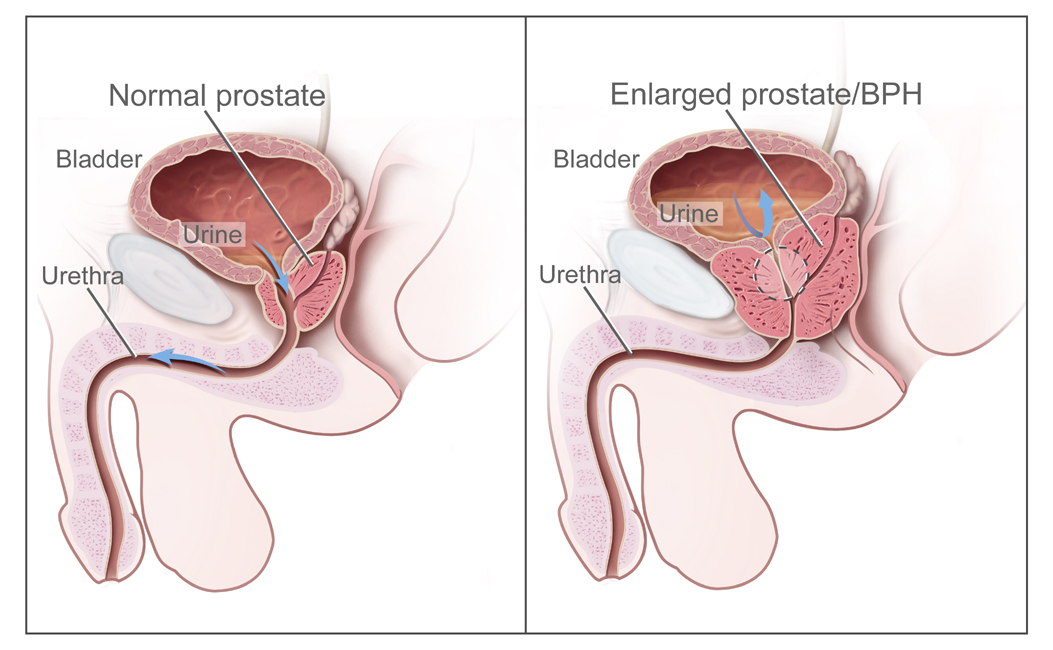
Benign prostatic hyperplasia (BPH) is a histologic diagnosis defined by non‑malignant proliferation of stromal and epithelial cells in the prostate transition zone, leading to gland enlargement that may cause bladder outlet obstruction and lower urinary tract symptoms (LUTS).
Also Called / Synonyms
- BPH (common abbreviation)
- Benign prostatic hypertrophy (historical misnomer, hyperplasia, not hypertrophy, is the correct histologic term)
- Prostatic adenoma (used in older pathology literature)
- LUTS/BPH (clinical construct combining symptoms with putative prostatic origin)
- Benign prostatic obstruction (BPO), urodynamic term for proven obstruction when BPH is the cause [13]D5
Terminology Clarification
BPH is distinct from the clinical syndromes it produces. The 2017 Singapore Urological Association guidelines explicitly define BPH as a histologic entity that can be phenotyped with noninvasive transabdominal ultrasonography, according to intravesical prostatic protrusion and prostate volume, and classified by severity for individualised treatment [19]A1c. The term “benign prostatic obstruction” (BPO) is reserved for urodynamically confirmed obstruction attributable to BPH, a distinction that guidelines increasingly adopt to avoid conflating histology with symptoms [13]D5. Lower urinary tract symptoms (LUTS) is the umbrella term for storage, voiding, and post‑micturition complaints; in aging men, BPH is the most common cause but not the only one, overlap with prostatitis, overactive bladder, and polyuria is frequent [9]B2c.
Histologic Classification of Inflammation in BPH
Inflammatory infiltrates are nearly universal in BPH specimens. The Chronic Prostatitis Collaborative Research Network (CPCRN) and International Prostatitis Collaborative Network (IPCN) classification system categorizes inflammation by anatomical location (glandular, periglandular, stromal) and grade (glandular: aggressiveness of epithelial invasion; periglandular/stromal: density of infiltrate) [6]C4. Periglandular inflammation is the most common pattern (95.6% of specimens) [6]C4. The aggressiveness of glandular inflammation correlates independently with serum PSA elevation (R = 0.289, P = 0.000), beyond the effect of prostate volume [6]C4. This classification is relevant clinically because it helps interpret PSA elevations in men without .
Clinical Staging Framework
BPH is staged for treatment using a three‑tier system based on symptom severity, quality‑of‑life impact, and objective markers [19]A1c:
- Mild‑moderate disease (IPSS ≤ 19, no bother) - managed with watchful waiting, fluid adjustment, exercise, diet [19]A1c.
- Moderate‑severe disease (IPSS ≥ 8, bothersome) - pharmacotherapy with α‑blockers and/or 5α‑reductase inhibitors (5‑ARIs) for prostates > 30 g [19]A1c.
- Advanced disease (refractory symptoms, retention, renal impairment) - surgical intervention [19]A1c.
This staging framework underpins the treatment algorithms discussed in later sections. The next section details the cellular and molecular mechanisms driving the hyperplastic process.
Pearl: The term “BPH” is histologic, not clinical; always use LUTS/BPH for the symptom complex and reserve BPO for urodynamically proven obstruction, this distinction avoids misleading patients and guides appropriate therapy selection [13]D5.
| Term | Definition | Relevance |
|---|---|---|
| BPH | Histologic hyperplasia of transition zone | Pathologic diagnosis; not a symptom complex |
| LUTS | Storage, voiding, post-micturition symptoms | Clinical presentation; may be caused by BPH or other conditions |
| BPO | Urodynamically proven obstruction due to BPH | Objective diagnosis; guides interventional decisions |
| LUTS/BPH | Clinical construct: LUTS attributed to BPH | Common in guidelines; implies causal link |
Pathophysiology & Mechanism
- ▸BPH pathogenesis involves both static (glandular/stromal hyperplasia driven by DHT and chronic inflammation) and dynamic (α1-adrenergic-mediated smooth muscle contraction) components that together determine bladder outlet obstruction.
- ▸Emerging evidence implicates ferroptosis, oxidative stress, and the Nrf2/GPX4 pathway in the proliferative and inflammatory cascade of BPH, offering potential novel therapeutic targets.
- ▸Chronic obstruction leads to compensatory detrusor hypertrophy, overactivity, and eventual decompensation (detrusor underactivity), which predicts poorer outcomes after surgical intervention.
From the defined nomenclature of prostatic hyperplasia, the mechanistic chain that produces lower urinary tract symptoms proceeds through two parallel axes: a static, structural component driven by cellular proliferation, and a dynamic, functional component governed by neurohormonal tone. Both converge on the final common pathway of bladder outlet obstruction.
The Static Component: Cellular Hyperplasia and Stromal Expansion
Benign prostatic hyperplasia arises from the transition zone of the prostate, where both glandular epithelium and stromal elements hyperproliferate [41]D5. Androgen signaling is the primary permissive factor: intraprostatic (DHT), produced by type 2, binds the androgen receptor, activating transcription of growth factors such as fibroblast growth factor (FGF) and transforming growth factor-β (TGF-β). These mediators drive stromal cell proliferation, extracellular matrix deposition, and epithelial budding [41]D5. Chronic inflammation, now recognized as a key pathogenic contributor, recruits T cells and macrophages, releasing cytokines (IL-6, IL-8, TNF-α) that further stimulate growth factor production and stem cell activation [41]D5. This inflammatory milieu also promotes oxidative stress, which recent evidence implicates in ferroptosis dysregulation: in a murine BPH model, prostate tissues showed elevated Fe²⁺ and malondialdehyde (MDA) and decreased glutathione (GSH) and GPX4 expression, consistent with ferroptotic injury [56]D5. Upregulation of the Nrf2/GPX4 pathway reduced hyperplasia, suggesting that oxidative damage to cellular membranes contributes to the proliferative drive [56]D5. The net result is a quantifiable increase in prostate volume, typically measured by transrectal ultrasound, that physically compresses the prostatic urethra.
The Dynamic Component: Smooth Muscle Tone and α1-Adrenergic Signaling
Superimposed on the static enlargement is a reversible, neurally mediated increase in resistance. The prostatic stroma and capsule are richly innervated by sympathetic nerve fibers that release norepinephrine, which binds postsynaptic s on smooth muscle cells [52]D5. Three subtypes (α1A, α1B, α1D) are expressed; α1A is the predominant isoform mediating contraction in the human prostate. Receptor activation couples to Gq/11, leading to phospholipase C activation, inositol trisphosphate (IP3) generation, and calcium release from the sarcoplasmic reticulum, causing smooth muscle shortening and increased urethral resistance [52]D5. Beyond this classical pathway, α1-adrenoceptors also signal through mitogen-activated protein kinases (MAPK), Akt, and transcription factors, suggesting a role in long-term growth regulation as well as acute contraction [52]D5. This dynamic component is the basis for the rapid symptomatic relief provided by α1-blockers.
Bladder Outlet Obstruction and Detrusor Compensation
The combined static and dynamic resistance elevates the bladder outlet obstruction index (BOOI), defined as PdetQmax - 2Qmax. As BOOI rises, the detrusor must generate higher pressure to sustain flow. The bladder initially compensates through smooth muscle hypertrophy and increased contractility, but over time, chronic obstruction leads to detrusor overactivity, fibrosis, and reduced compliance [53]D5. In a subset of patients, this progresses to detrusor underactivity (BCI < 100), characterized by impaired contractility and incomplete emptying, which predicts poorer surgical outcomes (pooled mean difference in IPSS improvement -3.73, 95% CI -5.65 to -1.80) [31]B2a. The transition from compensation to decompensation is poorly understood but appears to involve ischemia-reperfusion injury, oxidative stress, and mitochondrial dysfunction within the detrusor muscle [53]D5.
Integrated Model
BPH is therefore not a single disease mechanism but a convergence of: (1) androgen-dependent, inflammation-driven static hyperplasia; (2) sympathetic α1-adrenergic-mediated dynamic obstruction; and (3) progressive detrusor injury from chronic high-pressure voiding. Each component offers a therapeutic target: s reduce static volume, α1-blockers relieve dynamic tone, and muscarinic antagonists or β3-agonists address detrusor overactivity. The clinical phenotype, predominantly storage versus voiding symptoms, reflects the relative contributions of these processes.
Pearl: The immediate response to α1-blockers is a measure of the dynamic component; failure to respond after 4-6 weeks suggests a predominantly static or detrusor-driven etiology, warranting reassessment of the treatment strategy.
Epidemiology, Etiology & Risk Factors
- ▸BPH prevalence and severity increase progressively with age, with IPSS rising 0.18 points per year and peak flow declining 2% per year in community-dwelling men [85].
- ▸Prior prostatitis (OR 2.44) and long-term testosterone therapy (HR 1.32) are significant modifiable risk factors for BPH diagnosis [102, 101].
- ▸Dietary factors such as high starch intake increase risk, while polyunsaturated fatty acids appear protective [100]; statins and insulin resistance are not associated with LUTS incidence or progression [68, 86].
The histologic proliferation of smooth muscle and epithelium within the transition zone described in the preceding section becomes clinically relevant in a large and growing proportion of aging men. Understanding the epidemiologic burden and the modifiable and fixed drivers of this condition anchors prevention strategies and refines pretest probability at the point of care.
Prevalence and Incidence
Benign prostatic hyperplasia is among the most common conditions affecting older men worldwide. In community-based cohorts, the prevalence of moderate-to-severe lower urinary tract symptoms (LUTS) increases with each decade of life. The Olmsted County study, which followed a randomly selected cohort of 2115 men aged 40-79 years for 12 years, documented an average annual increase in the International Prostate Symptom Score (IPSS) of 0.18 points, ranging from 0.05 in men aged 50 years to 0.44 in those aged 70 years [85]D5. Peak urinary flow rate declined by 2% per year, and median prostate volume grew by 1.9% per year [85]D5. The cumulative incidence of acute urinary retention (AUR) over 4 years was 2.7% [85]D5. In the placebo arm of the Prostate Trial (PCPT), the rate of incident clinical BPH (defined as initiation of treatment, surgery, or IPSS >14) was 19 per 1000 person-years [64]B2b. Population-based data from Italy report BPH-related hospitalization rates of 9.04 per 1000 patient-years and BPH surgery rates of 12.6 per 1000 patient-years [74]B2b.
Demographic Distribution
Age is the dominant risk factor. The prevalence of LUTS/BPH increases progressively after age 40, with the steepest rises in the seventh and eighth decades. In surgical cohorts, the mean age of men undergoing transurethral resection of the prostate (TURP) is approximately 71 years [77]B3b, and for those receiving minimally invasive surgical treatments (MISTs) the mean age is 79.8 years [80]B2a. Although the condition affects men of all ethnicities, the limited data available suggest that African ancestry may be associated with higher rates of complications when surgery is required, though population-based incidence comparisons across racial groups are sparse [88]B3b. In a meta-analysis of 11 studies, the pooled prevalence of among men with LUTS/BPH was 79.53% (95% CI 71.63%-85.74%), with higher rates in low- and middle-income countries (78.7%) compared with high-income countries (70.9%) [95]B2a.
Temporal Trends
Bibliometric analysis of the most-cited BPH literature shows that the focus of research has shifted from pathogenesis and etiology in the 1980s and 1990s toward treatment outcomes in the 2000s, reflecting both an aging population and expanding therapeutic options [57]D5. The incidence of BPH-related surgery has declined in some regions due to improved medical therapy, but the prevalence of LUTS continues to rise with population aging. No seasonal variation in BPH incidence or exacerbation has been reported in the available literature.
Risk Factors
Multiple fixed and modifiable factors have been associated with the development or progression of BPH/LUTS. The strongest evidence is summarized in the table below.
| Risk Factor | Odds Ratio / Hazard Ratio (95% CI) | Evidence Level | Source |
|---|---|---|---|
| Age (per decade increase) | See text (progressive annual IPSS increase) | High | [85]D5 |
| Physician-diagnosed prostatitis | OR 2.44 (1.48-4.01) for later BPH diagnosis; OR 1.69 (1.28-2.22) for BPH treatment | Moderate | [102]B2b |
| Testosterone therapy (≥2.5 yr) | HR 1.32 (1.28-1.36) for BPH diagnosis | Moderate | [101]B2b |
| High starch intake (highest vs lowest quintile) | OR 1.51 (1.15-1.99) | Low | [100]B3b |
| Polyunsaturated fatty acids (highest vs lowest) | OR 0.72 (0.55-0.93) - protective | Low | [100]B3b |
| Linoleic acid (highest vs lowest) | OR 0.73 (0.56-0.94) - protective | Low | [100]B3b |
| Linolenic acid (highest vs lowest) | OR 0.71 (0.54-0.93) - protective | Low | [100]B3b |
| Obesity (BMI ≥30 kg/m²) | Attenuates finasteride benefit (p interaction = 0.04) | Moderate | [64]B2b |
| Insulin resistance (HOMA-IR) | No association with LUTS incidence or progression (p > 0.60) | High | [86]B2b |
| Statin use | No association: HR 1.05 (0.78-1.41) for LUTS incidence; HR 1.13 (0.96-1.33) for progression | High | [68]B2b |
| Moderate-to-severe LUTS (MACE risk) | OR 1.68 (1.13-2.50) for incident major adverse cardiac events | Moderate | [70]B2a |
Prostatitis is a notable early marker: a longitudinal population-based study found that a prior diagnosis of prostatitis conferred a 2.4-fold increased odds of receiving a later BPH diagnosis and a 70% increased odds of requiring BPH treatment [102]B2b. This suggests that inflammatory pathways may contribute to prostatic hyperplasia, or that prostatitis unmasks latent obstruction. Testosterone therapy in hypogonadal men does not increase BPH risk in the first 2.5 years, but beyond that point the risk of receiving a BPH diagnosis rises by 32% (HR 1.32, 95% CI 1.28-1.36) [101]B2b. However, testosterone therapy does not increase the need for subsequent prostatic interventions [101]B2b. Diet also plays a role: a large Italian case-control study found that high starch intake increased BPH risk (OR 1.51), while polyunsaturated fatty acids, linoleic acid, and linolenic acid were each associated with a roughly 30% reduction in risk [100]B3b.
Special Considerations
In kidney transplant recipients, the prevalence of male LUTS ranges from 5.8% to 33.0%, with surgical intervention for benign prostatic obstruction required in 2.5% to 20.0% of cases [34]B2a. This variability underscores the need for standardized assessment in this population. Additionally, in men with multiple system atrophy (MSA), urogenital symptoms, including storage and voiding LUTS, can mimic BPH, and up to 25% of these patients may die from complications of recurrent urinary tract infections [97]D5. Unnecessary surgery for presumed BPH in MSA patients has been reported, highlighting the importance of careful neurologic evaluation when atypical features are present [97]D5.
Pearl: When evaluating a man with new or worsening LUTS, a prior diagnosis of prostatitis increases the odds of BPH by more than twofold [102]B2b, and testosterone therapy beyond 2.5 years raises the risk of a BPH diagnosis by 32% [101]B2b - these historical details should be actively sought, as they inform both risk stratification and counseling.
Clinical Presentation
- ▸LUTS from BPH are divided into storage (frequency, urgency, nocturia) and voiding (hesitancy, weak stream, intermittency) domains; standardized assessment with IPSS quantifies severity and guides management.
- ▸Digital rectal examination underestimates prostate volume by 30-50%; a smooth, symmetric, elastic gland is consistent with BPH, while nodularity or asymmetry raises suspicion for malignancy.
- ▸Acute urinary retention and complications (hematuria, recurrent UTIs, bladder stones, renal impairment) are red flags that shift management from surveillance toward intervention.
From this epidemiological backdrop, where aging, metabolic syndrome, and physical inactivity converge to drive prostate growth, the clinician next encounters the patient whose symptoms reflect the downstream consequences of bladder outlet obstruction. Lower urinary tract symptoms (LUTS) attributed to BPH are classically divided into storage (frequency, urgency, nocturia, urge incontinence) and voiding (hesitancy, weak stream, intermittency, straining, terminal dribbling) domains [20]A1c[61]A1c. Nocturia, the most bothersome symptom, wakes the patient repeatedly; its severity correlates with disease progression and reduced quality of life [115]A1a. Storage symptoms arise from secondary detrusor overactivity, while voiding symptoms reflect mechanical obstruction and impaired detrusor contractility [50]D5[51]D5.
Symptom Inventory and Quantification
Standardized symptom assessment is the foundation of clinical presentation. The International Prostate Symptom Score (IPSS) (or its identical predecessor, the AUA Symptom Index) asks seven questions covering both storage and voiding domains plus a single quality-of-life question [20]A1c[61]A1c. Scores classify symptoms as mild (0-7), moderate (8-19), or severe (20-35). A 4-point change is the minimal clinically important difference [126]A1a. In the natural history of untreated BPH, the IPSS worsens by approximately 0.3-0.5 points per year, though progression is highly variable [61]A1c[121]B2c.
| Symptom Domain | Specific Complaint | Typical Progression Pattern |
|---|---|---|
| Storage | Frequency, urgency, nocturia, urge incontinence | Often the earliest; may precede voiding symptoms by years [20]A1c[50]D5 |
| Voiding | Hesitancy, weak stream, intermittency, straining, terminal dribbling | Reflects progressive obstruction; worsens with larger prostate volume [28]B2a[54]D5 |
| Post-micturition | Sensation of incomplete emptying, post-void dribbling | Common but under-reported; correlates with elevated post-void residual [34]B2a |
Physical Examination Findings
Digital rectal examination (DRE) assesses prostate size, consistency, and symmetry. A BPH-affected prostate is typically symmetrically enlarged, smooth, firm, and elastic, with a palpable median sulcus [20]A1c. DRE underestimates true prostate volume by 30-50% compared to ultrasound or MRI [54]D5. The presence of a nodule, asymmetry, or induration raises suspicion for and mandates further evaluation [20]A1c. A focused neurological examination of the perineum and lower extremities should exclude , and a post-void residual (PVR) measurement, either by bladder scan or catheterization, completes the initial assessment. A PVR > 150 mL is considered elevated and may indicate decompensation or chronic retention [61]A1c[62]A1c.
Natural History and Red Flags
Symptoms typically progress insidiously over years. Acute deterioration, especially sudden inability to void, defines acute urinary retention (AUR), a sentinel event that occurs in approximately 1-2% of men per year in unselected populations and up to 5% per year in those with moderate-to-severe symptoms and prostate volume > 30 mL [103]A1b[119]A1a. Other red flags requiring immediate evaluation include hematuria (gross or microscopic), recurrent urinary tract infections, bladder stones, and renal impairment from chronic obstruction [20]A1c[61]A1c. The presence of any of these complications shifts from watchful waiting toward procedural intervention [62]A1c.
Atypical Presentations
Not all men with BPH report classic LUTS. Some present with overflow incontinence (constant dribbling due to chronic retention) or nocturnal [50]D5. Others may be asymptomatic despite significant obstruction, identified only when an elevated PVR or hydronephrosis is discovered incidentally [54]D5. Conversely, storage-predominant symptoms, especially in the absence of a palpable prostate enlargement, should prompt consideration of overactive bladder (OAB) as a comorbid or alternative diagnosis [51]D5[104]A1b.
Pearl: In a man with moderate-to-severe LUTS, a prostate volume > 40 mL on DRE or imaging and a PSA > 1.5 ng/mL identify those at highest risk of progression who may benefit most from 5α-reductase inhibitor therapy [103]A1b[119]A1a.
Diagnosis & Workup
- ▸The diagnostic workup for BPH combines symptom scoring (IPSS), physical exam, urinalysis, and uroflowmetry to establish the diagnosis and exclude mimics.
- ▸Pressure-flow urodynamics (BOOI ≥40) is the gold standard for confirming BOO, but is reserved for equivocal cases or suspected detrusor underactivity.
- ▸A nomogram using Qmax and transitional zone volume predicts BOO with 83% accuracy, reducing the need for invasive testing.
With the clinical presentation of LUTS established, the diagnostic workup must distinguish BPH from other causes of LUTS, quantify bladder outlet obstruction (BOO), and assess prostate size and morphology. The evaluation proceeds through a structured, stepwise algorithm that combines symptom scoring, physical examination, laboratory tests, and functional studies.
History and Physical Examination
Every patient should complete the International Prostate Symptom Score (IPSS), a validated 7-item questionnaire (range 0-35) that classifies symptoms as mild (0-7), moderate (8-19), or severe (20-35). The IPSS quality-of-life question (0-6) captures bother. A voiding diary (24-72 hours) records frequency, urgency, nocturia, and voided volumes. The digital rectal examination (DRE) assesses prostate size, consistency, and symmetry; nodules or asymmetry raise suspicion for .
Laboratory Studies
Urinalysis is essential to exclude urinary tract infection or hematuria. Serum creatinine detects renal impairment from chronic obstruction (though rare). Prostate-specific antigen (PSA) is not diagnostic for BPH but is used to assess prostate cancer risk and to estimate prostate volume. A PSA <1.5 ng/mL with a smooth DRE makes cancer unlikely; higher values, especially with rising trend, warrant further evaluation. The 12-month placebo effect on IPSS averages 4.4 points, a consideration when interpreting trial results [149]A1a.
Uroflowmetry and Postvoid Residual
Uroflowmetry measures maximum urinary flow rate (Qmax). A Qmax <10 mL/s suggests obstruction, but values 10-15 mL/s are equivocal. Postvoid residual (PVR) volume >50 mL indicates incomplete emptying; >200 mL raises concern for decompensation. Both tests are noninvasive and should be performed at least twice for consistency.
Urodynamic Studies
Pressure-flow urodynamics (PFS) is the gold standard for diagnosing BOO, defined as a Bladder Outlet Obstruction Index (BOOI) ≥40. The nomogram combining Qmax and transitional zone volume (TZV) predicts BOO with 83% accuracy, reducing the need for invasive testing [157]B2b. In practice, UDS is reserved for:
- Equivocal symptom scores or flow rates,
- Suspected detrusor underactivity (DU), which is associated with poorer IPSS and Qmax improvement after surgery [31]B2a,
- Prior failed medical or surgical therapy,
- Neurologic disease (e.g., Parkinson's, multiple sclerosis).
UDS utilization for BPH has declined over time, and most urologists do not perform it routinely before surgery [155]B2c.
Imaging
Transrectal ultrasound (TRUS) measures prostate volume (total and transitional zone) and can detect intravesical prostatic protrusion (IPP), which correlates with BOO severity [54]D5. MRI is not routine but may be used when prostate cancer is suspected or when precise anatomical delineation is needed for surgical planning. CT urography is reserved for hematuria workup or suspected upper tract pathology.
Cystoscopy
Cystourethroscopy is not required for diagnosis but is indicated when:
- Hematuria is present,
- Urethral stricture or bladder neck stenosis is suspected,
- Prior to minimally invasive surgical therapy (e.g., prostatic urethral lift) to assess anatomy.
Bladder trabeculation grade on cystoscopy correlates with BOO severity (BOOI ≥40; AUC 0.72) [160]B2b.
Diagnostic Algorithm
Step 1: History, IPSS, DRE, urinalysis, and serum creatinine. If IPSS ≥8, proceed. Step 2: Uroflowmetry + PVR. If Qmax <10 mL/s repeated, or PVR >100 mL, consider BOO. Step 3: If diagnosis remains uncertain or surgery is planned, obtain TRUS for volume and morphology. For patients with equivocal findings or suspected DU, perform pressure-flow urodynamics. Step 4: If PSA is elevated or DRE is abnormal, evaluate for prostate cancer (biopsy if indicated, note that incidental prostate cancer is found in 10% of surgical specimens, rising to 35% in men >72 years with PSAD >0.1 ng/mL/cm³ [89]B3b).
A diagnostic algorithm is summarized in Table 1.
Table 1. Diagnostic Tests for BPH and Their Performance
| Test | Key Finding | Sensitivity/Specificity | Notes |
|---|---|---|---|
| IPSS | Score ≥8 (moderate) | Not diagnostic | Symptom severity, not obstruction |
| Qmax | <10 mL/s | 70% / 80% for BOO | Repeat at least twice |
| PVR | >100 mL | Low specificity | May indicate decompensation |
| BOOI | ≥40 | 90% / 90% for BOO | Gold standard, invasive |
| TRUS volume | >30 mL | Correlates with obstruction | Transitional zone >0.5 ratio |
| Cystoscopy | Trabeculation ≥ grade 2 | AUC 0.72 for BOO [160]B2b | Reserved for select cases |
Pearl: A pressure-flow urodynamic study confirming BOOI ≥40 is the gold standard for BOO, but in practice, the combination of IPSS ≥8, Qmax <10 mL/s, and prostate volume >30 mL by TRUS has a high positive predictive value, routine UDS is not required for most patients.
Severity, Staging & Risk Stratification
- ▸Risk stratification uses IPSS, Qmax, prostate volume, PSA, and nomograms to predict progression and select management.
- ▸The Slawin nomogram (concordance index 0.71) estimates 2-year risk of AUR or surgery, halved by dutasteride (NNT = 27).
- ▸Frailty assessment (5i-FI ≥ 2) independently predicts postoperative complications and should inform surgical planning.
The diagnostic evaluation yields a set of parameters that stratify patients into risk tiers, guiding the choice between watchful waiting, medical therapy, and surgical intervention. The goal is to identify men at risk for disease progression, acute urinary retention (AUR), need for surgery, or renal impairment, and match them to the appropriate intensity of treatment.
Symptom score and uroflowmetry
Symptom severity is graded by the International Prostate Symptom Score (IPSS): 0-7 mild, 8-19 moderate, 20-35 severe. A peak urinary flow rate (Qmax) < 10 mL/s on a voided volume ≥ 150 mL suggests bladder outlet obstruction (BOO) [157]B2b. However, symptom score alone does not predict progression. In a large cross-sectional study, 60.8% of men with LUTS were categorized as obstructed or high-pressure/high-flow on the Newcastle Noninvasive Nomogram, and median Qmax was 10.9 mL/s [170]B2c. The combination of Qmax and transitional zone volume (TZV) predicts BOO with a predictive accuracy of 83.2% [157]B2b.
Prostate volume and PSA
Prostate volume (PV) and its surrogate, serum PSA, mark the risk of progression. In the CombAT trial, men with PV ≥ 30 mL and PSA 1.5-10 ng/mL had a 7.4% 2-year rate of AUR or surgery on placebo, which was halved to 3.7% with dutasteride (absolute risk reduction 3.7%, relative risk reduction 50%; NNT = 27) [189]B2b. A PSA level ≥ 1.5 ng/mL is a reasonable proxy for significant prostate enlargement when volume measurement is unavailable. The Slawin nomogram, incorporating the American Urological Association Symptom Index, BPH Impact Index, prior alpha-blocker use, prostate volume, PSA, and Qmax, predicts 2-year risk of AUR/surgery with a concordance index of 0.71 [189]B2b. This tool can identify the highest-risk men (maximal predicted risk 27% vs. median 7.4% on placebo).
Nomograms for obstruction and surgical risk
Pressure-flow studies remain the gold standard for quantifying BOO. The Bladder Outlet Obstruction Index (BOOI = pdetQmax - 2Qmax) classifies obstruction: BOOI > 40 indicates obstruction, 20-40 equivocal, < 20 unobstructed. The Schäfer nomogram grades obstruction from 0 (none) to 6 (severe). However, noninvasive approximation methods are increasingly used. The three-parameter model (3PM) estimates the minimum urethral opening pressure (pmuo) within 10 cmH2O of the actual value in 75.9% of men [181]C4. The BOOI-Wmax nomogram simultaneously displays obstruction and detrusor contractility; values below the 25th percentile define detrusor underactivity, which is associated with older age, larger bladder capacity, and higher post-void residual [182]B2b.
For surgical risk stratification, the Jeldres nomogram predicts 30-day mortality after transurethral resection of the prostate (TURP) using age and Charlson comorbidity index, achieving 83% accuracy in external validation; overall 30-day mortality was 0.4% [171]B2b. Early stress urinary incontinence after endoscopic enucleation is predicted by age ≥ 65 years, BMI ≥ 25 kg/m², LUTS duration ≥ 5 years, and prostate volume ≥ 75 mL [184]B2b.
Frailty and comorbidity assessment
Frailty independently predicts postoperative complications. The 5-item Frailty Index (5i-FI) score ≥ 2 is associated with higher odds of any complication (OR 1.50), major complications (Clavien-Dindo ≥ 3; OR 1.63), length of stay ≥ 2 days (OR 1.31), and 30-day readmission (OR 1.65) [185]B2b. After inverse probability weighting, laser enucleation of the prostate had the lowest rates of all complications (6.29%), major complications (2.30%), and readmission (3.80%) compared with TURP and photovaporization [185]B2b. Emerging data also link phenotypic age acceleration to BPH risk (AUC 0.853 when combined with clinical factors) [179]C4 and dynamic frailty trajectories to higher BPH/LUTS incidence (OR 2.01-2.82 for moderately increasing and high-increasing trajectories) [187]B2b.
Integration into selection
A practical risk stratification algorithm combines symptom burden, objective obstruction, and surgical candidacy:
| Risk Domain | Low Risk | Intermediate Risk | High Risk |
|---|---|---|---|
| IPSS | 0-7 | 8-19 | 20-35 |
| Qmax (mL/s) | > 15 | 10-15 | < 10 |
| Prostate volume (mL) | < 30 | 30-60 | > 60 |
| PSA (ng/mL) | < 1.5 | 1.5-4.0 | > 4.0 |
| 2-year AUR/surgery risk (Slawin) | < 5% | 5-15% | > 15% |
| Frailty (5i-FI) | 0 | 1 | ≥ 2 |
Low-risk patients are candidates for watchful waiting and lifestyle modification. Intermediate-risk men may benefit from medical therapy (alpha-blockers, 5-alpha-reductase inhibitors, or combination). High-risk men, especially those with Qmax < 10 mL/s, large prostate volume, or high Slawin nomogram risk, should be considered for surgical intervention. Frailty assessment further refines the surgical risk-benefit discussion, favoring less invasive modalities (e.g., laser enucleation) in frail patients.
Pearl: Symptom severity alone does not predict disease progression; combining IPSS, Qmax, prostate volume, and PSA provides the best risk stratification for selecting between watchful waiting, medical therapy, and surgery.
| Risk Domain | Low Risk | Intermediate Risk | High Risk |
|---|---|---|---|
| IPSS | 0-7 | 8-19 | 20-35 |
| Qmax (mL/s) | > 15 | 10-15 | < 10 |
| Prostate volume (mL) | < 30 | 30-60 | > 60 |
| PSA (ng/mL) | < 1.5 | 1.5-4.0 | > 4.0 |
| 2-year AUR/surgery risk (Slawin) | < 5% | 5-15% | > 15% |
| Frailty (5i-FI) | 0 | 1 | ≥ 2 |
Acute Management & Decompression
- ▸Acute urinary retention (AUR) requires prompt catheterization and α-blocker therapy (alfuzosin 10 mg, tamsulosin 0.4 mg, or silodosin 8 mg) for 2-3 days before trial without catheter (TWOC).
- ▸TWOC should be performed after 3-5 days of catheterization; shorter duration reduces complications without compromising success.
- ▸Persistent retention after TWOC failure is best managed with HoLEP or TURP, which achieve >95% catheter-free rates.
When lower urinary tract symptoms progress to acute urinary retention (AUR), the need for decompression becomes time-critical. AUR is the most common urologic emergency in men with BPH, occurring at a cumulative incidence of 2-7% over 4 years in community-based cohorts [85]D5[193]B2a. Prompt intervention relieves pain, prevents detrusor damage, and reduces the risk of urosepsis and renal impairment [210]A1c.
Step 1: Initial Assessment and Severity Classification
Confirm AUR by history (sudden inability to void, suprapubic pain) and physical examination (palpable bladder). Assess for complicated retention: fever, leukocytosis, hematuria, or elevated serum creatinine. Classify as simple AUR (no infection, no renal impairment) or complicated AUR (with urinary tract infection, acute kidney injury, or clot retention). Obtain urinalysis, urine culture, and serum creatinine. Perform renal ultrasound if hydronephrosis is suspected [53]D5.
Step 2: Decompression
Immediate bladder drainage is the cornerstone. Urethral catheterization is first-line; use a 16-18 Fr Foley catheter. Suprapubic catheterization is preferred when urethral access is contraindicated (urethral stricture, recent urethral surgery, pelvic trauma) and may offer superior patient comfort and lower colonization rates [210]A1c. Clean intermittent self-catheterization (CISC) is a viable alternative for motivated patients, improving quality of life [210]A1c. Document drained volume: >1000 mL indicates chronic retention and carries risk of post-obstructive diuresis [212]B2b.
Step 3: Medical Therapy
Start an α₁-blocker immediately after catheterization and continue for 2-3 days before trial without catheter (TWOC). The French Urological Association guidelines recommend alfuzosin 10 mg once daily, tamsulosin 0.4 mg once daily, or silodosin 8 mg once daily; no agent has demonstrated superiority [210]A1c. α-blockers significantly improve TWOC success rates (odds ratio ~2.0) by reducing bladder outlet resistance [210]A1c[202]D5. Do not routinely add 5α-reductase inhibitors or antimuscarinics in the acute setting; their onset is too slow or they may increase retention risk [140]A1a[192]A1a.
Step 4: Trial Without Catheter
Perform TWOC after 3-5 days of catheterization and α-blocker therapy. Shorter catheterization (<3-5 days) reduces infection and discomfort without compromising outcomes [210]A1c. Remove the catheter in the morning; instruct the patient to void within 6-8 hours. Measure post-void residual (PVR) by ultrasound. Success is defined as voiding >200 mL with PVR <150 mL. If TWOC fails, replace the catheter and consider a second TWOC after another 2-3 days of α-blocker, or proceed to definitive surgery [210]A1c.
Step 5: Escalation for Persistent Retention
If TWOC fails repeatedly, definitive surgical intervention is indicated. Holmium laser enucleation of the prostate (HoLEP) achieves catheter-free rates > at 3 months for AUR, with durable outcomes even in high-pressure chronic retention [217]B3b. Transurethral resection of the prostate (TURP) remains the historical benchmark, with 3-month catheter-free rates of 88-95% [195]A1b[116]A1a. For patients unfit for surgery, transurethral microwave thermotherapy (TUMT) offers an alternative, with 79% catheter-free success in one randomized trial [195]A1b.
Acute Hematuria and Clot Retention
Gross hematuria with clot retention requires urgent catheterization with a 22-24 Fr three-way catheter and continuous bladder irrigation (CBI) using normal saline. If irrigation fails to clear clots, perform bedside cystoscopic clot evacuation. Identify and treat the source (e.g., prostate bleeding, infection). In patients on antithrombotic therapy, photoselective vaporization (PVP) may be preferred over TURP or enucleation due to lower bleeding risk [207]B2a.
Infected Obstruction (Urosepsis)
In patients with AUR and signs of systemic infection (fever, hypotension), obtain blood and urine cultures, start broad-spectrum (e.g., or a third-generation cephalosporin), and drain the bladder emergently. Suprapubic catheterization may be preferred to avoid urethral manipulation in the presence of prostatic abscess [210]A1c.
Controversies and Guideline Disagreement
| Question | Position A | Position B | Strength | Implication |
|---|---|---|---|---|
| Immediate surgery vs TWOC after first AUR | French CTMH 2025, insufficient evidence to recommend immediate surgery; TWOC with α-blocker is standard [210]A1c | AUA 2026, shared decision-making; early surgery may be considered in high-risk patients (large prostate, high PVR, recurrent AUR) [22]A1c | Moderate | Most patients undergo TWOC first; those with risk factors may benefit from earlier definitive treatment. |
Pearl: Administer α-blockers immediately upon catheterization and schedule TWOC within 3-5 days; failure to void warrants definitive surgical intervention, with HoLEP offering >98% catheter-free rates for AUR [217]B3b.
| Drug | Dose | Frequency | Duration before TWOC |
|---|---|---|---|
| Alfuzosin | 10 mg | Once daily | 2-3 days |
| Tamsulosin | 0.4 mg | Once daily | 2-3 days |
| Silodosin | 8 mg | Once daily | 2-3 days |
From French Urological Association guidelines [210]A1c. No agent has demonstrated superiority.
Long-term & Definitive Management: Medical vs Endourologic/Surgical
- ▸Medical therapy (α-blocker, 5-ARI, or combination) is first-line for moderate symptoms; combination therapy reduces risk of AUR and surgery (CombAT).
- ▸Minimally invasive surgical therapies (Rezūm, PUL, PAE, Aquablation) offer durable symptom relief with lower morbidity than TURP but higher retreatment rates.
- ▸HoLEP is the size-independent gold standard for surgical desobstruction, with lowest transfusion rates and shortest catheterisation.
Once acute urinary retention has been decompressed and the patient is stable, the clinician and patient must select a long-term strategy from a widening spectrum of options: continued medical therapy, minimally invasive surgical therapies (MISTs), or definitive surgical desobstruction. The AUA 2026 Guideline on of LUTS/BPH provides a structured framework for shared decision-making that weighs efficacy, durability, safety, and patient preference [21]A1c[22]A1c. The central question is whether the patient's symptom burden, prostate size, and treatment goals favour a medication-first approach or a procedural intervention.
Step 1: Stratify by Disease Severity and Prostate Size
AUA Symptom Score (AUA-SI) and prostate volume drive the initial branch. Mild symptoms (AUA-SI ≤7) are managed with behavioral/lifestyle changes alone, as per the AUA 2026 Guideline [21]A1c. For moderate-to-severe symptoms (AUA-SI ≥8), the choice depends on prostate volume:
- Prostate volume <30 mL: α-blocker monotherapy is first-line, as 5α-reductase inhibitors (5-ARIs) require ≥30 mL volume to be effective [21]A1c[22]A1c.
- Prostate volume 30-80 mL: offer either medical therapy (α-blocker, 5-ARI, or combination) or a MIST (e.g., water vapor thermal therapy [WVTT], prostatic urethral lift [PUL], or prostatic artery embolisation [PAE]) [22]A1c[108]A1a.
- Prostate volume >80 mL: surgical options such as holmium laser enucleation (HoLEP), robotic simple prostatectomy (RASP), or Aquablation are preferred for their superior durability [22]A1c[71]A1a[240]B2b.
Step 2: Medical Therapy - The Evidence Ladder
α-Blockers remain the most commonly prescribed first-line agents. Tamsulosin 0.4 mg daily produces a mean improvement in AUA-SI of -4 to -6 points, with a group-level mean difference of -2.96 (95% CI -4.37 to -1.54) compared with placebo in an N-of-1 deprescribing trial [122]A1b (1b). However, about one in three men on chronic tamsulosin derive minimal symptomatic benefit [122]A1b (1b).
5α-Reductase Inhibitors (dutasteride 0.5 mg, finasteride 5 mg) reduce prostate volume and prevent progression. In the CombAT trial (N=4844), combination therapy (dutasteride + tamsulosin) was superior to tamsulosin alone for reducing the risk of acute urinary retention (AUR) or BPH-related surgery at 4 years; combination therapy was also superior to either monotherapy for reducing BPH clinical progression [103]A1b (1b). Finasteride reduced the risk of incident clinical BPH by 40% (HR 0.60) over 5.3 years in the Prostate Trial [64]B2b (2b).
Combination Pharmacotherapy is recommended for men with moderate-to-severe symptoms and prostate enlargement. A novel fixed-dose combination of dutasteride 0.5 mg/tadalafil 5 mg demonstrated superior IPSS reduction at 48 weeks (-9.49 vs -4.40 for dutasteride alone; LSMD -5.09, 95% CI -6.13 to -4.50; P<0.001) with an acceptable safety profile [141]A1b (1b). For patients with persistent overactive bladder (OAB) symptoms despite α-blocker therapy, add-on vibegron 75 mg daily reduced daily micturitions by -0.74 (95% CI -1.02 to -0.46) and urgency episodes by -0.95 (95% CI -1.37 to -0.54) vs placebo at 12 weeks in the phase 3 COURAGE trial, without increasing urinary retention (0.9% vs 0.7%) [104]A1b[36]A1b (1b).
What NOT to do: Saw palmetto (160 mg twice daily) showed no benefit over placebo for AUA-SI (mean difference 0.04, 95% CI -0.93 to 1.01) or peak flow rate in a 1-year RCT [72]A1b (1b). Intraprostatic botulinum toxin A (200-300 U) did not significantly improve IPSS vs placebo, with a large placebo effect from the injectable route [222]A1b (1b).
Step 3: Minimally Invasive Surgical Therapies (MISTs)
| Modality | Indication | Key Efficacy at 1-5 yr | Sexual Function | Retreatment Rate | Evidence Level |
|---|---|---|---|---|---|
| Water vapor thermal therapy (Rezūm) | Prostate 30-80 cc, moderate-severe LUTS | IPSS reduced 48%, Qmax improved 44% at 5 yr [223]A1b (1b) | No de novo ; ejaculatory function preserved [151]B2b | 4.4% at 5 yr [223]A1b | 1b |
| Prostatic urethral lift (PUL/UroLift) | Prostate 30-80 cc, no large middle lobe | IPSS reduction -11.5 at 1 yr (-13.2 vs sham) [105]A1b (1b); superior to TURP on BPH6 endpoint [220]A1b (1b) | Superior ejaculation preservation vs TURP (p<0.01) [220]A1b | ~6% at 5 yr (estimated) | 1b |
| Aquablation | Prostate 30-150 cc | IPSS reduction -14.4 at 3 yr (30-80 cc) and -16.3 (80-150 cc) [240]B2b (2b); noninferior to laser enucleation at 3 mo [87]B2b | Lower anejaculation vs TURP (10% vs 36%) [133]A1b; lower retrograde ejaculation vs LEP (14.8% vs 77.1%) [87]B2b | 3-4% at 3 yr [240]B2b | 1b |
| Transurethral microwave thermotherapy (TUMT) | Moderate LUTS, not on anticoagulation | IPSS reduced 65% (vs 77% for TURP) [46]A1a (1a) | Variable | Higher retreatment rates vs TURP [47]A1a | 1a |
A Cochrane network meta-analysis of 27 RCTs (3017 men) found that among MISTs, PUL and PAE had the highest likelihood of being most efficacious for urinary symptoms and quality of life, while TUMT had the highest rate of retreatment [108]A1a (1a). The AUA 2026 Guideline recommends shared decision-making, noting that MISTs offer lower morbidity than TURP but may have higher retreatment rates [22]A1c.
Step 4: Surgical Desobstruction - Definitive Options
For patients who desire the most durable symptom relief or have very large prostates (>80 mL), surgical resection or enucleation is indicated.
Transurethral Resection of the Prostate (TURP) remains the historical gold standard. Bipolar TURP produces a mean IPSS reduction of -11.6 at 1 month and durable improvement, but carries a retrograde ejaculation rate of 72% [10]A1b (1b).
Holmium Laser Enucleation (HoLEP) is size-independent and provides outcomes equivalent to TURP with lower transfusion risk (75% reduction vs TURP) and shorter catheterisation (mean 1.3 days) [71]A1a[239]A1b (1a). HoLEP reduces operative time by 49 min and length of stay by 1.5 days compared with robotic simple prostatectomy [71]A1a (1a). In a randomised trial, a modified HoLEP technique preserving 1 cm of peri-verumontanum tissue did not improve ejaculation preservation (66.6% of patients bothered little or not at all by ejaculatory dysfunction) [123]A1b (1b).
Robotic-Assisted Simple Prostatectomy (RASP) is an option for large prostates. Single-port RASP offers reduced blood loss and shorter hospital stay vs open prostatectomy, with comparable functional outcomes [250]D5 (5).
Aquablation showed noninferior IPSS improvement to laser enucleation at 3 mo (-12.9 vs -13.1; estimated difference 0.93; noninferiority probability >0.999) with superior ejaculation preservation (14.8% retrograde ejaculation vs 77.1%) and less persistent stress urinary incontinence (0% vs 9.3%) [87]B2b (2b).
Bipolar Transurethral Vaporization (TUVP) offers shorter operative time (70 min vs 87 min) and less blood loss (Hb drop 0.37 vs 1.51 g/dL) than TURP, but may have slightly less durable symptom control [10]A1b (1b).
Post-procedural monitoring: Establish a new PSA nadir at 3-6 months after ablative procedures for surveillance [242]D5 (5).
Dosing Table
| Drug | Starting dose | Target dose | Renal adjustment | Key monitoring |
|---|---|---|---|---|
| Tamsulosin | 0.4 mg PO daily | 0.4-0.8 mg daily | Not required | Orthostatic BP, dizziness |
| Dutasteride | 0.5 mg PO daily | 0.5 mg daily | Not required | PSA (expected 50% decrease after 6 mo) |
| Finasteride | 5 mg PO daily | 5 mg daily | Not required | PSA, sexual function |
| Dutasteride/tadalafil FDC | 0.5/5 mg PO daily | 0.5/5 mg daily | Not required | BP, sexual function, PSA |
| Vibegron | 75 mg PO daily | 75 mg daily | eGFR ≥30: no adjustment; <30: avoid | PVR, BP, urinary retention |
| Tadalafil | 5 mg PO daily | 5 mg daily | Not required | BP, PDE5i contraindications |
Treatment Failure Protocol
- Medical failure: If IPSS improves <3 points or patient remains dissatisfied after 4-12 weeks of adequate therapy, consider switching α-blocker, adding 5-ARI, or proceeding to MIST/surgery.
- MIST failure: If symptoms recur or IPSS returns to baseline within 1-2 years, perform cystoscopy and pressure-flow studies; if obstruction persists, proceed to TURP/HoLEP/Aquablation.
- Surgical failure: If obstruction persists after TURP/HoLEP, rule out detrusor underactivity via urodynamics; consider repeat endoscopic procedure or ATOMS for stress incontinence [248]C4 (4).
Controversies and Guideline Disagreement
| Question | Position A | Position B | Strength | Implication |
|---|---|---|---|---|
| PAE as first-line therapy | AUA 2026: recommends PAE as a MIST option for men with moderate-to-severe LUTS who desire treatment [22]A1c | P-EASY ADVANCE trial: PAE was more effective than combination medical therapy in treatment-naïve men (63% vs 28% unobstructed) [32]A1b | Mild (AUA does not designate PAE as first-line over medication; trial suggests potential first-line role) | PAE may be offered as first-line in selected patients, but heterogeneity in outcomes requires shared decision-making [228]B2b |
| Role of pressure-flow studies before surgery | ICI-RS 2023: Preoperative urodynamics may identify patients with good bladder contractility who benefit most; those with low-capacity/high-amplitude detrusor overactivity are at risk for persistent OAB [98]D5 | AUA 2026: does not mandate urodynamics before surgery except in equivocal cases [22]A1c | Moderate | Use urodynamics selectively in patients with prior failed therapy or concern for detrusor underactivity. |
Pearl: For most men with moderate-to-severe LUTS and prostate volume ≥30 mL, combination medical therapy (e.g., α-blocker + 5-ARI) effectively reduces progression risk; however, a single water vapor thermal therapy procedure provides symptom improvement comparable to daily medication at 5 years, with lower rates of clinical progression (4.6% vs 12-20% with medication) and no sexual side effects, making it an attractive option for those prioritising convenience and sexual function [112]B2b[151]B2b[223]A1b.
| Modality | Indication | Key Efficacy at 1-5 yr | Sexual Function | Retreatment Rate | Evidence Level |
|---|---|---|---|---|---|
| Water vapor thermal therapy (Rezūm) | Prostate 30-80 cc, moderate-severe LUTS | IPSS reduced 48%, Qmax improved 44% at 5 yr [223]A1b | No de novo ED; ejaculatory function preserved [151]B2b | 4.4% at 5 yr [223]A1b | 1b |
| Prostatic urethral lift (PUL) | Prostate 30-80 cc, no large middle lobe | IPSS reduction -11.5 at 1 yr [105]A1b | Superior ejaculation preservation vs TURP [220]A1b | ~6% at 5 yr | 1b |
| Prostatic artery embolisation (PAE) | Any size; emerging first-line | IPSS reduction -9.2 at 2 yr vs -12.1 for TURP [221]A1b | Preserved erectile function vs TURP [221]A1b | 21% required TURP within 2 yr [221]A1b | 1b |
| Aquablation | Prostate 30-150 cc | IPSS reduction -14.4 to -16.3 at 3 yr [240]B2b | Lower anejaculation vs TURP (10% vs 36%) [133]A1b | 3-4% at 3 yr [240]B2b | 1b |
| Transurethral microwave thermotherapy (TUMT) | Moderate LUTS, not on anticoagulation | IPSS reduced 65% (vs 77% for TURP) [46]A1a | Variable | Higher retreatment vs TURP [47]A1a | 1a |
| Drug | Starting dose | Target dose | Renal adjustment | Key monitoring |
|---|---|---|---|---|
| Tamsulosin | 0.4 mg PO daily | 0.4-0.8 mg daily | Not required | Orthostatic BP, dizziness |
| Dutasteride | 0.5 mg PO daily | 0.5 mg daily | Not required | PSA (expected 50% decrease after 6 mo) |
| Finasteride | 5 mg PO daily | 5 mg daily | Not required | PSA, sexual function |
| Dutasteride/tadalafil FDC | 0.5/5 mg PO daily | 0.5/5 mg daily | Not required | BP, sexual function, PSA |
| Vibegron | 75 mg PO daily | 75 mg daily | eGFR ≥30: no adjustment; <30: avoid | PVR, BP, urinary retention |
| Tadalafil | 5 mg PO daily | 5 mg daily | Not required | BP, PDE5i contraindications |
History and Evolution of Treatment
- ▸Landmark trials (MTOPS, CombAT, PLESS) established that combination therapy with an α-blocker and 5-ARI reduces the risk of clinical progression, AUR, and surgery more effectively than either monotherapy.
- ▸Phytotherapy (saw palmetto, beta-sitosterol, Cernilton) has not been supported by rigorous evidence and is not recommended by current guidelines.
- ▸Minimally invasive therapies such as water vapor therapy, Aquablation, and PAE offer durable symptom relief with favorable sexual function preservation, though long-term data for some remain limited.
The evolution of treatment for LUTS/BPH has been shaped by landmark trials that established the efficacy of medical therapy, refined surgical techniques, and identified therapies that failed to deliver durable benefit.
Early Surgical Era and the Rise of TURP
Transurethral resection of the prostate (TURP) became the gold standard in the 20th century, with technological improvements reducing transfusion rates from 7.1% to 0.4% and eliminating TUR syndrome in modern series [27]D5. The Veterans Affairs Cooperative Study (1995) randomized 556 men with moderate symptoms to TURP or watchful waiting, finding surgery reduced treatment failure by 52% (relative risk 0.48, 95% CI 0.30-0.77) [257]A1b. This trial established that watchful waiting is safe for less bothered men, but surgery provides superior symptom relief. A 2024 meta-analysis of 103 RCTs confirmed TURP's durable efficacy, with complication rates including TURP syndrome (2%), bleeding (8%), and transfusion (6%) [116]A1a.
The Medical Therapy Revolution
The 1990s introduced two drug classes. The VA Cooperative Study (1996) compared terazosin (10 mg), finasteride (5 mg), and combination therapy in 1229 men: terazosin improved symptom scores by 6.1 points vs 2.6 for placebo (P<0.001), while finasteride was no better than placebo [258]A1b. The Finasteride Study Group (1992) showed finasteride 5 mg reduced prostate volume by 19% and improved flow by 1.6 mL/s [256]A1b. The PLESS trial (1998) demonstrated finasteride reduced the risk of acute urinary retention by 57% (95% CI 40-69%) and surgery by 55% (95% CI 41-65%) over 4 years [259]A1b. The MTOPS trial (2003) randomized 3047 men to placebo, doxazosin, finasteride, or combination over 4.5 years: combination therapy reduced clinical progression risk by 66% vs placebo (P<0.001), superior to either monotherapy [255]A1b. The CombAT study (2009) confirmed dutasteride/tamsulosin combination was superior to tamsulosin for reducing AUR and surgery, though not superior to dutasteride alone [103]A1b.
The Phytotherapy Era and Its Decline
Phytotherapy was widely used despite limited evidence. A landmark RCT (2006) of saw palmetto (160 mg twice daily) in 225 men found no difference vs placebo in AUASI score (mean difference 0.04 points, 95% CI -0.93 to 1.01) or flow rate [72]A1b. Beta-sitosterol showed short-term symptom improvement in a 1995 trial (Boyarsky score decrease -6.7 vs -2.1, P<0.01) [260]A1b, but an 18-month follow-up had high dropout and no placebo control [254]C4. Cernilton (rye pollen extract) improved self-rated symptoms vs placebo (RR 2.40, 95% CI 1.21-4.75) but did not improve flow rates or prostate size [127]A1a. These agents are not recommended by current guidelines [21]A1c.
Minimally Invasive Surgical Therapies
Transurethral microwave thermotherapy (TUMT) and needle ablation (TUNA) were introduced in the 1990s. A Cochrane review found TUMT improved symptom scores by 65% vs 77% for TURP but with higher retreatment rates [46]A1a; both have been largely abandoned as newer technologies emerged [13]D5. Laser therapies gained prominence: HoLEP, photoselective vaporization (PVP), and diode laser. A 2011 critical review confirmed HoLEP as a valid alternative to TURP for any prostate size with durable efficacy [244]D5. Water vapor thermal therapy (Rezūm) showed 48% IPSS reduction at 5 years and a 4.4% retreatment rate, with no de novo [223]A1b. Aquablation (WATER trial, 2018) demonstrated noninferior symptom relief to TURP with lower rates of anejaculation (10% vs 36%, P=0.0003) [133]A1b; the WATER III trial (2026) found Aquablation noninferior to laser enucleation for large prostates (80-180 mL) with superior ejaculation preservation [87]B2b. Prostatic artery embolization (PAE) was superior to sham in a 2019 RCT (IPSS improvement 13.2 points greater, P<0.0001) [219]A1b and showed better outcomes than combined medical therapy in treatment-naïve men [32]A1b. Other novel techniques include Optilume (drug-coated balloon), TULSA (MRI-guided ultrasound), high-frequency irreversible electroporation, and transperineal laser ablation [105]A1b[262]C4[146]A1b[226]A1b.
Emerging Medical Strategies
Newer combinations continue to evolve. A 2026 phase III trial found fixed-dose dutasteride/tadalafil (0.5/5 mg) improved IPSS by -9.49 points vs -4.40 for dutasteride alone (P<0.001) [141]A1b. The COURAGE trial (2024) demonstrated that adding vibegron to α-blocker therapy in men with persistent OAB reduced daily micturitions by -0.74 (95% CI -1.02 to -0.46) and urgency episodes by -0.95 (95% CI -1.37 to -0.54) without increasing urinary retention [104]A1b. Deprescribing trials such as the N-of-1 study of tamsulosin (2026) showed that 1 in 3 older men experienced minimal benefit and could be candidates for therapy discontinuation [122]A1b.
These procedural innovations are discussed in detail in the next section, which covers endoscopic and procedural technique considerations.
Pearl: Minimally invasive therapies such as water vapor therapy, Aquablation, and PAE offer durable symptom relief with favorable sexual function preservation, though long-term data for some remain limited.
| Trial (Year) | Intervention | Key Finding |
|---|---|---|
| VA Cooperative Study (1996) [258]A1b | Terazosin, finasteride, combination | Terazosin effective; finasteride no better than placebo |
| PLESS (1998) [259]A1b | Finasteride vs placebo | 57% reduction in AUR risk, 55% reduction in surgery risk over 4 years |
| MTOPS (2003) [255]A1b | Doxazosin, finasteride, combination | Combination reduced progression risk by 66% vs placebo |
| CombAT (2009) [103]A1b | Dutasteride/tamsulosin vs monotherapy | Combo superior to tamsulosin for AUR/surgery reduction |
| Saw Palmetto RCT (2006) [72]A1b | Saw palmetto 160 mg BID vs placebo | No difference in symptom score or flow rate |
| WATER (2018) [133]A1b | Aquablation vs TURP | Noninferior symptom relief; lower anejaculation (10% vs 36%) |
| Rezūm 5-year (2021) [223]A1b | Water vapor thermal therapy | 48% IPSS reduction, 4.4% retreatment, preserved sexual function |
| PAE vs Sham (2019) [219]A1b | Prostatic artery embolization | IPSS improvement 13.2 points greater than sham |
Endoscopic & Procedural Technique Considerations
- ▸TURP remains the most common BPH surgery, but laser enucleation (HoLEP, DiLEP) and Aquablation provide equivalent symptom relief with lower bleeding risk and shorter hospitalization.
- ▸Prostatic urethral lift (PUL) and prostatic artery embolization (PAE) are effective alternatives that best preserve erectile and ejaculatory function, though with less improvement in objective flow measures.
- ▸Procedural selection must account for prostate volume, anticoagulation, and patient preferences; shared decision-making is essential per AUA guidelines.
Building on the historical arc from open to endoscopic and minimally invasive techniques, the contemporary urologist must master a nuanced set of procedural skills and decision nodes that determine both success and morbidity. Every procedural choice begins with shared decision-making, weighing patient preferences against objective factors such as prostate volume, comorbidity burden, anticoagulation status, and the priority of preserving erectile and ejaculatory function [22]A1c[305]B2c. The American Urological Association (AUA) guideline emphasizes that the procedure should be tailored to the individual patient, with counseling on the specific risks and benefits of each modality [22]A1c[62]A1c.
Transurethral Resection of the Prostate (TURP)
TURP remains the most commonly performed BPH surgery in the United States, comprising the majority of cases across all years studied [306]B2c. Contemporary bipolar TURP has largely replaced monopolar resection, virtually eliminating TUR syndrome (now 0.0% in modern series) and reducing transfusion rates to 0.4% [27]D5. The technique begins with systematic resection from the bladder neck to the verumontanum, maintaining a clear view of the capsule to avoid perforation. Microprocessor-controlled cutting loops and video TUR have further improved safety [27]D5. Catheterization time averages 1-2 days, and length of stay is typically 1-2 days [116]A1a. In patients with concurrent bladder tumor, simultaneous TURBT and TURP does not increase the risk of bladder neck or prostatic urethra recurrence (RR 0.93) [293]A1a.
Laser Enucleation: HoLEP, ThuLEP, and DiLEP
Holmium laser enucleation of the prostate (HoLEP) is the most rigorously analyzed laser technique, with durable efficacy for any prostate size and low early and late morbidity [244]D5. The procedure involves enucleation of the transition zone along the surgical capsule, followed by morcellation of the tissue within the bladder. Low-power HoLEP (20-50 W) shows comparable efficacy to high-power (80-100 W) at 3 months (IPSS MD 0.45 points, p=0.35) but with lower enucleation efficiency (MD -0.17 g/min, p<0.00001) [83]A1a. Morcellation device choice matters: oscillating blade systems (Piranha™) achieve higher efficiency (7.80 g/min) than reciprocating devices (VersaCut™, 4.70 g/min) and carry a lower risk of bladder mucosal injury (RR 3.22 for VersaCut vs Piranha) [299]A1a. Preservation of peri-verumontanum tissue during HoLEP does not improve antegrade ejaculation preservation compared with standard technique [123]A1b. The 1470-nm diode laser enucleation (DiLEP) offers comparable efficacy to TURP for large prostates (>90 mL) with shorter operative time, smaller hemoglobin decrease, and lower incidence of retrograde ejaculation (p<0.05) [45]A1b.
Laser Vaporization: Photoselective Vaporization of the Prostate (PVP)
PVP using 80-120 W potassium-titanyl-phosphate (KTP) laser produces non-contact vaporization with a side-firing fiber. A meta-analysis of nine randomized controlled trials showed shorter catheterization time (by 1.91 days, 95%) and length of stay (by 2.13 days, 95%) compared with TURP, with a significantly lower risk of blood transfusion (RR 0.16, 95% CI 0.05-0.53) [292]A1a. Operative time is longer by about 20 minutes [292]A1a. At 5-year follow-up, the revision rate for PVP is 11.6%, comparable to TURP (10.3%, p=0.12) [43]B3b.
Aquablation
This robot-assisted, image-guided waterjet ablation uses real-time transrectal ultrasound to plan and execute a contour resection. Resection time averages 4 minutes (vs 27 minutes for TURP, p<0.0001), with total operative time of 33-37 minutes [133]A1b. In large prostates (80-150 mL), mean gland volume 107 mL, Aquablation achieves a 12-month IPSS improvement from 23.2 to 6.2 (p<0.0001) and preserves antegrade ejaculation in 81% of sexually active men [118]C4. The procedure is safe in patients over 75, with predominantly low-grade adverse events [80]B2a.
Prostatic Urethral Lift (PUL)
PUL places permanent implants through a cystoscope to retract the lateral prostatic lobes, opening the urethra without tissue ablation. It has been rapidly adopted, now comprising over one third of all BPH surgeries logged in the American Board of Urology case logs [306]B2c. PUL ranks highest among interventions for erectile function preservation at 24 months (MD 3.63, 95% CrI 0.14-7.11 vs mTURP, rank p=0.948) [24]A1a. The Cochrane review found that PUL likely improves quality of life (MD -1.20, 95% CI -1.67 to -0.73) but with less improvement in flow rate than TURP [298]A1a.
Prostatic Artery Embolization (PAE)
Performed by interventional radiologists, PAE has gained a place in AUA guidelines [291]A1c and is supported by updated Society of Interventional Radiology practice guidance (2026) [124]A1c. In men with prostate volumes 80-250 mL, PAE produces similar IPSS and quality-of-life improvement to HoLEP at 1 year, with better sexual function (IIEF-15) and continence outcomes, and avoids catheterization [295]B2b. HoLEP outperforms PAE in Qmax and post-void residual improvement [295]B2b. PAE is feasible under local anesthesia and is particularly suitable for older patients with multiple comorbidities [80]B2a.
Transperineal Laser Ablation (TPLA)
This technique preserves antegrade ejaculation in 96% of patients (vs 4% after TURP), but provides less improvement in Qmax (mean 6.0 mL/s vs 23.9 mL/s after TURP, p<0.001) [226]A1b. It is a day-case procedure under local anesthesia, with minimal effect on erectile function.
Robotic and Open Simple Prostatectomy
For prostates >80 mL, minimally invasive simple prostatectomy (MISP) using multiport or single-port robotic platforms offers similar functional outcomes to open simple prostatectomy (OSP) with less blood loss (WMD -187 mL, p=0.015) and shorter hospital stay (WMD -1.6 days, p=0.02), but longer operative time (WMD 37.8 min, p<0.0001) [241]B2a. Single-port robotic simple prostatectomy (SP-RASP) reduces postoperative use compared with multiport (SMD 0.59, 95% CI 0.01-1.16) [134]A1a. OSP remains a reliable option for very large glands, though with higher transfusion rates [81]A1a.
Special Considerations
- Anticoagulated patients: Laser techniques (HoLEP, PVP) are preferred over TURP to reduce hemorrhagic risk; continuing platelet-aggregation inhibitors during the procedure is feasible [297]D5.
- Opioid stewardship: Opioid prescribing after endoscopic prostate procedures varies widely across surgeons (0-88.9%) and facilities; targeted interventions for younger patients and those on preoperative opioids may reduce overprescribing [307]B2c.
- Learning curves: HoLEP is more likely to be performed by urologists with higher BPH surgical volume and endourology subspecialization (OR 2.41, 95% CI 1.45-4.01) [306]B2c. In Africa, TURP is the most widely used endoscopic technique, but 32.5% of centers still rely exclusively on open prostatectomy due to lack of equipment and training [308]B2c.
Pearl: The choice of endoscopic technique should be guided by prostate size, comorbidity, anticoagulation status, and the patient's priority for preserving ejaculation; HoLEP and Aquablation offer durable deobstruction with low morbidity, while PUL and PAE best preserve sexual function but with less improvement in flow rate.
| Technique | Prostate Volume | Operative Time (min) | Catheterization | Hospital Stay | Antegrade Ejaculation Preservation | Retreatment Rate (5 yr) | Key Advantage |
|---|---|---|---|---|---|---|---|
| TURP (bipolar) | 30-80 mL | 36-45 | 1-2 d | 1-2 d | ~64% (anejaculation 36%) | 10.3% | Gold standard, durable |
| HoLEP | Any size | 40-90 | 1 d | 1 d | ~66% (preservation not improved by peri-verumontanum sparing) | ~1-2% at 2 yr | Size-independent, low morbidity |
| PVP (GreenLight) | 30-80 mL | 50-70 | 1 d | 1 d | ~64% | 11.6% | Less bleeding, short LOS |
| Aquablation | 80-150 mL | 33-37 | 1 d | 1.6 d | 81% | 0% at 1 yr | Safe in large prostates, preserves ejaculation |
| PUL | 30-70 mL | 15-30 | None | Outpatient | ~96% (anejaculation rare) | ~13% | Best erectile function preservation |
| PAE | 80-250 mL | 60-115 | None | 1 d | Preserved | Requires repeat in ~10% | Avoids catheter, local anesthesia |
| TPLA | 30-80 mL | 30-45 | None | Day-case | 96% | Not reported | Ejaculation preservation, minimal recovery |
| RASP (robotic) | >80 mL | 141 | 1-2 d | 2-3 d | Preserved | <5% | Less blood loss vs open |
| OSP | >80 mL | 90-120 | 2-3 d | 3-5 d | Preserved | <5% | Definitive for very large glands |
Complications
- ▸TURP syndrome (hyponatremia, cerebral edema) is now rare (<0.5%) with modern irrigants and shorter resection times [27][116].
- ▸Urethral stricture occurs at rates of 1.7-3.8% after endoscopic surgery; risk is lower with enucleation techniques (1.7%) than with monopolar TURP (3.8%) [315].
- ▸Pelvic floor muscle training started immediately after catheter removal improves continence recovery [125].
Following any endoscopic or procedural intervention, vigilance for complications is paramount. Both disease-related and treatment-related adverse events require systematic surveillance, as they drive morbidity, reintervention, and quality-of-life impairment [96]B2b.
| Complication | Frequency | Mechanism / Prevention | |
|---|---|---|---|
| TURP syndrome | 0-2% (recent era 0%) [27]D5[116]A1a | Glycine absorption, hyponatremia; limit resection time <60 min, use isotonic irrigant | Hypertonic saline, diuretics, supportive care |
| Bleeding / transfusion | 0.4-6% (TURP); 0% (GreenLight) [27]D5[116]A1a[317]A1a | Disrupted prostatic sinusoids; meticulous hemostasis, avoid anticoagulants perioperatively | Catheter traction, fulguration; transfusion if Hb <7 g/dL or symptomatic |
| Urinary tract infection | 1.7-2.5% [27]D5[104]A1b | Catheterization, mucosal injury; perioperative | Culture-directed antibiotics |
| Urinary retention | 3-4% (postop) [27]D5[116]A1a | Detrusor failure, edema; α-blocker pretreatment | Trial without catheter 1-2 weeks; recatheterization if needed |
| Urethral stricture | 1.7-3.8% (resection) [315]A1a | Instrument trauma, prolonged catheterization; use smaller-caliber scopes, minimize catheter time | Endoscopic urethrotomy or open urethroplasty [93]B2a |
| Bladder neck contracture | 0.3-2% [27]D5[116]A1a | Devascularization, excessive cautery; avoid deep resection at bladder neck | Incision or resection |
| Incontinence (stress/urge) | <0.5% late stress; 30-40% early urge [27]D5 | Sphincter injury, detrusor overactivity; pelvic floor muscle training (PFMT) [125]A1a | PFMT, biofeedback; artificial urinary sphincter for persistent stress incontinence [49]A1a[218]A1c |
| Sexual dysfunction | Retrograde ejaculation 40-72% (TURP) [10]A1b[45]A1b; variable | α-blocker, 5-ARI, surgical technique; nerve-sparing approaches | PDE5 inhibitors [84]A1a; discuss ejaculatory preservation preoperatively |
| Medical therapy side effects | α-blockers: orthostasis, dizziness; 5-ARIs: decreased libido, ; antimuscarinics: dry mouth, constipation; β3-agonists: [104]A1b[107]A1a[114]A1a | Dose titration, evening dosing for α-blockers; monitor blood pressure | Switch agent or dose; discontinue if intolerable |
Respiratory Monitoring
In the setting of TURP syndrome, monitor for pulmonary edema and cerebral edema. Check oxygen saturation, respiratory rate, and mental status. If hyponatremia <120 mEq/L or altered consciousness, consider intubation and hyperventilation. No specific FVC thresholds are validated for BPH procedures.
Autonomic Complications
TURP syndrome can cause bradycardia, hypotension, or arrhythmias from hyponatremia. Postoperative ileus is rare; urinary retention is managed with catheter reinsertion. Blood pressure lability may occur with α-blocker continuation.
DVT/PE Prophylaxis
For patients with additional risk factors (age >70, obesity, prior VTE), administer low‑molecular‑weight postoperatively until ambulatory. Early mobilization is encouraged.
Pain Management
Postoperative pain is typically mild to moderate. Use acetaminophen 650 mg every 6 hours; add NSAIDs if no contraindication. Opioids are rarely needed beyond 24 hours.
Rehabilitation
Initiate pelvic floor muscle training (PFMT) as soon as the catheter is removed. Supervised PFMT with biofeedback may hasten continence recovery after surgery [125]A1a.
Hospital-Acquired Complications
Prevent catheter-associated UTI by removing the catheter as early as possible (typically 1-2 days after TURP) [27]D5. Encourage early ambulation to reduce pneumonia and pressure injury. Monitor for hematuria and clot retention.
Pearl: The most common preventable complication after TURP is urethral stricture, use the smallest feasible resectoscope and limit catheterization to <48 hours to reduce the risk from 3.8% to ≤2% [315]A1a.
Prognosis & Natural History
- ▸BPH is a progressive disease: IPSS increases 0.18 points/year, Qmax declines 2%/year, and cumulative AUR risk is 2.7% over 4 years in community cohorts.
- ▸Placebo effect on IPSS at 12 months averages 4.4 points, confounding symptom assessment.
- ▸Surgical therapies (TURP, laser enucleation) provide the greatest symptom relief and flow improvement but carry higher risks of retrograde ejaculation and bleeding; MISTs offer similar symptom improvement with better safety and sexual function preservation.
Having reviewed the complications of BPH and its treatments, the expected trajectory of the disease, both treated and untreated, is essential for counseling patients. BPH is a progressive disease in most men. Longitudinal community-based studies and placebo arms of large trials provide consistent data. In the Olmsted County study, IPSS increased by a mean of 0.18 points per year (range 0.05 for men in their 50s to 0.44 for those in their 70s), peak urinary flow rate declined by 2% per year, and prostate volume increased by 1.9% per year [85]D5. The cumulative incidence of acute urinary retention (AUR) was 2.7% over 4 years [85]D5. In the placebo arm of the MTOPS trial (mean follow-up 4.5 years), symptom deterioration (≥4-point IPSS increase) was the most common progression event, occurring in 14% of men; AUR occurred in 2% and BPH-related surgery in 5% [85]D5. The ALTESS study similarly reported cumulative incidences of symptom deterioration 16.8%, AUR 2.2%, and surgery 6.5% over 2 years [85]D5.
A substantial placebo effect confounds both natural history and treatment assessment. A meta-analysis of 25 RCTs with 10,587 men found that at 12 months, placebo or sham treatment produced a mean IPSS improvement of 4.4 points (range 0.7-6.8), while peak flow improvement was minimal (+0.8 mL/s) [149]A1a. This underscores the importance of sham-controlled trials for evaluating new therapies.
Medical Therapy Outcomes
Alpha-blockers (e.g., 0.4 mg daily) improve IPSS by 12-16% over placebo and increase Qmax by 1.1 mL/s [129]A1a. 5α-reductase inhibitors (e.g., 5 mg daily) reduce prostate volume, lower AUR risk by **** (from 6.7% to 1.6% in REDUCE; absolute risk reduction, NNT = 20), and decrease BPH surgery rates over 4 years [73]A1b[126]A1a. Combination therapy with dutasteride 0.5 mg plus tamsulosin 0.4 mg reduces the relative risk of AUR or BPH-related surgery compared to tamsulosin monotherapy but not to dutasteride alone [103]A1b. Combination therapy also reduces BPH clinical progression more than either monotherapy [103]A1b. However, sexual side effects are common: finasteride and combination therapy cause significant worsening of erectile and ejaculatory function, while doxazosin also impairs sexual desire and erectile function [151]B2b.
Surgical and Minimally Invasive Treatment Outcomes
Transurethral resection of the prostate ( ) remains the gold standard. Pooled analyses show IPSS improvement of 77% and Qmax increase of 119% from baseline [46]A1a[47]A1a. The retreatment rate is 3- at 5 years [27]D5. Modern TURP series report transfusion rates of 0.4%, TUR syndrome 0.0%, and mortality 0- [27]D5. Retrograde ejaculation occurs in 72% of men after TURP [10]A1b.
Laser enucleation (e.g., , 1470-nm diode laser) provides similar symptom relief with lower blood loss, shorter catheterization, and better preservation of antegrade ejaculation. DiLEP reduced retrograde ejaculation to ~40% vs TURP [45]A1b.
Minimally invasive surgical therapies (MISTs) offer comparable symptom improvement with lower adverse event rates. At 4 years, water vapor thermal therapy ( ) achieved a 47% IPSS reduction and 50% Qmax improvement, with a surgical retreatment rate of 4.4% and no negative impact on sexual function [111]A1b[112]B2b. Aquablation was noninferior to TURP for IPSS reduction at 6 months and superior in safety (26% vs 42% Clavien-Dindo ≥2), with a lower anejaculation rate (10% vs 36%) [133]A1b. Prostatic urethral lift ( ) and prostatic artery embolization (PAE) show similar symptom improvement to TURP in network meta-analyses, though Qmax improvement is less robust [26]A1a[108]A1a. PAE resulted in 63% of patients unobstructed on urodynamics vs 28% with combined medical therapy [32]A1b.
Long-Term Durability
TURP provides durable symptom relief for 10+ years, but up to 15% of men require retreatment [27]D5. MISTs have shorter follow-up: Rezūm shows sustained efficacy at 5 years, clinical progression was 4.6% vs 17% with doxazosin and 10% with finasteride in a propensity-matched comparison [112]B2b. Aquablation at 1 year showed no retreatment episodes [118]C4.
Sexual Function Preservation
Medical therapy consistently impairs sexual function. In the MTOPS cohort, finasteride and combination therapy caused significant worsening of desire, erectile function, and ejaculation; doxazosin reduced desire and erectile function but preserved overall satisfaction [151]B2b. In contrast, Rezūm improved sexual desire and erectile function at 1 year and maintained overall sexual satisfaction over 5 years, with only a modest decline in ejaculatory function (-10% at 3-5 years) [151]B2b.
Pearl: When counseling patients, emphasize that BPH progression, especially symptom worsening, is common, and the 12-month placebo effect on IPSS averages 4.4 points [149]A1a. For men who prioritize preserving sexual function, MISTs like Rezūm, Aquablation, or Urolift are superior to both medical therapy and TURP.
| Treatment | IPSS Improvement (%) | Qmax Improvement (%) | Retreatment Rate | AUR Risk Reduction | Retrograde Ejaculation (%) | Sexual Function Preservation |
|---|---|---|---|---|---|---|
| Placebo (12 mo) | 26% (4.4 pts) [149]A1a | +0.8 mL/s [149]A1a | Not applicable | Not applicable | Not applicable | Not applicable |
| Tamsulosin 0.4 mg | 12% over placebo [129]A1a | +1.1 mL/s [129]A1a | Similar to placebo | None | Not reported | Mild decline [151]B2b |
| Combination (dutasteride + tamsulosin) | 6-9 pts at 4 yr [103]A1b | +2.5 mL/s [103]A1b | 4% at 4 yr [103]A1b | Superior to tamsulosin alone [103]A1b | ~20% [151]B2b | Worsening [151]B2b |
| TURP | 77% [46]A1a | 119% [46]A1a | 3-14.5% at 5 yr [27]D5 | High | 72% [10]A1b | Decline [10]A1b |
| HoLEP / DiLEP | 70-80% [45]A1b | 100-120% [45]A1b | <5% at 5 yr | High | 40% [45]A1b | Preserved [45]A1b |
| Rezūm (WVTT) | 47% at 4 yr [111]A1b | 50% at 4 yr [111]A1b | 4.4% at 4 yr [111]A1b | Moderate | 10% [133]A1b | Improved [151]B2b |
| Aquablation | Noninferior to TURP [133]A1b | +12.5 mL/s at 1 yr [118]C4 | 0% at 1 yr [118]C4 | Moderate | 10% [133]A1b | Preserved [118]C4 |
| Urolift (PUL) | Similar to TURP [26]A1a | Lower than TURP [26]A1a | 8% at 1 yr [139]C4 | Low | 5% [26]A1a | Preserved [26]A1a |
| PAE | Similar to TURP [26]A1a | Lower than TURP [26]A1a | 10-20% at 5 yr | Moderate | Rare | Preserved [32]A1b |
Special Populations
- ▸Elderly men (≥75 years) benefit from MISTs (PAE, Rezum, UroLift) with serious complication rates below 2.5%
- ▸Anticoagulated patients can safely undergo PVP without interruption of antiplatelet agents; coumarin derivatives should be bridged with LMWH
- ▸CKD is present in 5.9% of BPH patients and is independently associated with decreased peak flow and hypertension/diabetes, warranting early urodynamic evaluation
The prognostic considerations discussed above are substantially modified by patient age, comorbidity burden, and medication profile, requiring tailored diagnostic and therapeutic strategies.
Pediatrics
Benign prostatic hyperplasia does not occur in children. Congenital anomalies such as bladder exstrophy-epispadias complex may present with lower urinary tract symptoms in adulthood, but reconstruction and oncologic surveillance follow separate principles [347]C4.
Pregnancy
Not applicable.
Elderly
Men ≥75 years account for a growing proportion of BPH surgical candidates. Minimally invasive surgical treatments (MISTs), including prostatic artery embolization (PAE), Rezum, and UroLift, offer significant symptom improvement with predominantly mild (Grade 1-2) adverse events; serious complications (Grade ≥3) occur in 1.2% (Rezum), 2.1% (PAE), and 2.5% (UroLift) [80]B2a. Procedure times range from 6 to 115 minutes, and most are feasible under local anesthesia [80]B2a.
Medical therapy: once-daily tadalafil 5 mg improves IPSS in men <75 years, but efficacy in those ≥75 years did not reach statistical significance in pooled analyses, possibly due to greater comorbidity and polypharmacy [343]A1a. Silodosin significantly improves IPSS and Qmax regardless of age, with Qmax improvement slightly greater in patients <65 years (P = 0.009) and similar cardiovascular safety [344]A1a. Desmopressin 0.1 mg at bedtime reduces nocturnal polyuria episodes and prolongs first sleep period, but serum sodium should be monitored at 1 week because of gradual hyponatremia [324]A1b.
Surgical outcomes: Aquablation in men ≥65 years yields similar 3‑year IPSS reduction (7.68 vs 7.12 points, P > 0.05) and Qmax increase (20.6 vs 19.3 mL/s) compared with younger men, with comparable ejaculatory dysfunction (12.0% vs 9.7%) and retreatment rates (1.5% vs 0.8% annually) [353]B2b. Endoscopic enucleation of the prostate (EEP) in men ≥80 years (median age 82, median prostate volume 90 mL) is safe; postoperative incontinence occurred in 15.5%, and only 2.2% had major complications [214]B3b. Prostate volume >200 mL was associated with higher odds of incontinence (OR 5.84), while en‑bloc enucleation reduced it (OR 0.51, 95% CI 0.32-0.80) [214]B3b. Both prostatic urethral lift (PUL) and water vapor energy therapy (WAVE) significantly reduce bladder outlet obstruction index (BOOI) at 6 months, but residual obstruction (Schafer grade ≥III) persists in 16.3% and 15.8%, respectively [351]C4.
Anticoagulated Patients
Patients on oral anticoagulation (coumarin derivatives, , ) are at high bleeding risk with conventional TURP. Photoselective vaporization of the prostate (PVP) with a 532‑nm laser is recommended as first‑line therapy; in a series of 116 anticoagulated men, no transfusions were needed, and the hemoglobin decrease (8.6%) matched controls (8.8%) [325]B2b. In 162 anticoagulated men (62% on aspirin, 19% on , 12% on clopidogrel, 7% on ≥2 agents), PVP produced a mean hematocrit drop of only 1.94%, with delayed bleeding in 4% and transfusion in 1.9% [333]C4. Anesthetic bridges: continue platelet‑aggregation inhibitors perioperatively; replace coumarin derivatives with low‑molecular‑weight [297]D5. Anatomic endoscopic enucleation (AEEP) is also feasible but carries a higher bleeding risk with anticoagulation than with antiplatelet therapy alone [355]D5. Tranexamic acid (TXA) reduces intraoperative blood loss during TURP (P = 0.04) and improves postoperative 24‑hour hemoglobin (P < 0.001), making it valuable for anemic or anticoagulated patients [345]A1a.
Patients with Chronic Kidney Disease
Among men with LUTS/BPH, 5.9% have CKD (serum creatinine ≥133 µmol/L) at presentation. Independent predictors are decreased peak flow rate (P = 0.001) and a history of or diabetes (both P < 0.001); obstruction‑related symptoms (weak stream, hesitancy) are also associated [341]C4. CKD should prompt early urodynamic evaluation and consideration of definitive surgery before renal function deteriorates.
Immunocompromised
Evidence is limited. Immunocompromised patients (e.g., organ transplant, HIV, chronic steroid use) are at increased risk of postoperative urinary tract infection and delayed wound healing. Perioperative antibiotic prophylaxis should be extended per local susceptibility patterns, and MISTs (PAE, Rezum, UroLift) that minimize catheterization time are preferred [80]B2a.
Pearl: In elderly men with BPH, MISTs, especially PAE, Rezum, and UroLift, offer equivalent symptom relief with lower morbidity than TURP, making them the preferred first-line surgical options for frail patients with multiple comorbidities.
Prevention, Screening & Surveillance
- ▸After BPH surgery, establish a PSA nadir at 3-6 months for accurate prostate cancer surveillance [242].
- ▸5-ARIs reduce grade progression in men with low-grade prostate cancer on active surveillance (HR 0.80 per year) and do not increase depression risk [359][361].
- ▸Incidental prostate cancer occurs in 5.6% of BPH surgical specimens; preoperative PSA density (threshold 0.15 ng/mL/cc) aids risk stratification [370].
After addressing the acute or definitive treatment of BPH, the clinical focus shifts to preventing symptom recurrence, reducing the risk of acute urinary retention (AUR), and maintaining appropriate surveillance for (PCa) in eligible patients.
Primary Prevention
No proven strategy exists to prevent the development of BPH. The pooled prevalence of BPH in aging men is 13.2%, but modifiable risk factors remain poorly defined [367]B2a. Lifestyle measures such as weight and regular exercise are recommended for general health, though evidence for BPH-specific prevention is lacking.
Secondary Prevention of Progression and Recurrence
For men with BPH, 5α-reductase inhibitors (5-ARIs) reduce prostate volume and the risk of AUR. In men on active surveillance for low-grade PCa, each year of 5-ARI use was associated with a 20% reduction in grade progression (HR 0.80, 95% CI 0.72-0.89) and a 47% reduction in definitive PCa treatment (HR 0.53, 0.41-0.67) [359]C4. 5-ARIs are not associated with increased depression risk (symmetry ratio 0.84, 0.80-0.89) [361]B3b. After surgery, a new PSA nadir should be established at 3-6 months to enable accurate PCa surveillance [242]D5. Enucleation procedures produce the largest and most sustained PSA drop, whereas newer techniques (e.g., Aquablation, Rezūm, Urolift) yield smaller reductions [242]D5. Reoperation rates after photoselective vaporization are 7.6% at a mean 40.5 months, with most adverse events occurring in the first year, mandating close follow-up during that period [363]B2b.
Screening and Surveillance
There is no population screening for BPH; case-finding occurs in men with LUTS. For men with BPH, concurrent PCa screening should follow age-appropriate guidelines. Incidental prostate cancer (iPCa) is detected in 5.6% of BPH surgical specimens [370]C4. Preoperative PSA density (PSAD) is the strongest predictor of iPCa (AUC 0.86), with a threshold of 0.15 ng/mL/cc providing balanced sensitivity (~0.82) and specificity (~0.78) [370]C4. Prior negative biopsy increases the odds of iPCa nearly fivefold (OR 5.2, p=0.01) [368]B3b. For men on active surveillance, every previous biopsy raises the risk of infectious complications (OR 1.33 per biopsy) [362]B2b.
Patient Education
Key points include: BPH is a chronic condition requiring long-term therapy; adherence to medications is critical; after surgery, follow-up in the first year is essential [363]B2b; and a post-treatment PSA nadir at 3-6 months enables accurate PCa surveillance [242]D5. Shared decision-making, as emphasized by the AUA 2026 guideline, ensures risk communication regarding medication side effects and the need for continued monitoring [21]A1c.
Vaccine Considerations
No specific vaccine recommendations for BPH exist. Patients should receive routine age-appropriate vaccinations (influenza, pneumococcal, , etc.) per general health guidelines. There is no evidence that vaccination influences BPH progression or that deferral is needed.
Pearl: For any man undergoing BPH surgery, establish a PSA nadir at 3-6 months and discuss the 5.6% risk of incidental prostate cancer, especially if prior biopsies were performed; PSAD >0.15 ng/mL/cc should prompt closer scrutiny [242]D5[370]C4.
References
- [1]
Johnson AR, Munoz A, Gottlieb JL et al.. “High dose zinc increases hospital admissions due to genitourinary complications.” The Journal of urology (2007). PMID: 17222649 ↗
L2RCTCited in: Definition, Classification & Nomenclature - [2]
Galosi AB, Montironi R, Fabiani A et al.. “Cystic lesions of the prostate gland: an ultrasound classification with pathological correlation.” The Journal of urology (2008). PMID: 19091354 ↗
L4OTHERCited in: Definition, Classification & Nomenclature - [3]
Vaughan CP, Johnson TM, Haukka J et al.. “The fluctuation of nocturia in men with lower urinary tract symptoms allocated to placebo during a 12-month randomized, controlled trial.” The Journal of urology (2013). PMID: 24333108 ↗
L2OTHERCited in: Definition, Classification & Nomenclature - [4]
Clemens JQ, Meenan RT, O'Keeffe Rosetti MC et al.. “Prevalence of and risk factors for prostatitis: population based assessment using physician assigned diagnoses.” The Journal of urology (2007). PMID: 17706722 ↗
L3OTHERCited in: Definition, Classification & Nomenclature - [5]
Feiertag N, Tawfik MM, Loloi J et al.. “Should Men Eat More Plants? A Systematic Review of the Literature on the Effect of Plant-Forward Diets on Men's Health.” Urology (2023). PMID: 36963667 ↗
L2SR_OBSCited in: Definition, Classification & Nomenclature - [6]
Song L, Zhu Y, Han P et al.. “A retrospective study: correlation of histologic inflammation in biopsy specimens of Chinese men undergoing surgery for benign prostatic hyperplasia with serum prostate-specific antigen.” Urology (2010). PMID: 20974483 ↗
L4COHORTCited in: Definition, Classification & Nomenclature - [7]
Clennon EK, Martinez Acevedo A, Sajadi KP. “Safety and effectiveness of zero antimicrobial prophylaxis protocol for outpatient cystourethroscopy.” BJU international (2019). PMID: 30578737 ↗
L4OTHERCited in: Definition, Classification & Nomenclature - [8]
Volpe A, Billia M, Quaglia M et al.. “Transurethral resection of the prostate in kidney transplant recipients: urological and renal functional outcomes at long-term follow-up.” BJU international (2013). PMID: 23496755 ↗
L4OTHERCited in: Definition, Classification & Nomenclature - [9]
Barry MJ, Link CL, McNaughton-Collins MF et al.. “Overlap of different urological symptom complexes in a racially and ethnically diverse, community-based population of men and women.” BJU international (2007). PMID: 17868419 ↗
L2OTHERCited in: Definition, Classification & Nomenclature - [10]
Lotfy AM, Kamel MM, Abdallah M et al.. “Safety and Efficacy of Bipolar Transurethral Vaporization of the Prostate and Bipolar Transurethral Resection of the Prostate in the Management of Large Volume Benign Prostatic Hyperplasia: A Prospective Randomized Study.” The Prostate (2026). PMID: 42018529 ↗
L1RCTCited in: Definition, Classification & Nomenclature, Pathophysiology & Mechanism, Diagnosis & Workup, Long-term & Definitive Management: Medical vs Endourologic/Surgical, History and Evolution of Treatment, Complications, Prognosis & Natural History - [11]
Kang TW, Jung JH, Hwang EC et al.. “Convective radiofrequency water vapour thermal therapy for lower urinary tract symptoms in men with benign prostatic hyperplasia.” The Cochrane database of systematic reviews (2020). PMID: 32212174 ↗
L1SR_OBSCited in: Definition, Classification & Nomenclature, Diagnosis & Workup, Acute Management & Decompression, Complications - [12]
Bouhadana D, Lu XH, Luo JW et al.. “Clinical Applications of Machine Learning for Urolithiasis and Benign Prostatic Hyperplasia: A Systematic Review.” Journal of endourology (2022). PMID: 36266993 ↗
L2SR_OBSCited in: Definition, Classification & Nomenclature - [13]
Hashim H, Tarcan T, Acar O et al.. “Evaluation of new treatments for benign prostatic obstruction: ICI-RS 2023.” Neurourology and urodynamics (2023). PMID: 38078704 ↗
L5REVIEW_NARRATIVECited in: Definition, Classification & Nomenclature, Pathophysiology & Mechanism, Diagnosis & Workup, Acute Management & Decompression, History and Evolution of Treatment, Prognosis & Natural History - [14]
Xu P, Patel A, Roane A et al.. “The urologic impact of long-term finasteride 1-mg use for androgenic alopecia: a matched-cohort database analysis.” World journal of urology (2026). PMID: 42258011 ↗
L2OTHERCited in: Definition, Classification & Nomenclature - [15]
Oelke M, Adler E, Marschall-Kehrel D et al.. “Nocturia: state of the art and critical analysis of current assessment and treatment strategies.” World journal of urology (2014). PMID: 25216925 ↗
L5OTHERCited in: Definition, Classification & Nomenclature - [16]
Porto JG, Arbelaez MCS, Blachman-Braun R et al.. “Complications associated with minimally invasive surgical therapies (MIST) for surgical management of benign prostatic hyperplasia: a Manufacturer and User Facility Device Experience (MAUDE) database review.” World journal of urology (2023). PMID: 37222779 ↗
L4REVIEW_NARRATIVECited in: Definition, Classification & Nomenclature - [17]
Lekili M, Müezzinoğlu T, Uyanik BS et al.. “Serum lipid levels in benign prostatic hyperplasia.” World journal of urology (2006). PMID: 16506048 ↗
L2OTHERCited in: Definition, Classification & Nomenclature - [18]
Mamoulakis C, Efthimiou I, Kazoulis S et al.. “The modified Clavien classification system: a standardized platform for reporting complications in transurethral resection of the prostate.” World journal of urology (2010). PMID: 20461386 ↗
L4OTHERCited in: Definition, Classification & Nomenclature - [19]
. “Singapore Urological Association Clinical Guidelines for Male Lower Urinary Tract Symptoms/Benign Prostatic Hyperplasia.” Singapore medical journal (2017). PMID: 28848988 ↗
L1GUIDELINECited in: Definition, Classification & Nomenclature - [20]
Goueli R, Badlani GH, Welliver C et al.. “Management of Lower Urinary Tract Symptoms Attributed to Benign Prostatic Hyperplasia: AUA Guideline (2026) Part I: Presentation and Evaluation.” The Journal of urology (2026). PMID: 42095481 ↗
L1GUIDELINECited in: Pathophysiology & Mechanism, Clinical Presentation, History and Evolution of Treatment, Endoscopic & Procedural Technique Considerations - [21]
Goueli R, Badlani GH, Welliver C et al.. “Management of Lower Urinary Tract Symptoms Attributed to Benign Prostatic Hyperplasia: AUA Guideline (2026) Part II: Medical Management.” The Journal of urology (2026). PMID: 42095477 ↗
L1GUIDELINECited in: Pathophysiology & Mechanism, Clinical Presentation, Acute Management & Decompression, Long-term & Definitive Management: Medical vs Endourologic/Surgical, History and Evolution of Treatment, Prevention, Screening & Surveillance - [22]
Goueli R, Badlani GH, Welliver C et al.. “Management of Lower Urinary Tract Symptoms Attributed to Benign Prostatic Hyperplasia: AUA Guideline (2026) Part III: Procedural/Surgical Management.” The Journal of urology (2026). PMID: 42095468 ↗
L1GUIDELINECited in: Pathophysiology & Mechanism, Acute Management & Decompression, Long-term & Definitive Management: Medical vs Endourologic/Surgical, History and Evolution of Treatment, Endoscopic & Procedural Technique Considerations - [23]
Abrams P, Chapple C, Khoury S et al.. “Evaluation and treatment of lower urinary tract symptoms in older men.” The Journal of urology (2009). PMID: 19233402 ↗
L1GUIDELINECited in: Pathophysiology & Mechanism, Severity, Staging & Risk Stratification, Complications - [24]
Light A, Jabarkhyl D, Gilling P et al.. “Erectile Function Following Surgery for Benign Prostatic Obstruction: A Systematic Review and Network Meta-analysis of Randomised Controlled Trials.” European urology (2021). PMID: 34127315 ↗
L1SR_MA_RCTCited in: Pathophysiology & Mechanism, Endoscopic & Procedural Technique Considerations - [25]
Gilling P, Anderson P, Tan A. “Aquablation of the Prostate for Symptomatic Benign Prostatic Hyperplasia: 1-Year Results.” The Journal of urology (2017). PMID: 28111300 ↗
L4TRIAL_NONRANDOMCited in: Pathophysiology & Mechanism, Diagnosis & Workup, Endoscopic & Procedural Technique Considerations - [26]
Cornu JN, Zantek P, Burtt G et al.. “Minimally Invasive Treatments for Benign Prostatic Obstruction: A Systematic Review and Network Meta-analysis.” European urology (2023). PMID: 36964042 ↗
L1SR_OBSCited in: Pathophysiology & Mechanism, Clinical Presentation, Diagnosis & Workup, Endoscopic & Procedural Technique Considerations, Prognosis & Natural History - [27]
Rassweiler J, Teber D, Kuntz R et al.. “Complications of transurethral resection of the prostate (TURP)--incidence, management, and prevention.” European urology (2006). PMID: 16469429 ↗
L5SR_OBSCited in: Pathophysiology & Mechanism, Epidemiology, Etiology & Risk Factors, Acute Management & Decompression, History and Evolution of Treatment, Endoscopic & Procedural Technique Considerations, Complications, Prognosis & Natural History - [28]
Creta M, Russo GI, Bhojani N et al.. “Bladder Outlet Obstruction Relief and Symptom Improvement Following Medical and Surgical Therapies for Lower Urinary Tract Symptoms Suggestive of Benign Prostatic Hyperplasia: A Systematic Review.” European urology (2024). PMID: 38749852 ↗
L2SR_OBSCited in: Pathophysiology & Mechanism, Clinical Presentation, Diagnosis & Workup, Endoscopic & Procedural Technique Considerations, Prognosis & Natural History - [29]
Fusco F, Palmieri A, Ficarra V et al.. “α1-Blockers Improve Benign Prostatic Obstruction in Men with Lower Urinary Tract Symptoms: A Systematic Review and Meta-analysis of Urodynamic Studies.” European urology (2016). PMID: 26831507 ↗
L1SR_OBSCited in: Pathophysiology & Mechanism, Diagnosis & Workup - [30]
Franco A, Ditonno F, Manfredi C et al.. “Systematic Review and Pooled Analysis of Functional and Sexual Outcomes of Minimally Invasive Surgical Treatments for Benign Prostatic Obstruction.” European urology (2025). PMID: 40967932 ↗
L2SR_OBSCited in: Pathophysiology & Mechanism - [31]
Kim M, Jeong CW, Oh SJ. “Effect of Preoperative Urodynamic Detrusor Underactivity on Transurethral Surgery for Benign Prostatic Hyperplasia: A Systematic Review and Meta-Analysis.” The Journal of urology (2017). PMID: 28760632 ↗
L2SR_OBSCited in: Pathophysiology & Mechanism, Diagnosis & Workup - [32]
Brown N, Kiosoglous A, Castree S et al.. “The 'Prostate Embolisation AS first-line therapY compAred to meDication in treatment naïVe men with prostAte eNlargement, a randomised ControllEd trial' (P-EASY ADVANCE): a randomised controlled trial of prostate embolisation vs medication for BPH.” BJU international (2024). PMID: 39139009 ↗
L1RCTCited in: Pathophysiology & Mechanism, Clinical Presentation, Diagnosis & Workup, Long-term & Definitive Management: Medical vs Endourologic/Surgical, History and Evolution of Treatment, Prognosis & Natural History - [33]
Viitala A, Anttinen M, Mäkelä P et al.. “Magnetic resonance imaging-guided transurethral ultrasound ablation for benign prostatic obstruction: 1-year clinical outcomes of a phase II study.” BJU international (2025). PMID: 40432395 ↗
L4TRIAL_NONRANDOMCited in: Pathophysiology & Mechanism, Complications - [34]
Costa Silva A, Pina-Vaz T, Morgado A et al.. “Prevalence of non-neurogenic male lower urinary tract symptoms after kidney transplantation.” BJU international (2024). PMID: 38520403 ↗
L2SR_OBSCited in: Pathophysiology & Mechanism, Epidemiology, Etiology & Risk Factors, Clinical Presentation - [35]
Hashmi TM, Zia R, Ashraf H et al.. “Tamsulosin plus Tadalafil compared with Tamsulosin alone for benign prostate hyperplasia in patients with or without erectile dysfunction: a meta-analysis and meta-regression of randomized controlled trials.” World journal of urology (2025). PMID: 40349279 ↗
L1SR_MA_RCTCited in: Pathophysiology & Mechanism, Epidemiology, Etiology & Risk Factors - [36]
Rovner ES, Owens-Grillo J, Thomas E et al.. “Bladder Function and Safety of Vibegron in Men With Overactive Bladder Receiving Treatment for Benign Prostatic Hyperplasia: Outcomes From the Phase 3 Randomized Controlled COURAGE Trial.” Neurourology and urodynamics (2025). PMID: 41363221 ↗
L1RCTCited in: Pathophysiology & Mechanism, Diagnosis & Workup, Acute Management & Decompression, Long-term & Definitive Management: Medical vs Endourologic/Surgical, History and Evolution of Treatment, Prognosis & Natural History - [37]
Lebdai S, Delongchamps NB, Sapoval M et al.. “Early results and complications of prostatic arterial embolization for benign prostatic hyperplasia.” World journal of urology (2015). PMID: 26276151 ↗
L5SR_OBSCited in: Pathophysiology & Mechanism, Clinical Presentation, Diagnosis & Workup, Acute Management & Decompression, Prognosis & Natural History - [38]
Yilmaz M, Karaaslan M, Polat ME et al.. “Is day-case surgery feasible for laser endoscopic enucleation of the prostate? A systematic review.” World journal of urology (2023). PMID: 37689604 ↗
L2SR_OBSCited in: Pathophysiology & Mechanism, Complications - [39]
Zhong J, Feng Z, Peng Y et al.. “A Systematic Review and Meta-analysis of Efficacy and Safety Following Holmium Laser Enucleation of Prostate and Transurethral Resection of Prostate for Benign Prostatic Hyperplasia.” Urology (2019). PMID: 31129190 ↗
L2SR_OBSCited in: Pathophysiology & Mechanism - [40]
Hao N, Tian Y, Liu W et al.. “Antimuscarinics and α-blockers or α-blockers monotherapy on lower urinary tract symptoms--a meta-analysis.” Urology (2013). PMID: 24361007 ↗
L1SR_OBSCited in: Pathophysiology & Mechanism, Clinical Presentation, Acute Management & Decompression - [41]
Devlin CM, Simms MS, Maitland NJ. “Benign prostatic hyperplasia - what do we know?” BJU international (2020). PMID: 32893964 ↗
L5REVIEW_NARRATIVECited in: Pathophysiology & Mechanism, History and Evolution of Treatment - [42]
Ilie CP, Mischianu DL, Pemberton RJ. “Painful ejaculation.” BJU international (2007). PMID: 17346279 ↗
L5REVIEW_NARRATIVECited in: Pathophysiology & Mechanism, Epidemiology, Etiology & Risk Factors, Diagnosis & Workup, Long-term & Definitive Management: Medical vs Endourologic/Surgical - [43]
Jain A, Nassour AJ, Khannani H et al.. “Australian surgical revision rate for benign prostatic obstruction.” BJU international (2023). PMID: 37346012 ↗
L3OTHERCited in: Pathophysiology & Mechanism, Endoscopic & Procedural Technique Considerations - [44]
Lv Z, Wang Y, Lv C et al.. “Global stagnation and misaligned priorities in BPH drug development: a 25-year landscape analysis of clinical trial registries.” npj aging (2026). PMID: 42000718 ↗
L2TRIAL_NONRANDOMCited in: Pathophysiology & Mechanism - [45]
Liu H, Wang X, Shi X. “Transurethral anatomical enucleation of the prostate using a 1470-nm diode laser (DiLEP) versus transurethral resection of the prostate (TURP) for large-volume benign prostatic hyperplasia: a prospective randomized controlled trial.” Lasers in medical science (2026). PMID: 42149256 ↗
L1RCTCited in: Pathophysiology & Mechanism, Epidemiology, Etiology & Risk Factors, Clinical Presentation, Diagnosis & Workup, Endoscopic & Procedural Technique Considerations, Complications, Prognosis & Natural History - [46]
Hoffman RM, Monga M, Elliot SP et al.. “Microwave thermotherapy for benign prostatic hyperplasia.” The Cochrane database of systematic reviews (2007). PMID: 17943811 ↗
L1SR_OBSCited in: Pathophysiology & Mechanism, Acute Management & Decompression, Long-term & Definitive Management: Medical vs Endourologic/Surgical, History and Evolution of Treatment, Prognosis & Natural History - [47]
Hoffman RM, Monga M, Elliott SP et al.. “Microwave thermotherapy for benign prostatic hyperplasia.” The Cochrane database of systematic reviews (2012). PMID: 22972068 ↗
L1SR_OBSCited in: Pathophysiology & Mechanism, Acute Management & Decompression, Long-term & Definitive Management: Medical vs Endourologic/Surgical, History and Evolution of Treatment, Prognosis & Natural History - [48]
Wilt TJ, Howe RW, Rutks I et al.. “WITHDRAWN: Terazosin for benign prostatic hyperplasia.” The Cochrane database of systematic reviews (2011). PMID: 21901686 ↗
L1SR_OBSCited in: Pathophysiology & Mechanism, Clinical Presentation, History and Evolution of Treatment - [49]
Silva LA, Andriolo RB, Atallah ÁN et al.. “Surgery for stress urinary incontinence due to presumed sphincter deficiency after prostate surgery.” The Cochrane database of systematic reviews (2014). PMID: 25261861 ↗
L1SR_OBSCited in: Pathophysiology & Mechanism, Acute Management & Decompression, Long-term & Definitive Management: Medical vs Endourologic/Surgical, Endoscopic & Procedural Technique Considerations, Complications - [50]
Andersson KE. “LUTS treatment: future treatment options.” Neurourology and urodynamics (2007). PMID: 17696154 ↗
L5REVIEW_NARRATIVECited in: Pathophysiology & Mechanism, Clinical Presentation - [51]
Shapiro KK, Brucker BM. “Treatment of overactive bladder in men: Is it really different?” Neurourology and urodynamics (2022). PMID: 35781322 ↗
L5REVIEW_NARRATIVECited in: Pathophysiology & Mechanism, Clinical Presentation - [52]
Hennenberg M, Stief CG, Gratzke C. “Prostatic α1-adrenoceptors: new concepts of function, regulation, and intracellular signaling.” Neurourology and urodynamics (2013). PMID: 24038148 ↗
L5REVIEW_NARRATIVECited in: Pathophysiology & Mechanism - [53]
Oelke M, Kirschner-Hermanns R, Thiruchelvam N et al.. “Can we identify men who will have complications from benign prostatic obstruction (BPO)? ICI-RS 2011.” Neurourology and urodynamics (2012). PMID: 22415947 ↗
L5REVIEW_NARRATIVECited in: Pathophysiology & Mechanism, Epidemiology, Etiology & Risk Factors, Acute Management & Decompression, Special Populations & Pregnancy - [54]
Foo KT. “What is a disease? What is the disease clinical benign prostatic hyperplasia (BPH)?” World journal of urology (2019). PMID: 30805683 ↗
L5REVIEW_NARRATIVECited in: Pathophysiology & Mechanism, Clinical Presentation, Diagnosis & Workup, Severity, Staging & Risk Stratification - [55]
Peyronnet B, Brucker BM, De Nunzio C et al.. “Vibegron in overactive bladder: a comprehensive review of efficacy, safety and patient-reported outcomes.” World journal of urology (2025). PMID: 40856729 ↗
L5REVIEW_NARRATIVECited in: Pathophysiology & Mechanism, History and Evolution of Treatment - [56]
Yang D, Zhai C, Ren J et al.. “Hydroxycitric acid inhibits ferroptosis and ameliorates benign prostatic hyperplasia by upregulating the Nrf2/GPX4 pathway.” World journal of urology (2025). PMID: 40392347 ↗
L5OTHERCited in: Pathophysiology & Mechanism - [57]
Paniagua Cruz A, Zhu KY, Ellimoottil C et al.. “Characterizing the Benign Prostatic Hyperplasia Literature: A Bibliometric Analysis.” Urology (2019). PMID: 31801683 ↗
L5REVIEW_NARRATIVECited in: Pathophysiology & Mechanism, Epidemiology, Etiology & Risk Factors - [58]
Weiss JP, Everaert K. “Management of Nocturia and Nocturnal Polyuria.” Urology (2019). PMID: 31586470 ↗
L5REVIEW_NARRATIVECited in: Pathophysiology & Mechanism, History and Evolution of Treatment - [59]
Wu Y, Lv K, Zhao Y et al.. “Prediction Model for Detrusor Underactivity via Noninvasive Clinical Parameters in Men With Benign Prostatic Hyperplasia.” Urology (2025). PMID: 40683565 ↗
L3OTHERCited in: Pathophysiology & Mechanism - [60]
Chermansky CJ, Chancellor MB. “Use of Botulinum Toxin in Urologic Diseases.” Urology (2016). PMID: 26777748 ↗
L5REVIEW_NARRATIVECited in: Pathophysiology & Mechanism - [61]
Lerner LB, McVary KT, Barry MJ et al.. “Management of Lower Urinary Tract Symptoms Attributed to Benign Prostatic Hyperplasia: AUA GUIDELINE PART I-Initial Work-up and Medical Management.” The Journal of urology (2021). PMID: 34384237 ↗
L1GUIDELINECited in: Epidemiology, Etiology & Risk Factors, Clinical Presentation, History and Evolution of Treatment - [62]
Foster HE, Barry MJ, Dahm P et al.. “Surgical Management of Lower Urinary Tract Symptoms Attributed to Benign Prostatic Hyperplasia: AUA Guideline.” The Journal of urology (2018). PMID: 29775639 ↗
L1GUIDELINECited in: Epidemiology, Etiology & Risk Factors, Clinical Presentation, History and Evolution of Treatment, Endoscopic & Procedural Technique Considerations - [63]
Foster HE, Dahm P, Kohler TS et al.. “Surgical Management of Lower Urinary Tract Symptoms Attributed to Benign Prostatic Hyperplasia: AUA Guideline Amendment 2019.” The Journal of urology (2019). PMID: 31059668 ↗
L1GUIDELINECited in: Epidemiology, Etiology & Risk Factors, Endoscopic & Procedural Technique Considerations - [64]
Parsons JK, Schenk JM, Arnold KB et al.. “Finasteride reduces the risk of incident clinical benign prostatic hyperplasia.” European urology (2012). PMID: 22459892 ↗
L2RCTCited in: Epidemiology, Etiology & Risk Factors, Long-term & Definitive Management: Medical vs Endourologic/Surgical - [65]
Drake MJ, Chapple C, Sokol R et al.. “Long-term safety and efficacy of single-tablet combinations of solifenacin and tamsulosin oral controlled absorption system in men with storage and voiding lower urinary tract symptoms: results from the NEPTUNE Study and NEPTUNE II open-label extension.” European urology (2014). PMID: 25070148 ↗
L4RCTCited in: Epidemiology, Etiology & Risk Factors, Acute Management & Decompression - [66]
Roehrborn CG, Andriole GL, Wilson TH et al.. “Effect of dutasteride on prostate biopsy rates and the diagnosis of prostate cancer in men with lower urinary tract symptoms and enlarged prostates in the Combination of Avodart and Tamsulosin trial.” European urology (2010). PMID: 21093145 ↗
L2RCTCited in: Epidemiology, Etiology & Risk Factors, Severity, Staging & Risk Stratification - [67]
Kaplan SA, Parekattil SJ, Wu NZ et al.. “12-Month Outcomes From a Randomized, Sham-Controlled Trial Evaluating a Novel Prostatic Urethral Stent for the Treatment of Benign Prostatic Hyperplasia.” The Journal of urology (2025). PMID: 41396103 ↗
L1RCTCited in: Epidemiology, Etiology & Risk Factors, Diagnosis & Workup, Long-term & Definitive Management: Medical vs Endourologic/Surgical - [68]
Kramer JJ, Gu L, Moreira D et al.. “Statin Use and Lower Urinary Tract Symptoms Incidence and Progression in Reduction by Dutasteride of Prostate Cancer Events (REDUCE) Trial.” The Journal of urology (2021). PMID: 34544265 ↗
L2RCTCited in: Epidemiology, Etiology & Risk Factors - [69]
Vela-Navarrete R, Alcaraz A, Rodríguez-Antolín A et al.. “Efficacy and safety of a hexanic extract of Serenoa repens (Permixon® ) for the treatment of lower urinary tract symptoms associated with benign prostatic hyperplasia (LUTS/BPH): systematic review and meta-analysis of randomised controlled trials and observational studies.” BJU international (2018). PMID: 29694707 ↗
L1SR_MA_RCTCited in: Epidemiology, Etiology & Risk Factors - [70]
Gacci M, Corona G, Sebastianelli A et al.. “Male Lower Urinary Tract Symptoms and Cardiovascular Events: A Systematic Review and Meta-analysis.” European urology (2016). PMID: 27451136 ↗
L2SR_OBSCited in: Epidemiology, Etiology & Risk Factors, Clinical Presentation, History and Evolution of Treatment, Complications - [71]
Benzouak T, Addar A, Prudencio-Brunello MA et al.. “Comparative Analysis of Holmium Laser Enucleation of the Prostate and Robotic-Assisted Simple Prostatectomy in Benign Prostatic Hyperplasia Management: A Systematic Review and Meta-Analysis.” The Journal of urology (2024). PMID: 39423101 ↗
L1SR_OBSCited in: Epidemiology, Etiology & Risk Factors, Long-term & Definitive Management: Medical vs Endourologic/Surgical - [72]
Bent S, Kane C, Shinohara K et al.. “Saw palmetto for benign prostatic hyperplasia.” The New England journal of medicine (2006). PMID: 16467543 ↗
L1RCTCited in: Epidemiology, Etiology & Risk Factors, Clinical Presentation, Diagnosis & Workup, Long-term & Definitive Management: Medical vs Endourologic/Surgical, History and Evolution of Treatment, Prognosis & Natural History - [73]
Andriole GL, Bostwick DG, Brawley OW et al.. “Effect of dutasteride on the risk of prostate cancer.” The New England journal of medicine (2010). PMID: 20357281 ↗
L1RCTCited in: Epidemiology, Etiology & Risk Factors, Diagnosis & Workup, Acute Management & Decompression, Long-term & Definitive Management: Medical vs Endourologic/Surgical, History and Evolution of Treatment, Prognosis & Natural History - [74]
Cindolo L, Pirozzi L, Fanizza C et al.. “Drug adherence and clinical outcomes for patients under pharmacological therapy for lower urinary tract symptoms related to benign prostatic hyperplasia: population-based cohort study.” European urology (2014). PMID: 25465970 ↗
L2COHORTCited in: Epidemiology, Etiology & Risk Factors - [75]
Pattanaik S, Mavuduru RS, Panda A et al.. “Phosphodiesterase inhibitors for lower urinary tract symptoms consistent with benign prostatic hyperplasia.” BJU international (2019). PMID: 30681264 ↗
L1SR_OBSCited in: Epidemiology, Etiology & Risk Factors, Diagnosis & Workup - [76]
Lin Y, Wu X, Xu A et al.. “Transurethral enucleation of the prostate versus transvesical open prostatectomy for large benign prostatic hyperplasia: a systematic review and meta-analysis of randomized controlled trials.” World journal of urology (2015). PMID: 26699627 ↗
L1SR_MA_RCTCited in: Epidemiology, Etiology & Risk Factors - [77]
Shamout S, Carlson K, Brotherhood HL et al.. “Incidence and predictors of early and late hospital readmission after transurethral resection of the prostate: a population-based cohort study.” BJU international (2020). PMID: 32790101 ↗
L3COHORTCited in: Epidemiology, Etiology & Risk Factors - [78]
Roehrborn CG, Nickel JC, Andriole GL et al.. “Dutasteride improves outcomes of benign prostatic hyperplasia when evaluated for prostate cancer risk reduction: secondary analysis of the REduction by DUtasteride of prostate Cancer Events (REDUCE) trial.” Urology (2011). PMID: 21764428 ↗
L1RCTCited in: Epidemiology, Etiology & Risk Factors - [79]
Castellani D, Cormio A, Alberti A et al.. “Incidence of Overactive Bladder Symptoms and Dysuria Following Transurethral Interventions for Benign Prostatic Enlargement: A Systematic Review and Meta-Analysis of Comparative and Randomized Studies.” Neurourology and urodynamics (2025). PMID: 40831020 ↗
L1SR_OBSCited in: Epidemiology, Etiology & Risk Factors, Clinical Presentation - [80]
Ozervarli MF, Oba KC, Yilmaz M et al.. “Minimally invasive treatments for benign prostatic hyperplasia in patients over 75: a systematic review.” World journal of urology (2025). PMID: 41251804 ↗
L2SR_OBSCited in: Epidemiology, Etiology & Risk Factors, Diagnosis & Workup, Endoscopic & Procedural Technique Considerations, Prognosis & Natural History, Special Populations & Pregnancy - [81]
Titus RS, Bhatia A, Porto JG et al.. “Open simple prostatectomy in the last three decades: results of a meta-analysis.” World journal of urology (2024). PMID: 39499333 ↗
L1SR_OBSCited in: Epidemiology, Etiology & Risk Factors, Clinical Presentation, Diagnosis & Workup, Long-term & Definitive Management: Medical vs Endourologic/Surgical, Endoscopic & Procedural Technique Considerations, Prognosis & Natural History - [82]
Castellani D, Wroclawski ML, Pirola GM et al.. “Bladder neck stenosis after transurethral prostate surgery: a systematic review and meta-analysis.” World journal of urology (2021). PMID: 33974100 ↗
L1SR_OBSCited in: Epidemiology, Etiology & Risk Factors - [83]
Chen L, Chen C, Li C et al.. “Low-power versus high-power laser for holmium laser enucleation of prostate: systematic review and meta-analysis.” World journal of urology (2025). PMID: 40244475 ↗
L1SR_OBSCited in: Epidemiology, Etiology & Risk Factors, Endoscopic & Procedural Technique Considerations - [84]
Liu L, Zheng S, Han P et al.. “Phosphodiesterase-5 inhibitors for lower urinary tract symptoms secondary to benign prostatic hyperplasia: a systematic review and meta-analysis.” Urology (2011). PMID: 21195830 ↗
L1SR_OBSCited in: Epidemiology, Etiology & Risk Factors, Complications - [85]
Fitzpatrick JM. “The natural history of benign prostatic hyperplasia.” BJU international (2006). PMID: 16507045 ↗
L5REVIEW_NARRATIVECited in: Epidemiology, Etiology & Risk Factors, Acute Management & Decompression, History and Evolution of Treatment, Prognosis & Natural History - [86]
Zheng R, Daniels JP, Mirocha JM et al.. “Does Insulin Resistance Predict Lower Urinary Tract Symptoms? Results From the Reduction by Dutasteride of Prostate Cancer (REDUCE) Trial.” The Prostate (2026). PMID: 41821360 ↗
L2RCTCited in: Epidemiology, Etiology & Risk Factors, Long-term & Definitive Management: Medical vs Endourologic/Surgical, History and Evolution of Treatment - [87]
Ritter M, Stein J, Barber N et al.. “WATER III: A Prospective, Partially Randomized Trial of Aquablation Therapy Versus Transurethral Laser Enucleation of the Prostate for Treatment of Lower Urinary Tract Symptoms.” European urology focus (2026). PMID: 41638951 ↗
L2RCTCited in: Epidemiology, Etiology & Risk Factors, Long-term & Definitive Management: Medical vs Endourologic/Surgical, History and Evolution of Treatment - [88]
Barashi NS, Pearce SM, Cohen AJ et al.. “Incidence, Risk Factors, and Outcomes for Rectal Injury During Radical Prostatectomy: A Population-based Study.” European urology oncology (2018). PMID: 31158094 ↗
L3OTHERCited in: Epidemiology, Etiology & Risk Factors, Diagnosis & Workup, Long-term & Definitive Management: Medical vs Endourologic/Surgical, Endoscopic & Procedural Technique Considerations, Prognosis & Natural History - [89]
Anract J, Klein C, Pinar U et al.. “Incidental Prostate Cancer in Patients Undergoing Surgery for Benign Prostatic Hyperplasia: A Predictive Model.” European urology oncology (2024). PMID: 39256094 ↗
L3OTHERCited in: Epidemiology, Etiology & Risk Factors, Diagnosis & Workup - [90]
Ilic D, Forbes KM, Hassed C. “Lycopene for the prevention of prostate cancer.” The Cochrane database of systematic reviews (2011). PMID: 22071840 ↗
L1SR_OBSCited in: Epidemiology, Etiology & Risk Factors, Prognosis & Natural History - [91]
Wilt TJ, MacDonald R, Hagerty K et al.. “Five-alpha-reductase Inhibitors for prostate cancer prevention.” The Cochrane database of systematic reviews (2008). PMID: 18425978 ↗
L1SR_OBSCited in: Epidemiology, Etiology & Risk Factors, History and Evolution of Treatment, Prognosis & Natural History - [92]
Pattanaik S, Mavuduru RS, Panda A et al.. “Phosphodiesterase inhibitors for lower urinary tract symptoms consistent with benign prostatic hyperplasia.” The Cochrane database of systematic reviews (2018). PMID: 30480763 ↗
L1SR_OBSCited in: Epidemiology, Etiology & Risk Factors - [93]
Lo Re M, Cadenar A, Pezzoli M et al.. “Effectiveness of contemporary treatments for iatrogenic urethral strictures following endoscopic management of benign prostatic hyperplasia: a comprehensive review.” World journal of urology (2026). PMID: 42165905 ↗
L2SR_OBSCited in: Epidemiology, Etiology & Risk Factors, Diagnosis & Workup, Endoscopic & Procedural Technique Considerations, Complications, Prognosis & Natural History - [94]
Hao X, Wang S, Deng F et al.. “Robot-assisted simple prostatectomy vs. laser enucleation of the prostate for large-volume benign prostatic hyperplasia (BPH, ≥80 mL): a systematic review and meta-analysis.” Frontiers in medicine (2026). PMID: 42164167 ↗
L2SR_OBSCited in: Epidemiology, Etiology & Risk Factors, Complications - [95]
Bukyana S, Fillie PC, Kakooza J et al.. “Prevalence of erectile dysfunction in men with lower urinary tract symptoms/benign prostatic hyperplasia: a systematic review and meta-analysis.” Sexual medicine reviews (2026). PMID: 42117744 ↗
L2SR_OBSCited in: Epidemiology, Etiology & Risk Factors, Diagnosis & Workup - [96]
Vasudevan V, Fernandez GM, Dunn RL et al.. “Relative Impact of Male Urinary Conditions on Overall Quality of Life.” Neurourology and urodynamics (2025). PMID: 40452415 ↗
L2OTHERCited in: Epidemiology, Etiology & Risk Factors, Complications - [97]
Papatsoris AG, Papapetropoulos S, Singer C et al.. “Urinary and erectile dysfunction in multiple system atrophy (MSA).” Neurourology and urodynamics (2008). PMID: 17563111 ↗
L5REVIEW_NARRATIVECited in: Epidemiology, Etiology & Risk Factors, Prognosis & Natural History - [98]
Tarcan T, Hashim H, Malde S et al.. “Can we predict and manage persistent storage and voiding LUTS following bladder outflow resistance reduction surgery in men? ICI-RS 2023.” Neurourology and urodynamics (2024). PMID: 38477358 ↗
L5REVIEW_NARRATIVECited in: Epidemiology, Etiology & Risk Factors, Long-term & Definitive Management: Medical vs Endourologic/Surgical - [99]
Nitti VW, Kohan A, McCammon K et al.. “Efficacy and safety of onabotulinumtoxinA for the treatment of overactive bladder in men and women: A pooled analysis.” Neurourology and urodynamics (2024). PMID: 38973548 ↗
L1OTHERCited in: Epidemiology, Etiology & Risk Factors, Acute Management & Decompression, Complications - [100]
Bravi F, Bosetti C, Dal Maso L et al.. “Macronutrients, fatty acids, cholesterol, and risk of benign prostatic hyperplasia.” Urology (2006). PMID: 16765180 ↗
L3OTHERCited in: Epidemiology, Etiology & Risk Factors - [101]
Fendereski K, Horns JJ, Dehghanbanadaki H et al.. “The Impact of Testosterone Therapy on Benign Prostatic Hyperplasia in Hypogonadal Males.” Urology (2024). PMID: 39550043 ↗
L2OTHERCited in: Epidemiology, Etiology & Risk Factors - [102]
St Sauver JL, Jacobson DJ, McGree ME et al.. “Longitudinal association between prostatitis and development of benign prostatic hyperplasia.” Urology (2008). PMID: 18342190 ↗
L2OTHERCited in: Epidemiology, Etiology & Risk Factors - [103]
Roehrborn CG, Siami P, Barkin J et al.. “The effects of combination therapy with dutasteride and tamsulosin on clinical outcomes in men with symptomatic benign prostatic hyperplasia: 4-year results from the CombAT study.” European urology (2009). PMID: 19825505 ↗
L1RCTCited in: Clinical Presentation, Diagnosis & Workup, Acute Management & Decompression, Long-term & Definitive Management: Medical vs Endourologic/Surgical, History and Evolution of Treatment, Prognosis & Natural History - [104]
Staskin D, Owens-Grillo J, Thomas E et al.. “Efficacy and Safety of Vibegron for Persistent Symptoms of Overactive Bladder in Men Being Pharmacologically Treated for Benign Prostatic Hyperplasia: Results From the Phase 3 Randomized Controlled COURAGE Trial.” The Journal of urology (2024). PMID: 38708869 ↗
L1RCTCited in: Clinical Presentation, Long-term & Definitive Management: Medical vs Endourologic/Surgical, History and Evolution of Treatment, Complications - [105]
Kaplan SA, Moss J, Freedman S et al.. “The PINNACLE Study: A Double-blind, Randomized, Sham-controlled Study Evaluating the Optilume BPH Catheter System for the Treatment of Lower Urinary Tract Symptoms Secondary to Benign Prostatic Hyperplasia.” The Journal of urology (2023). PMID: 37555604 ↗
L1RCTCited in: Clinical Presentation, Diagnosis & Workup, Long-term & Definitive Management: Medical vs Endourologic/Surgical, History and Evolution of Treatment, Prognosis & Natural History - [106]
Parsons JK, Kashefi C. “Physical activity, benign prostatic hyperplasia, and lower urinary tract symptoms.” European urology (2008). PMID: 18358592 ↗
L2SR_OBSCited in: Clinical Presentation - [107]
Serati M, Andersson KE, Dmochowski R et al.. “Systematic Review of Combination Drug Therapy for Non-neurogenic Lower Urinary Tract Symptoms.” European urology (2018). PMID: 30293906 ↗
L1SR_OBSCited in: Clinical Presentation, Complications - [108]
Franco JVA, Jung JH, Imamura M et al.. “Minimally invasive treatments for benign prostatic hyperplasia: a Cochrane network meta-analysis.” BJU international (2021). PMID: 34820997 ↗
L1SR_OBSCited in: Clinical Presentation, Diagnosis & Workup, Long-term & Definitive Management: Medical vs Endourologic/Surgical, Prognosis & Natural History - [109]
Gacci M, Corona G, Vignozzi L et al.. “Metabolic syndrome and benign prostatic enlargement: a systematic review and meta-analysis.” BJU international (2014). PMID: 24602293 ↗
L2SR_OBSCited in: Clinical Presentation - [110]
Hollands C, Gray D, Marren A et al.. “Empowering patient choice: a systematic review of decision aids for benign prostatic hyperplasia.” BJU international (2025). PMID: 40420675 ↗
L1SR_OBSCited in: Clinical Presentation - [111]
McVary KT, Rogers T, Roehrborn CG. “Rezūm Water Vapor Thermal Therapy for Lower Urinary Tract Symptoms Associated With Benign Prostatic Hyperplasia: 4-Year Results From Randomized Controlled Study.” Urology (2019). PMID: 30677455 ↗
L1RCTCited in: Clinical Presentation, Diagnosis & Workup, Long-term & Definitive Management: Medical vs Endourologic/Surgical, History and Evolution of Treatment, Prognosis & Natural History - [112]
Long B, Cheema A, Copelan O et al.. “Five-Year Outcomes of Water Vapor Therapy vs Doxazosin, Finasteride, and Combination Therapy for Lower Urinary Tract Symptoms Secondary to Benign Prostatic Hyperplasia: Cohort Data From the Medical Therapy of Prostatic Symptoms Trial.” Urology (2025). PMID: 40683564 ↗
L2RCTCited in: Clinical Presentation, Diagnosis & Workup, Long-term & Definitive Management: Medical vs Endourologic/Surgical, History and Evolution of Treatment, Prognosis & Natural History - [113]
Pina-Vaz T, Silva AC, Silva C et al.. “The urinary and prostatic microbiome in non-neurogenic male LUTS/BPH: A systematic review.” Neurourology and urodynamics (2024). PMID: 38934484 ↗
L2SR_OBSCited in: Clinical Presentation, Prognosis & Natural History - [114]
Herschorn S, Tarcan T, Jiang YH et al.. “Safety and efficacy of an α1 -blocker plus mirabegron compared with an α1 -blocker plus antimuscarinic in men with lower urinary tract symptoms secondary to benign prostatic hyperplasia and overactive bladder: A systematic review and network meta-analysis.” Neurourology and urodynamics (2024). PMID: 38291827 ↗
L1SR_OBSCited in: Clinical Presentation, Diagnosis & Workup, Acute Management & Decompression, Complications, Prognosis & Natural History - [115]
Burke CA, Nitti VW, Stothers L. “Melatonin and melatonin receptor agonists in the treatment of nocturia: A systematic review.” Neurourology and urodynamics (2024). PMID: 38456646 ↗
L1SR_OBSCited in: Clinical Presentation, Diagnosis & Workup, Prognosis & Natural History - [116]
Porto JG, Bhatia AM, Bhat A et al.. “Evaluating transurethral resection of the prostate over twenty years: a systematic review and meta-analysis of randomized clinical trials.” World journal of urology (2024). PMID: 39547977 ↗
L1SR_OBSCited in: Clinical Presentation, Diagnosis & Workup, Acute Management & Decompression, History and Evolution of Treatment, Endoscopic & Procedural Technique Considerations, Complications, Prognosis & Natural History - [117]
Akgul B, Tozsin A, Aydın A et al.. “Reintervention rates after minimally invasive benign prostatic hyperplasia therapies: a systematic review including industry involvement.” World journal of urology (2025). PMID: 40817983 ↗
L2SR_OBSCited in: Clinical Presentation - [118]
Bhojani N, Bidair M, Zorn KC et al.. “Aquablation for Benign Prostatic Hyperplasia in Large Prostates (80-150 cc): 1-Year Results.” Urology (2019). PMID: 31059728 ↗
L4TRIAL_NONRANDOMCited in: Clinical Presentation, Diagnosis & Workup, Endoscopic & Procedural Technique Considerations, Complications, Prognosis & Natural History - [119]
Wu XJ, Zhi Y, Zheng J et al.. “Dutasteride on benign prostatic hyperplasia: a meta-analysis on randomized clinical trials in 6460 patients.” Urology (2013). PMID: 24246318 ↗
L1SR_OBSCited in: Clinical Presentation, Diagnosis & Workup, Acute Management & Decompression - [120]
Kathrins M, Doersch K, Nimeh T et al.. “The Relationship Between Testosterone-Replacement Therapy and Lower Urinary Tract Symptoms: A Systematic Review.” Urology (2015). PMID: 26616095 ↗
L2SR_OBSCited in: Clinical Presentation - [121]
Launer BM, McVary KT, Ricke WA et al.. “The rising worldwide impact of benign prostatic hyperplasia.” BJU international (2020). PMID: 33124118 ↗
L2OTHERCited in: Clinical Presentation - [122]
Bauer SR, Kenfield SA, Oni-Orisan A et al.. “Tamsulosin Deprescribing for Lower Urinary Tract Symptoms in Older Men: A Randomized Clinical Trial.” JAMA network open (2026). PMID: 42406401 ↗
L1RCTCited in: Clinical Presentation, Diagnosis & Workup, Long-term & Definitive Management: Medical vs Endourologic/Surgical, History and Evolution of Treatment, Prognosis & Natural History - [123]
Spezzi Roncero LG, Montelli Yanzi G, Cristallo C et al.. “Modified HoLEP technique: does it preserve ejaculation?” World journal of urology (2026). PMID: 42373859 ↗
L1RCTCited in: Clinical Presentation, Long-term & Definitive Management: Medical vs Endourologic/Surgical, History and Evolution of Treatment, Endoscopic & Procedural Technique Considerations - [124]
Mouli S, Dolmatch BL, Gunn AJ et al.. “Society of Interventional Radiology (SIR) 2026 Practice Guidance Document for Prostatic Artery Embolization.” Journal of vascular and interventional radiology : JVIR (2026). PMID: 42223385 ↗
L1GUIDELINECited in: Clinical Presentation, History and Evolution of Treatment, Endoscopic & Procedural Technique Considerations - [125]
Johnson EE, Mamoulakis C, Stoniute A et al.. “Conservative interventions for managing urinary incontinence after prostate surgery.” The Cochrane database of systematic reviews (2023). PMID: 37070660 ↗
L1SR_OBSCited in: Clinical Presentation, Long-term & Definitive Management: Medical vs Endourologic/Surgical, Endoscopic & Procedural Technique Considerations, Complications - [126]
Tacklind J, Fink HA, Macdonald R et al.. “Finasteride for benign prostatic hyperplasia.” The Cochrane database of systematic reviews (2010). PMID: 20927745 ↗
L1SR_OBSCited in: Clinical Presentation, Acute Management & Decompression, Prognosis & Natural History - [127]
Wilt TJ, Macdonald R, Ishani A et al.. “WITHDRAWN: Cernilton for benign prostatic hyperplasia.” The Cochrane database of systematic reviews (2011). PMID: 21563128 ↗
L1SR_OBSCited in: Clinical Presentation, History and Evolution of Treatment - [128]
Tacklind J, Macdonald R, Rutks I et al.. “Serenoa repens for benign prostatic hyperplasia.” The Cochrane database of systematic reviews (2012). PMID: 23235581 ↗
L1SR_OBSCited in: Clinical Presentation - [129]
Wilt TJ, Macdonald R, Rutks I. “WITHDRAWN: Tamsulosin for benign prostatic hyperplasia.” The Cochrane database of systematic reviews (2011). PMID: 21901681 ↗
L1SR_OBSCited in: Clinical Presentation, History and Evolution of Treatment, Prognosis & Natural History - [130]
Siqueira MHB, Aldoukhi M, Bhojani N et al.. “Predictors of surgical retreatment following Rezūm water vapor therapy: a multi-center real-world cohort study.” World journal of urology (2026). PMID: 42371095 ↗
L2COHORTCited in: Clinical Presentation - [131]
Vincent MW, Gilling PJ. “HoLEP has come of age.” World journal of urology (2014). PMID: 25416347 ↗
L5REVIEW_NARRATIVECited in: Clinical Presentation, Long-term & Definitive Management: Medical vs Endourologic/Surgical - [132]
Yogiswara N, Rizaldi F, Soebadi MA. “The role of supramontanal preservation in ejaculation-sparing after transurethral resection of the prostate: A systematic review and meta-analysis.” Central European journal of urology (2026). PMID: 42375726 ↗
L1SR_OBSCited in: Clinical Presentation - [133]
Gilling P, Barber N, Bidair M et al.. “WATER: A Double-Blind, Randomized, Controlled Trial of Aquablation® vs Transurethral Resection of the Prostate in Benign Prostatic Hyperplasia.” The Journal of urology (2018). PMID: 29360529 ↗
L1RCTCited in: Diagnosis & Workup, Long-term & Definitive Management: Medical vs Endourologic/Surgical, History and Evolution of Treatment, Endoscopic & Procedural Technique Considerations, Complications, Prognosis & Natural History - [134]
Ficarra V, Romito I, Sorce G et al.. “Comparison of Single- and Multiport Robot-assisted Approaches in Prostate and Renal Surgery: A Systematic Review and Meta-analysis.” European urology (2025). PMID: 41016915 ↗
L1SR_OBSCited in: Diagnosis & Workup, Long-term & Definitive Management: Medical vs Endourologic/Surgical, Endoscopic & Procedural Technique Considerations, Prognosis & Natural History - [135]
Perera M, Roberts MJ, Doi SA et al.. “Prostatic urethral lift improves urinary symptoms and flow while preserving sexual function for men with benign prostatic hyperplasia: a systematic review and meta-analysis.” European urology (2014). PMID: 25466940 ↗
L1SR_OBSCited in: Diagnosis & Workup - [136]
Dahm P, Brasure M, MacDonald R et al.. “Comparative Effectiveness of Newer Medications for Lower Urinary Tract Symptoms Attributed to Benign Prostatic Hyperplasia: A Systematic Review and Meta-analysis.” European urology (2016). PMID: 27717522 ↗
L1SR_OBSCited in: Diagnosis & Workup, Long-term & Definitive Management: Medical vs Endourologic/Surgical, Prognosis & Natural History - [137]
Gacci M, Corona G, Salvi M et al.. “A systematic review and meta-analysis on the use of phosphodiesterase 5 inhibitors alone or in combination with α-blockers for lower urinary tract symptoms due to benign prostatic hyperplasia.” European urology (2012). PMID: 22405510 ↗
L1SR_OBSCited in: Diagnosis & Workup - [138]
Shim SR, Kanhai KJ, Ko YM et al.. “Efficacy and Safety of Prostatic Arterial Embolization: Systematic Review with Meta-Analysis and Meta-Regression.” The Journal of urology (2016). PMID: 27592008 ↗
L1SR_OBSCited in: Diagnosis & Workup, Prognosis & Natural History - [139]
Armitage JN, Cathcart PJ, Rashidian A et al.. “Epithelializing stent for benign prostatic hyperplasia: a systematic review of the literature.” The Journal of urology (2007). PMID: 17437773 ↗
L4SR_OBSCited in: Diagnosis & Workup, Prognosis & Natural History - [140]
Lenfant L, Pinar U, Roupret M et al.. “Role of Antimuscarinics Combined With Alpha-blockers in the Management of Urinary Storage Symptoms in Patients With Benign Prostatic Hyperplasia: An Updated Systematic Review and Meta-analysis.” The Journal of urology (2022). PMID: 36395428 ↗
L1SR_OBSCited in: Diagnosis & Workup, Acute Management & Decompression, Prognosis & Natural History - [141]
Lee SW, Lee SH, Kim JH et al.. “Combined therapy with dutasteride and tadalafil vs dutasteride or tadalafil monotherapy in benign prostatic hyperplasia: a randomised phase III trial.” BJU international (2026). PMID: 41667130 ↗
L1RCTCited in: Diagnosis & Workup, Long-term & Definitive Management: Medical vs Endourologic/Surgical, History and Evolution of Treatment, Prognosis & Natural History - [142]
Desai M, Bidair M, Bhojani N et al.. “WATER II (80-150 mL) procedural outcomes.” BJU international (2018). PMID: 29694702 ↗
L4TRIAL_NONRANDOMCited in: Diagnosis & Workup, Complications - [143]
MacDonald R, Tacklind JW, Rutks I et al.. “Serenoa repens monotherapy for benign prostatic hyperplasia (BPH): an updated Cochrane systematic review.” BJU international (2012). PMID: 22551330 ↗
L1SR_OBSCited in: Diagnosis & Workup, Prognosis & Natural History - [144]
Hagovska M, Svihra J, Macko L et al.. “The effect of pelvic floor muscle training in men with benign prostatic hyperplasia and overactive bladder.” World journal of urology (2024). PMID: 38698269 ↗
L1RCTCited in: Diagnosis & Workup, Long-term & Definitive Management: Medical vs Endourologic/Surgical, History and Evolution of Treatment, Endoscopic & Procedural Technique Considerations, Prognosis & Natural History - [145]
Tawfik A, Abo-Elenen M, Gaber M et al.. “Tadalafil versus tamsulosin as combination therapy with 5-alpha reductase inhibitors in benign prostatic hyperplasia, urinary and sexual outcomes.” World journal of urology (2024). PMID: 38308714 ↗
L1RCTCited in: Diagnosis & Workup, Long-term & Definitive Management: Medical vs Endourologic/Surgical, History and Evolution of Treatment, Prognosis & Natural History - [146]
Tong Z, Yang Z, Dong B et al.. “Efficacy and Safety of High-Frequency Irreversible Electroporation in Benign Prostatic Hyperplasia: A Randomized Controlled, Open-label, Multi-Center Clinical Study.” Urology (2025). PMID: 40122290 ↗
L1RCTCited in: Diagnosis & Workup, Long-term & Definitive Management: Medical vs Endourologic/Surgical, History and Evolution of Treatment, Prognosis & Natural History - [147]
Peters KM, Owens-Grillo J, Thomas E et al.. “Clinically Meaningful Improvements With Vibegron in Men With Overactive Bladder and Benign Prostatic Hyperplasia: A Responder Analysis of the Phase 3 COURAGE Trial.” Urology (2025). PMID: 40902908 ↗
L1RCTCited in: Diagnosis & Workup, Long-term & Definitive Management: Medical vs Endourologic/Surgical, Complications, Prognosis & Natural History - [148]
Altieri VM, Di Bello F, Saldutto P et al.. “Outcomes and safety of trans perineal laser ablation of the prostate: a systematic review.” World journal of urology (2025). PMID: 40548982 ↗
L4SR_OBSCited in: Diagnosis & Workup, Complications - [149]
Eredics K, Madersbacher S, Schauer I. “A Relevant Midterm (12 Months) Placebo Effect on Lower Urinary Tract Symptoms and Maximum Flow Rate in Male Lower Urinary Tract Symptom and Benign Prostatic Hyperplasia-A Meta-analysis.” Urology (2017). PMID: 28506862 ↗
L1SR_OBSCited in: Diagnosis & Workup, Prognosis & Natural History - [150]
Jung JH, McCutcheon KA, Borofsky M et al.. “Prostatic arterial embolisation for men with benign prostatic hyperplasia: a Cochrane review.” BJU international (2022). PMID: 35696302 ↗
L2REVIEW_NARRATIVECited in: Diagnosis & Workup - [151]
Han TM, Helon J, Long B et al.. “Sexual function outcomes of the 5-year treatment with Rezum compared to doxazosin, finasteride, and combination drug therapy for men with benign prostatic hyperplasia: cohort data from the Medical Therapy of Prostatic Symptoms Trial.” The journal of sexual medicine (2026). PMID: 42117741 ↗
L2RCTCited in: Diagnosis & Workup, Long-term & Definitive Management: Medical vs Endourologic/Surgical, History and Evolution of Treatment, Prognosis & Natural History - [152]
Tacklind J, MacDonald R, Rutks I et al.. “Serenoa repens for benign prostatic hyperplasia.” The Cochrane database of systematic reviews (2009). PMID: 19370565 ↗
L1SR_OBSCited in: Diagnosis & Workup - [153]
Hwang EC, Jung JH, Borofsky M et al.. “Aquablation of the prostate for the treatment of lower urinary tract symptoms in men with benign prostatic hyperplasia.” The Cochrane database of systematic reviews (2019). PMID: 30759311 ↗
L1SR_OBSCited in: Diagnosis & Workup, Endoscopic & Procedural Technique Considerations - [154]
Jung JH, McCutcheon KA, Borofsky M et al.. “Prostatic arterial embolization for the treatment of lower urinary tract symptoms in men with benign prostatic hyperplasia.” The Cochrane database of systematic reviews (2020). PMID: 33368143 ↗
L1SR_OBSCited in: Diagnosis & Workup - [155]
Sze C, Zhang TR, Dreyfuss L et al.. “US patterns of care for urodynamic evaluation for BPH.” Neurourology and urodynamics (2023). PMID: 37395472 ↗
L2OTHERCited in: Diagnosis & Workup - [156]
Marchal C, Perez JE, Herrera B et al.. “The use of botulinum toxin in benign prostatic hyperplasia.” Neurourology and urodynamics (2011). PMID: 21905088 ↗
L5REVIEW_NARRATIVECited in: Diagnosis & Workup - [157]
De Nunzio C, Autorino R, Bachmann A et al.. “The diagnosis of benign prostatic obstruction: Development of a clinical nomogram.” Neurourology and urodynamics (2014). PMID: 25524269 ↗
L2OTHERCited in: Diagnosis & Workup, Severity, Staging & Risk Stratification - [158]
Andersson KE, de Groat WC, McVary KT et al.. “Tadalafil for the treatment of lower urinary tract symptoms secondary to benign prostatic hyperplasia: pathophysiology and mechanism(s) of action.” Neurourology and urodynamics (2011). PMID: 21284024 ↗
L5REVIEW_NARRATIVECited in: Diagnosis & Workup - [159]
Zhao N, Tian E. “Effect of mind map-guided nursing on pain control after transurethral resection of the prostate.” Brazilian journal of medical and biological research = Revista brasileira de pesquisas medicas e biologicas (2026). PMID: 42018813 ↗
L1RCTCited in: Diagnosis & Workup - [160]
So SW, Lee H, Lee G et al.. “Effect of Urodynamic Bladder Outlet Obstruction on Bladder Trabeculation Grade in Patients With Benign Prostatic Hyperplasia: Retrospective Patient Cohort Study.” International neurourology journal (2026). PMID: 42415606 ↗
L2COHORTCited in: Diagnosis & Workup - [161]
Abrams P, Chapple C, Khoury S et al.. “Evaluation and treatment of lower urinary tract symptoms in older men.” The Journal of urology (2013). PMID: 23234640 ↗
L1GUIDELINECited in: Severity, Staging & Risk Stratification, Complications - [162]
Enikeev D, Rapoport L, Gazimiev M et al.. “Monopolar enucleation versus transurethral resection of the prostate for small- and medium-sized (< 80 cc) benign prostate hyperplasia: a prospective analysis.” World journal of urology (2019). PMID: 30963229 ↗
L2RCTCited in: Severity, Staging & Risk Stratification - [163]
Gravas S, Samarinas M, Zacharouli K et al.. “The effect of hexanic extract of Serenoa repens on prostatic inflammation: results from a randomized biopsy study.” World journal of urology (2018). PMID: 30027406 ↗
L1RCTCited in: Severity, Staging & Risk Stratification - [164]
Zlotta AR, Egawa S, Pushkar D et al.. “Prevalence of inflammation and benign prostatic hyperplasia on autopsy in Asian and Caucasian men.” European urology (2014). PMID: 25012523 ↗
L2OTHERCited in: Severity, Staging & Risk Stratification - [165]
Trojan L, Bode C, Weiss C et al.. “IGF-II serum levels increase discrimination between benign prostatic hyperplasia and prostate cancer and improve the predictive value of PSA in clinical staging.” European urology (2005). PMID: 16386354 ↗
L3OTHERCited in: Severity, Staging & Risk Stratification - [166]
Simone G, Misuraca L, Anceschi U et al.. “Urethra and Ejaculation Preserving Robot-assisted Simple Prostatectomy: Near-infrared Fluorescence Imaging-guided Madigan Technique.” European urology (2018). PMID: 30553615 ↗
L5OTHERCited in: Severity, Staging & Risk Stratification - [167]
Tomas D, Kruslin B, Rogatsch H et al.. “Different types of atrophy in the prostate with and without adenocarcinoma.” European urology (2006). PMID: 16824675 ↗
L3OTHERCited in: Severity, Staging & Risk Stratification - [168]
Pantuck AJ, Baniel J, Kirkali Z et al.. “A novel resectoscope for transurethral resection of bladder tumors and the prostate.” The Journal of urology (2007). PMID: 17936809 ↗
L4OTHERCited in: Severity, Staging & Risk Stratification - [169]
Seki N, Nomura H, Yamaguchi A et al.. “Effects of photoselective vaporization of the prostate on urodynamics in patients with benign prostatic hyperplasia.” The Journal of urology (2008). PMID: 18639299 ↗
L4OTHERCited in: Severity, Staging & Risk Stratification - [170]
Kaplan SA, Kohler TS, Kausik SJ. “Noninvasive Pressure Flow Studies in the Evaluation of Men with Lower Urinary Tract Symptoms Secondary to Benign Prostatic Hyperplasia: A Review of 50,000 Patients.” The Journal of urology (2020). PMID: 32568608 ↗
L2REVIEW_NARRATIVECited in: Severity, Staging & Risk Stratification - [171]
Jeldres C, Isbarn H, Capitanio U et al.. “Development and external validation of a highly accurate nomogram for the prediction of perioperative mortality after transurethral resection of the prostate for benign prostatic hyperplasia.” The Journal of urology (2009). PMID: 19535100 ↗
L2OTHERCited in: Severity, Staging & Risk Stratification - [172]
Fitzpatrick JM, Banu E, Oudard S. “Prostate-specific antigen kinetics in localized and advanced prostate cancer.” BJU international (2009). PMID: 19210674 ↗
L5REVIEW_NARRATIVECited in: Severity, Staging & Risk Stratification - [173]
Emberton M, Fitzpatrick JM, Rees J. “Risk stratification for benign prostatic hyperplasia (BPH) treatment.” BJU international (2011). PMID: 21265993 ↗
L5REVIEW_NARRATIVECited in: Severity, Staging & Risk Stratification, Acute Management & Decompression - [174]
Schwarzenbach H, Chun FK, Müller I et al.. “Microsatellite analysis of allelic imbalance in tumour and blood from patients with prostate cancer.” BJU international (2008). PMID: 18336598 ↗
L3OTHERCited in: Severity, Staging & Risk Stratification - [175]
Trojan L, Rensch F, Voss M et al.. “The role of the lymphatic system and its specific growth factor, vascular endothelial growth factor C, for lymphogenic metastasis in prostate cancer.” BJU international (2006). PMID: 16978291 ↗
L3OTHERCited in: Severity, Staging & Risk Stratification - [176]
Westbrook P, Farooq A, Venkatraman G et al.. “A systematic review of associations-exploring whether prostate size is related to sexual function outcomes following water vapor thermal therapy.” Sexual medicine reviews (2026). PMID: 41722093 ↗
L2SR_OBSCited in: Severity, Staging & Risk Stratification - [177]
Li H, Zhang Y, Chen L et al.. “Plasma proteomic signatures predict incident benign prostatic hyperplasia: a prospective cohort study of 20 996 men.” Journal of global health (2026). PMID: 42281484 ↗
L2COHORTCited in: Severity, Staging & Risk Stratification, Special Populations & Pregnancy - [178]
Liang S, Lao Y, Ma P et al.. “Development and interpretability of a machine learning-derived model for the identification of latent prostate cancer in patients initially diagnosed with benign prostatic hyperplasia: a retrospective cohort study.” BMC medical informatics and decision making (2026). PMID: 42260550 ↗
L2COHORTCited in: Severity, Staging & Risk Stratification - [179]
Li X, Lian P, Chen H et al.. “Phenotypic age acceleration as a novel predictor of benign prostatic hyperplasia: a prospective cohort study.” GeroScience (2025). PMID: 40931290 ↗
L4COHORTCited in: Severity, Staging & Risk Stratification - [180]
Berto FG, McClure JA, Campbell J et al.. “Use of alpha-adrenergic antagonists for lower urinary tract symptoms is not associated with worsening cognitive function.” Neurourology and urodynamics (2024). PMID: 38803218 ↗
L2OTHERCited in: Severity, Staging & Risk Stratification - [181]
van Dort W, Rosier PFWM, Geurts BJ et al.. “Quantifying bladder outflow obstruction in men: A comparison of four approximation methods exploiting large data samples.” Neurourology and urodynamics (2023). PMID: 37614044 ↗
L4OTHERCited in: Severity, Staging & Risk Stratification - [182]
Oelke M, Rademakers KL, van Koeveringe GA. “Unravelling detrusor underactivity: Development of a bladder outlet resistance-Bladder contractility nomogram for adult male patients with lower urinary tract symptoms.” Neurourology and urodynamics (2015). PMID: 26235823 ↗
L2OTHERCited in: Severity, Staging & Risk Stratification - [183]
Wada N, Kita M, Hashizume K et al.. “Urodynamic effects of dutasteride add-on therapy to alpha-adrenergic antagonist for patients with benign prostatic enlargement: prospective pressure-flow study.” Neurourology and urodynamics (2013). PMID: 23861329 ↗
L4OTHERCited in: Severity, Staging & Risk Stratification - [184]
Li X, He F, Huang C et al.. “Development and validation of a nomogram for predicting early stress urinary incontinence following endoscopic enucleation of the prostate.” World journal of urology (2021). PMID: 33475762 ↗
L2OTHERCited in: Severity, Staging & Risk Stratification - [185]
Labban M, Frego N, Qian Z et al.. “Does the 5-item Frailty Index predict surgical complications of endoscopic surgical management for benign prostatic obstruction? An analysis of the ACS-NSQIP.” World journal of urology (2022). PMID: 36125504 ↗
L2OTHERCited in: Severity, Staging & Risk Stratification - [186]
De Nunzio C, Cantiello F, Fiori C et al.. “Urinary and sexual function after treatment with temporary implantable nitinol device (iTind) in men with LUTS: 6-month interim results of the MT-06-study.” World journal of urology (2020). PMID: 32851439 ↗
L4OTHERCited in: Severity, Staging & Risk Stratification - [187]
Li L, Dong A, Liu K et al.. “Frailty and frailty progression in relation to the risk of benign prostatic hyperplasia/lower urinary tract symptoms among Chinese middle-aged and older men: a prospective cohort study.” The aging male : the official journal of the International Society for the Study of the Aging Male (2026). PMID: 41793280 ↗
L2COHORTCited in: Severity, Staging & Risk Stratification - [188]
Lee EY, Kim JH, Park JW et al.. “Clinical Characteristics of Complex Karyotype Soft Tissue Sarcomas: A Single-Institution Cohort Study.” Medicina (Kaunas, Lithuania) (2026). PMID: 41752671 ↗
L4COHORTCited in: Severity, Staging & Risk Stratification - [189]
Slawin KM, Kattan MW, Roehrborn CG et al.. “Development of nomogram to predict acute urinary retention or surgical intervention, with or without dutasteride therapy, in men with benign prostatic hyperplasia.” Urology (2006). PMID: 16413338 ↗
L2OTHERCited in: Severity, Staging & Risk Stratification - [190]
Kaplan SA, He W, Koltun WD et al.. “Solifenacin plus tamsulosin combination treatment in men with lower urinary tract symptoms and bladder outlet obstruction: a randomized controlled trial.” European urology (2012). PMID: 22831853 ↗
L1RCTCited in: Acute Management & Decompression - [191]
Autorino R, Damiano R, Di Lorenzo G et al.. “Four-year outcome of a prospective randomised trial comparing bipolar plasmakinetic and monopolar transurethral resection of the prostate.” European urology (2009). PMID: 19185975 ↗
L1RCTCited in: Acute Management & Decompression - [192]
Filson CP, Hollingsworth JM, Clemens JQ et al.. “The efficacy and safety of combined therapy with α-blockers and anticholinergics for men with benign prostatic hyperplasia: a meta-analysis.” The Journal of urology (2013). PMID: 23727412 ↗
L1SR_OBSCited in: Acute Management & Decompression - [193]
Emberton M, Fitzpatrick JM, Garcia-Losa M et al.. “Progression of benign prostatic hyperplasia: systematic review of the placebo arms of clinical trials.” BJU international (2008). PMID: 18549433 ↗
L2TRIAL_NONRANDOMCited in: Acute Management & Decompression, Endoscopic & Procedural Technique Considerations, Prognosis & Natural History - [194]
Elterman D, Bhojani N, Vannabouathong C et al.. “Rezūm therapy for ≥80-mL benign prostatic enlargement: a large, multicentre cohort study.” BJU international (2022). PMID: 35466513 ↗
L2COHORTCited in: Acute Management & Decompression, History and Evolution of Treatment - [195]
Schelin S, Geertsen U, Walter S et al.. “Feedback microwave thermotherapy versus TURP/prostate enucleation surgery in patients with benign prostatic hyperplasia and persistent urinary retention: a prospective, randomized, controlled, multicenter study.” Urology (2006). PMID: 17070355 ↗
L1SR_MA_RCTCited in: Acute Management & Decompression, Long-term & Definitive Management: Medical vs Endourologic/Surgical - [196]
Chung SD, Chang HC, Chiu B et al.. “The efficacy of additive tolterodine extended release for 1-year in older men with storage symptoms and clinical benign proastatic hyperplasia.” Neurourology and urodynamics (2011). PMID: 21344494 ↗
L1RCTCited in: Acute Management & Decompression, Long-term & Definitive Management: Medical vs Endourologic/Surgical, History and Evolution of Treatment - [197]
MacDiarmid SA, Ellsworth PI, Ginsberg DA et al.. “Safety and efficacy of once-daily trospium chloride extended-release in male patients with overactive bladder.” Urology (2010). PMID: 20970833 ↗
L1RCTCited in: Acute Management & Decompression - [198]
Sciarra A, Di Silverio F, Salciccia S et al.. “Inflammation and chronic prostatic diseases: evidence for a link?” European urology (2007). PMID: 17618043 ↗
L5REVIEW_NARRATIVECited in: Acute Management & Decompression, Prevention, Screening & Surveillance - [199]
Ramos R, Ferguson E, Abou Zeinab M et al.. “Single-port Transvesical Robot-Assisted Simple Prostatectomy: Surgical Technique and Clinical Outcomes.” European urology (2023). PMID: 38057210 ↗
L4OTHERCited in: Acute Management & Decompression - [200]
Sotelo R, Clavijo R, Carmona O et al.. “Robotic simple prostatectomy.” The Journal of urology (2008). PMID: 18076926 ↗
L4OTHERCited in: Acute Management & Decompression - [201]
Marks LS, Roehrborn CG, Andriole GL. “Prevention of benign prostatic hyperplasia disease.” The Journal of urology (2006). PMID: 16952616 ↗
L5REVIEW_NARRATIVECited in: Acute Management & Decompression - [202]
McVary KT. “Alfuzosin for symptomatic benign prostatic hyperplasia: long-term experience.” The Journal of urology (2006). PMID: 16406865 ↗
L5REVIEW_NARRATIVECited in: Acute Management & Decompression - [203]
Pyrgidis N, Weinhold P, Schulz GB et al.. “Peri-operative outcomes of open, laparoscopic and robotic simple prostatectomy.” BJU international (2025). PMID: 40955513 ↗
L3OTHERCited in: Acute Management & Decompression - [204]
Roehrborn CG. “Definition of at-risk patients: baseline variables.” BJU international (2006). PMID: 16507046 ↗
L5REVIEW_NARRATIVECited in: Acute Management & Decompression, History and Evolution of Treatment - [205]
Emberton M. “Definition of at-risk patients: dynamic variables.” BJU international (2006). PMID: 16507047 ↗
L5REVIEW_NARRATIVECited in: Acute Management & Decompression - [206]
Hwang EC, Gandhi S, Jung JH et al.. “Naftopidil for the treatment of lower urinary tract symptoms compatible with benign prostatic hyperplasia.” The Cochrane database of systematic reviews (2018). PMID: 30306544 ↗
L1SR_OBSCited in: Acute Management & Decompression - [207]
Giulioni C, Cafarelli A, Falsetti F et al.. “Perioperative outcomes of ongoing antithrombotic therapy during endoscopic surgery for benign prostatic hyperplasia: a systematic review and meta-analysis of observational studies.” Prostate cancer and prostatic diseases (2026). PMID: 41781484 ↗
L2SR_OBSCited in: Acute Management & Decompression - [208]
Castellani D, Akand M, Giulioni C et al.. “Incidence of Acute Urinary Retention/Failure to Void after Transurethral Interventions for Benign Prostatic Enlargement: Results from a Systematic Review and Meta-Analysis of Comparative Randomized Studies by the FUTURE Collaborative of the Endourological Society.” Journal of endourology (2026). PMID: 41640376 ↗
L1SR_OBSCited in: Acute Management & Decompression - [209]
Rahematpura S, Marantidis J, Wibben A et al.. “Using intravesical botulinum toxin as an adjunct during urologic surgery: a systematic review.” World journal of urology (2026). PMID: 41609877 ↗
L2SR_OBSCited in: Acute Management & Decompression - [210]
Pinar U, Gas J, Sarrazin C et al.. “Management of acute urinary retention in men with benign prostatic hyperplasia: Literature review and guidelines from the French Urological Association Male LUTS Panel (CTMH).” The French journal of urology (2025). PMID: 41271374 ↗
L1GUIDELINECited in: Acute Management & Decompression, Special Populations & Pregnancy - [211]
Sotelo RJ, Astigueta JC, Desai MM et al.. “Laparoendoscopic single-site surgery simple prostatectomy: initial report.” Urology (2009). PMID: 19604561 ↗
L4CASE_REPORTCited in: Acute Management & Decompression - [212]
Abello A, DeWolf WC, Das AK. “Expectant long-term follow-up of patients with chronic urinary retention.” Neurourology and urodynamics (2018). PMID: 30407653 ↗
L2OTHERCited in: Acute Management & Decompression, Endoscopic & Procedural Technique Considerations - [213]
Kronenberg P. “Alpha-blockers: the magic pill for endourology-The great delusion.” World journal of urology (2024). PMID: 38421483 ↗
L5REVIEW_NARRATIVECited in: Acute Management & Decompression, Long-term & Definitive Management: Medical vs Endourologic/Surgical - [214]
Pirola GM, Castellani D, Naselli A et al.. “Endoscopic enucleation of the prostate in men aged 80 years and older. Outcomes from a global, large, and multicenter series using different energy sources and techniques.” World journal of urology (2025). PMID: 40448729 ↗
L3OTHERCited in: Acute Management & Decompression, Special Populations & Pregnancy - [215]
De Nunzio C, Salonia A, Gacci M et al.. “Inflammation is a target of medical treatment for lower urinary tract symptoms associated with benign prostatic hyperplasia.” World journal of urology (2020). PMID: 32060633 ↗
L5REVIEW_NARRATIVECited in: Acute Management & Decompression - [216]
Gravas S, Oelke M. “Current status of 5alpha-reductase inhibitors in the management of lower urinary tract symptoms and BPH.” World journal of urology (2009). PMID: 19956956 ↗
L5REVIEW_NARRATIVECited in: Acute Management & Decompression - [217]
Aho T, Finch W, Jefferson P et al.. “HoLEP for acute and non-neurogenic chronic urinary retention: how effective is it?” World journal of urology (2021). PMID: 33763730 ↗
L3OTHERCited in: Acute Management & Decompression - [218]
Sandhu JS, Breyer B, Comiter C et al.. “Incontinence after Prostate Treatment: AUA/SUFU Guideline.” The Journal of urology (2019). PMID: 31059663 ↗
L1GUIDELINECited in: Long-term & Definitive Management: Medical vs Endourologic/Surgical, History and Evolution of Treatment, Complications - [219]
Pisco JM, Bilhim T, Costa NV et al.. “Randomised Clinical Trial of Prostatic Artery Embolisation Versus a Sham Procedure for Benign Prostatic Hyperplasia.” European urology (2019). PMID: 31831295 ↗
L1RCTCited in: Long-term & Definitive Management: Medical vs Endourologic/Surgical, History and Evolution of Treatment, Complications - [220]
Sønksen J, Barber NJ, Speakman MJ et al.. “Prospective, randomized, multinational study of prostatic urethral lift versus transurethral resection of the prostate: 12-month results from the BPH6 study.” European urology (2015). PMID: 25937539 ↗
L1RCTCited in: Long-term & Definitive Management: Medical vs Endourologic/Surgical - [221]
Abt D, Müllhaupt G, Hechelhammer L et al.. “Prostatic Artery Embolisation Versus Transurethral Resection of the Prostate for Benign Prostatic Hyperplasia: 2-yr Outcomes of a Randomised, Open-label, Single-centre Trial.” European urology (2021). PMID: 33612376 ↗
L1RCTCited in: Long-term & Definitive Management: Medical vs Endourologic/Surgical - [222]
Marberger M, Chartier-Kastler E, Egerdie B et al.. “A randomized double-blind placebo-controlled phase 2 dose-ranging study of onabotulinumtoxinA in men with benign prostatic hyperplasia.” European urology (2012). PMID: 23098762 ↗
L1RCTCited in: Long-term & Definitive Management: Medical vs Endourologic/Surgical - [223]
McVary KT, Gittelman MC, Goldberg KA et al.. “Final 5-Year Outcomes of the Multicenter Randomized Sham-Controlled Trial of a Water Vapor Thermal Therapy for Treatment of Moderate to Severe Lower Urinary Tract Symptoms Secondary to Benign Prostatic Hyperplasia.” The Journal of urology (2021). PMID: 33872051 ↗
L1RCTCited in: Long-term & Definitive Management: Medical vs Endourologic/Surgical, History and Evolution of Treatment - [224]
Reich O, Gratzke C, Stief CG. “Techniques and long-term results of surgical procedures for BPH.” European urology (2006). PMID: 16481092 ↗
L5SR_OBSCited in: Long-term & Definitive Management: Medical vs Endourologic/Surgical, Endoscopic & Procedural Technique Considerations - [225]
Veccia A, Antonelli A, Francavilla S et al.. “Minimally Invasive Radical Prostatectomy after Previous Bladder Outlet Surgery: A Systematic Review and Pooled Analysis of Comparative Studies.” The Journal of urology (2019). PMID: 31039100 ↗
L2SR_OBSCited in: Long-term & Definitive Management: Medical vs Endourologic/Surgical - [226]
Bertolo R, Iacovelli V, Cipriani C et al.. “Ejaculatory function following transperineal laser ablation vs TURP for benign prostatic obstruction: a randomized trial.” BJU international (2023). PMID: 36917033 ↗
L1RCTCited in: Long-term & Definitive Management: Medical vs Endourologic/Surgical, History and Evolution of Treatment, Endoscopic & Procedural Technique Considerations - [227]
Horváth K, Walter G, Varga A et al.. “A novel approach to the treatment of benign prostatic hyperplasia.” BJU international (2006). PMID: 16686721 ↗
L1RCTCited in: Long-term & Definitive Management: Medical vs Endourologic/Surgical, Complications - [228]
Abt D, Müllhaupt G, Mordasini L et al.. “Outcome prediction of prostatic artery embolization: post hoc analysis of a randomized, open-label, non-inferiority trial.” BJU international (2018). PMID: 30499637 ↗
L2RCTCited in: Long-term & Definitive Management: Medical vs Endourologic/Surgical - [229]
Nickel JC, Gilling P, Tammela TL et al.. “Comparison of dutasteride and finasteride for treating benign prostatic hyperplasia: the Enlarged Prostate International Comparator Study (EPICS).” BJU international (2011). PMID: 21631695 ↗
L1RCTCited in: Long-term & Definitive Management: Medical vs Endourologic/Surgical - [230]
Wu SW, Tseng CS, Yuan LH et al.. “Prospective study of urinary incontinence recovery following endoscopic enucleation of the prostate.” BJU international (2024). PMID: 39030920 ↗
L2COHORTCited in: Long-term & Definitive Management: Medical vs Endourologic/Surgical - [231]
Yamanishi T, Kaga K, Sakata K et al.. “A randomized controlled study of the efficacy of tadalafil monotherapy versus combination of tadalafil and mirabegron for the treatment of persistent overactive bladder symptoms in men presenting with lower urinary tract symptoms (CONTACT Study).” Neurourology and urodynamics (2020). PMID: 31961963 ↗
L1RCTCited in: Long-term & Definitive Management: Medical vs Endourologic/Surgical, History and Evolution of Treatment, Complications - [232]
Matsukawa Y, Takai S, Majima T et al.. “Comparison in the efficacy of fesoterodine or mirabegron add-on therapy to silodosin for patients with benign prostatic hyperplasia complicated by overactive bladder: A randomized, prospective trial using urodynamic studies.” Neurourology and urodynamics (2019). PMID: 30779375 ↗
L1RCTCited in: Long-term & Definitive Management: Medical vs Endourologic/Surgical, History and Evolution of Treatment - [233]
Matsukawa Y, Takai S, Funahashi Y et al.. “Long-term efficacy of a combination therapy with an anticholinergic agent and an α1-blocker for patients with benign prostatic enlargement complaining both voiding and overactive bladder symptoms: A randomized, prospective, comparative trial using a urodynamic study.” Neurourology and urodynamics (2016). PMID: 27060991 ↗
L1RCTCited in: Long-term & Definitive Management: Medical vs Endourologic/Surgical, History and Evolution of Treatment - [234]
Totaro A, Pinto F, Pugliese D et al.. “Intraprostatic botulinum toxin type "A" injection in patients with benign prostatic hyperplasia and unsatisfactory response to medical therapy: A randomized, double-blind, controlled trial using urodynamic evaluation.” Neurourology and urodynamics (2017). PMID: 28840969 ↗
L1RCTCited in: Long-term & Definitive Management: Medical vs Endourologic/Surgical, History and Evolution of Treatment - [235]
Shorbagy AA, Ismail M, Kotb YM et al.. “Laser vs. bipolar prostate vaporization in bleeding-prone patients: a randomized trial and cutting-edge analysis.” World journal of urology (2025). PMID: 40407947 ↗
L1RCTCited in: Long-term & Definitive Management: Medical vs Endourologic/Surgical, History and Evolution of Treatment - [236]
El-Shaer W, Abd-Allah AR, El-Shafie MF et al.. “Evaluation of the Therapeutic Potential of Garcinia cambogia Alone or in Combination With Silodosin in the Management of LUTS/BPH: A Prospective Randomized Controlled Study.” Urology (2025). PMID: 40209997 ↗
L1RCTCited in: Long-term & Definitive Management: Medical vs Endourologic/Surgical, History and Evolution of Treatment - [237]
Ozdemir I, Bozkurt O, Demir O et al.. “Combination therapy with doxazosin and tenoxicam for the management of lower urinary tract symptoms.” Urology (2009). PMID: 19501883 ↗
L1RCTCited in: Long-term & Definitive Management: Medical vs Endourologic/Surgical - [238]
Lekas AG, Lazaris AC, Chrisofos M et al.. “Finasteride effects on hypoxia and angiogenetic markers in benign prostatic hyperplasia.” Urology (2006). PMID: 16904480 ↗
L1RCTCited in: Long-term & Definitive Management: Medical vs Endourologic/Surgical - [239]
Tong Z, Sherryn S, Xia S et al.. “MOSES™ Technology vs Non-Moses Holmium Laser Enucleation of the Prostate: A Randomized Controlled Trial From a High-Volume Center.” Urology (2024). PMID: 38490277 ↗
L1RCTCited in: Long-term & Definitive Management: Medical vs Endourologic/Surgical - [240]
Assad A, Nguyen DD, Barber N et al.. “WATER vs WATER II 3-Year Update: Comparing Aquablation Therapy for Benign Prostatic Hyperplasia in 30-80 cc and 80-150 cc Prostates.” Urology (2022). PMID: 35469810 ↗
L2RCTCited in: Long-term & Definitive Management: Medical vs Endourologic/Surgical - [241]
Lucca I, Shariat SF, Hofbauer SL et al.. “Outcomes of minimally invasive simple prostatectomy for benign prostatic hyperplasia: a systematic review and meta-analysis.” World journal of urology (2014). PMID: 24879405 ↗
L2SR_OBSCited in: Long-term & Definitive Management: Medical vs Endourologic/Surgical, Endoscopic & Procedural Technique Considerations - [242]
Bhat A, Blachman-Braun R, Herrmann TRW et al.. “Are all procedures for benign prostatic hyperplasia created equal? A systematic review on post-procedural PSA dynamics and its correlation with relief of bladder outlet obstruction.” World journal of urology (2021). PMID: 34212237 ↗
L5SR_OBSCited in: Long-term & Definitive Management: Medical vs Endourologic/Surgical, Prevention, Screening & Surveillance - [243]
Kuntz RM. “Current role of lasers in the treatment of benign prostatic hyperplasia (BPH).” European urology (2006). PMID: 16632179 ↗
L5REVIEW_NARRATIVECited in: Long-term & Definitive Management: Medical vs Endourologic/Surgical - [244]
Gravas S, Bachmann A, Reich O et al.. “Critical review of lasers in benign prostatic hyperplasia (BPH).” BJU international (2011). PMID: 21438974 ↗
L5REVIEW_NARRATIVECited in: Long-term & Definitive Management: Medical vs Endourologic/Surgical, History and Evolution of Treatment, Endoscopic & Procedural Technique Considerations - [245]
Chen C, Hong X, Lin T et al.. “Comprehensive analysis of KAP nursing model combined with digital health management on postoperative self-management in BPH patients.” Frontiers in public health (2026). PMID: 41668860 ↗
L1RCTCited in: Long-term & Definitive Management: Medical vs Endourologic/Surgical, History and Evolution of Treatment - [246]
Franco JV, Jung JH, Imamura M et al.. “Minimally invasive treatments for lower urinary tract symptoms in men with benign prostatic hyperplasia: a network meta-analysis.” The Cochrane database of systematic reviews (2021). PMID: 34693990 ↗
L1SR_OBSCited in: Long-term & Definitive Management: Medical vs Endourologic/Surgical - [247]
Hu S, Huang R, Keller P et al.. “Selective inhibition of neurogenic, but not agonist-induced contractions by phospholipase A2 inhibitors points to presynaptic phospholipase A2 functions in contractile neurotransmission to human prostate smooth muscle.” Neurourology and urodynamics (2023). PMID: 37583250 ↗
L5OTHERCited in: Long-term & Definitive Management: Medical vs Endourologic/Surgical - [248]
Stadelmeier LF, Lederer E, Heimke F et al.. “Adjustable TransObturator Male System (ATOMS) After Desobstructive Surgery for Benign Prostatic Hyperplasia - Does the Type of Desobstructive Surgery Make a Difference?” Neurourology and urodynamics (2026). PMID: 41549527 ↗
L4OTHERCited in: Long-term & Definitive Management: Medical vs Endourologic/Surgical, Endoscopic & Procedural Technique Considerations - [249]
Kuntz RM. “Laser treatment of benign prostatic hyperplasia.” World journal of urology (2007). PMID: 17530259 ↗
L5REVIEW_NARRATIVECited in: Long-term & Definitive Management: Medical vs Endourologic/Surgical - [250]
Ditonno F, Franco A, Manfredi C et al.. “Single-port robot-assisted simple prostatectomy: techniques and outcomes.” World journal of urology (2024). PMID: 38393399 ↗
L5REVIEW_NARRATIVECited in: Long-term & Definitive Management: Medical vs Endourologic/Surgical - [251]
Moore E, Bracken B, Bremner W et al.. “Proscar: five-year experience.” European urology (1995). PMID: 8575497 ↗
L4RCTCited in: History and Evolution of Treatment - [252]
Matzkin H, Soloway MS, Rangel MC et al.. “Efficacy of terazosin in patients with benign prostatic hyperplasia.” European urology (1992). PMID: 1379921 ↗
L4TRIAL_NONRANDOMCited in: History and Evolution of Treatment - [253]
Kang D, Andriole GL, Van De Vooren RC et al.. “Risk behaviours and benign prostatic hyperplasia.” BJU international (2004). PMID: 15180615 ↗
L3RCTCited in: History and Evolution of Treatment - [254]
Berges RR, Kassen A, Senge T. “Treatment of symptomatic benign prostatic hyperplasia with beta-sitosterol: an 18-month follow-up.” BJU international (2000). PMID: 10792163 ↗
L4RCTCited in: History and Evolution of Treatment - [255]
McConnell JD, Roehrborn CG, Bautista OM et al.. “The long-term effect of doxazosin, finasteride, and combination therapy on the clinical progression of benign prostatic hyperplasia.” The New England journal of medicine (2003). PMID: 14681504 ↗
L1RCTCited in: History and Evolution of Treatment - [256]
Gormley GJ, Stoner E, Bruskewitz RC et al.. “The effect of finasteride in men with benign prostatic hyperplasia. The Finasteride Study Group.” The New England journal of medicine (1992). PMID: 1383816 ↗
L1RCTCited in: History and Evolution of Treatment - [257]
Wasson JH, Reda DJ, Bruskewitz RC et al.. “A comparison of transurethral surgery with watchful waiting for moderate symptoms of benign prostatic hyperplasia. The Veterans Affairs Cooperative Study Group on Transurethral Resection of the Prostate.” The New England journal of medicine (1995). PMID: 7527493 ↗
L1RCTCited in: History and Evolution of Treatment - [258]
Lepor H, Williford WO, Barry MJ et al.. “The efficacy of terazosin, finasteride, or both in benign prostatic hyperplasia. Veterans Affairs Cooperative Studies Benign Prostatic Hyperplasia Study Group.” The New England journal of medicine (1996). PMID: 8684407 ↗
L1RCTCited in: History and Evolution of Treatment - [259]
McConnell JD, Bruskewitz R, Walsh P et al.. “The effect of finasteride on the risk of acute urinary retention and the need for surgical treatment among men with benign prostatic hyperplasia. Finasteride Long-Term Efficacy and Safety Study Group.” The New England journal of medicine (1998). PMID: 9475762 ↗
L1RCTCited in: History and Evolution of Treatment - [260]
Berges RR, Windeler J, Trampisch HJ et al.. “Randomised, placebo-controlled, double-blind clinical trial of beta-sitosterol in patients with benign prostatic hyperplasia. Beta-sitosterol Study Group.” Lancet (London, England) (1995). PMID: 7540705 ↗
L1RCTCited in: History and Evolution of Treatment - [261]
Andriole GL, Roehrborn C, Schulman C et al.. “Effect of dutasteride on the detection of prostate cancer in men with benign prostatic hyperplasia.” Urology (2004). PMID: 15351586 ↗
L1SR_MA_RCTCited in: History and Evolution of Treatment - [262]
Viitala A, Anttinen M, Wright C et al.. “Magnetic resonance imaging-guided transurethral ultrasound ablation for benign prostatic hyperplasia: 12-month clinical outcomes of a phase I study.” BJU international (2021). PMID: 34161649 ↗
L4TRIAL_NONRANDOMCited in: History and Evolution of Treatment, Complications - [263]
Da Silva FC. “Benign prostatic hyperplasia: natural evolution versus medical treatment.” European urology (1997). PMID: 9248811 ↗
L5REVIEW_NARRATIVECited in: History and Evolution of Treatment - [264]
Boccon-Gibod L. “Benign prostatic hyperplasia: surgical versus nonsurgical treatment. A critical review.” European urology (1991). PMID: 1722164 ↗
L5REVIEW_NARRATIVECited in: History and Evolution of Treatment - [265]
Anderson JB, Roehrborn CG, Schalken JA et al.. “The progression of benign prostatic hyperplasia: examining the evidence and determining the risk.” European urology (2001). PMID: 11306876 ↗
L5REVIEW_NARRATIVECited in: History and Evolution of Treatment - [266]
Andersen JT. “Benign prostatic hyperplasia: symptoms and objective interpretation.” European urology (1991). PMID: 1722160 ↗
L5REVIEW_NARRATIVECited in: History and Evolution of Treatment - [267]
Gratzke C, Bachmann A, Descazeaud A et al.. “EAU Guidelines on the Assessment of Non-neurogenic Male Lower Urinary Tract Symptoms including Benign Prostatic Obstruction.” European urology (2015). PMID: 25613154 ↗
L1REVIEW_NARRATIVECited in: History and Evolution of Treatment - [268]
Bechis SK, Otsetov AG, Ge R et al.. “Personalized medicine for the management of benign prostatic hyperplasia.” The Journal of urology (2014). PMID: 24582540 ↗
L5REVIEW_NARRATIVECited in: History and Evolution of Treatment - [269]
Sarma AV, Parsons JK, McVary K et al.. “Diabetes and benign prostatic hyperplasia/lower urinary tract symptoms--what do we know?” The Journal of urology (2009). PMID: 19846144 ↗
L5REVIEW_NARRATIVECited in: History and Evolution of Treatment - [270]
Porru D, Campus G, Caria A et al.. “Impact of early pelvic floor rehabilitation after transurethral resection of the prostate.” Neurourology and urodynamics (2001). PMID: 11135382 ↗
L1RCTCited in: History and Evolution of Treatment - [271]
Klingler HC, Madersbacher S, Schmidbauer CP. “Impact of different sized catheters on pressure-flow studies in patients with benign prostatic hyperplasia.” Neurourology and urodynamics (1996). PMID: 8857615 ↗
L1RCTCited in: History and Evolution of Treatment - [272]
Giuliano F. “Impact of medical treatments for benign prostatic hyperplasia on sexual function.” BJU international (2006). PMID: 16507052 ↗
L5REVIEW_NARRATIVECited in: History and Evolution of Treatment - [273]
Nakai H, Yamanishi T, Yasuda K et al.. “Correlation between lower urinary tract symptoms and urethral function in benign prostatic hyperplasia.” Neurourology and urodynamics (2004). PMID: 15382181 ↗
L4TRIAL_NONRANDOMCited in: History and Evolution of Treatment - [274]
Isaacs JT. “Etiology of benign prostatic hyperplasia.” European urology (1994). PMID: 7507055 ↗
L5OTHERCited in: History and Evolution of Treatment - [275]
McNaughton C, Mac Donald R, Wilt T. “Interventions for chronic abacterial prostatitis.” The Cochrane database of systematic reviews (2001). PMID: 11279750 ↗
L1SR_OBSCited in: History and Evolution of Treatment - [276]
Wang X, Su Y, Yang C et al.. “Benign prostatic hyperplasia and cardiovascular risk: a prospective study among Chinese men.” World journal of urology (2021). PMID: 34426873 ↗
L2COHORTCited in: History and Evolution of Treatment - [277]
Cohn JA. “Urodynamics in the Evaluation and Management of Bothersome Lower Urinary Tract Symptoms in Men With a Prostate.” Neurourology and urodynamics (2025). PMID: 40364603 ↗
L5REVIEW_NARRATIVECited in: History and Evolution of Treatment - [278]
Christidis D, Clarebrough E, Ly V et al.. “Prostatic artery embolization for benign prostatic obstruction: assessment of safety and efficacy.” World journal of urology (2018). PMID: 29445846 ↗
L5REVIEW_NARRATIVECited in: History and Evolution of Treatment - [279]
Yarnell E. “Botanical medicines for the urinary tract.” World journal of urology (2002). PMID: 12522584 ↗
L5REVIEW_NARRATIVECited in: History and Evolution of Treatment - [280]
Madsen FA, Bruskewitz RC. “Cystoscopy in the evaluation of benign prostatic hyperplasia.” World journal of urology (1995). PMID: 7539675 ↗
L5REVIEW_NARRATIVECited in: History and Evolution of Treatment - [281]
Le Guévelou J, Mathieu R, Peyrottes A et al.. “Tailoring prostate cancer external beam radiotherapy for patients with lower urinary tract symptoms.” World journal of urology (2025). PMID: 40481864 ↗
L5REVIEW_NARRATIVECited in: History and Evolution of Treatment - [282]
Suarez-Ibarrola R, Miernik A, Gratzke C et al.. “Reasons for new MIS. Let's be fair: iTIND, Urolift and Rezūm.” World journal of urology (2020). PMID: 32960328 ↗
L5REVIEW_NARRATIVECited in: History and Evolution of Treatment - [283]
Jacobsen SJ, Girman CJ, Lieber MM. “Natural history of benign prostatic hyperplasia.” Urology (2001). PMID: 11750242 ↗
L5REVIEW_NARRATIVECited in: History and Evolution of Treatment - [284]
Steers WD. “5alpha-reductase activity in the prostate.” Urology (2001). PMID: 11750244 ↗
L5REVIEW_NARRATIVECited in: History and Evolution of Treatment - [285]
O'Leary MP. “Tamsulosin: current clinical experience.” Urology (2001). PMID: 11750250 ↗
L5REVIEW_NARRATIVECited in: History and Evolution of Treatment - [286]
Kirby RS. “The natural history of benign prostatic hyperplasia: what have we learned in the last decade?” Urology (2000). PMID: 11074195 ↗
L5REVIEW_NARRATIVECited in: History and Evolution of Treatment - [287]
Selman SH. “The McNeal prostate: a review.” Urology (2011). PMID: 21908026 ↗
L5REVIEW_NARRATIVECited in: History and Evolution of Treatment - [288]
Kaplan SA. “5alpha-reductase inhibitors: what role should they play?” Urology (2001). PMID: 11750255 ↗
L5REVIEW_NARRATIVECited in: History and Evolution of Treatment - [289]
Knutson T, Edlund C, Fall M et al.. “BPH with coexisting overactive bladder dysfunction--an everyday urological dilemma.” Neurourology and urodynamics (2001). PMID: 11385690 ↗
L2OTHERCited in: History and Evolution of Treatment - [290]
Depaquit TL, Aguëro C, Uleri A et al.. “Persistence of nocturia after BPH surgery: a multicenter study.” World journal of urology (2025). PMID: 40540131 ↗
L3OTHERCited in: History and Evolution of Treatment - [291]
Parsons JK, Dahm P, Köhler TS et al.. “Surgical Management of Lower Urinary Tract Symptoms Attributed to Benign Prostatic Hyperplasia: AUA Guideline Amendment 2020.” The Journal of urology (2020). PMID: 32698710 ↗
L1GUIDELINECited in: Endoscopic & Procedural Technique Considerations - [292]
Thangasamy IA, Chalasani V, Bachmann A et al.. “Photoselective vaporisation of the prostate using 80-W and 120-W laser versus transurethral resection of the prostate for benign prostatic hyperplasia: a systematic review with meta-analysis from 2002 to 2012.” European urology (2012). PMID: 22575913 ↗
L1SR_OBSCited in: Endoscopic & Procedural Technique Considerations - [293]
Sari Motlagh R, Mori K, Miura N et al.. “The recurrence and progression risk after simultaneous endoscopic surgery of urothelial bladder tumour and benign prostatic hyperplasia: a systematic review and meta-analysis.” BJU international (2020). PMID: 32564458 ↗
L1SR_OBSCited in: Endoscopic & Procedural Technique Considerations - [294]
Biester K, Skipka G, Jahn R et al.. “Systematic review of surgical treatments for benign prostatic hyperplasia and presentation of an approach to investigate therapeutic equivalence (non-inferiority).” BJU international (2011). PMID: 21883855 ↗
L2SR_OBSCited in: Endoscopic & Procedural Technique Considerations - [295]
Bhatia S, Bhatia A, Richardson A et al.. “Prospective, non-randomized, controlled investigation of prostate (P) artery embolization (E) compared to holmium (Ho) laser enucleation of prostate for the treatment of symptomatic benign prostatic hyperplasia with prostate volume 80-250 cc: the hope trial outcome at 1 year.” World journal of urology (2026). PMID: 41528505 ↗
L2RCTCited in: Endoscopic & Procedural Technique Considerations, Complications - [296]
Castellani D, Pirola GM, Pacchetti A et al.. “State of the Art of Thulium Laser Enucleation and Vapoenucleation of the Prostate: A Systematic Review.” Urology (2019). PMID: 31726185 ↗
L2SR_OBSCited in: Endoscopic & Procedural Technique Considerations - [297]
Descazeaud A, Robert G, Azzousi AR et al.. “Laser treatment of benign prostatic hyperplasia in patients on oral anticoagulant therapy: a review.” BJU international (2009). PMID: 19154457 ↗
L5REVIEW_NARRATIVECited in: Endoscopic & Procedural Technique Considerations, Special Populations & Pregnancy - [298]
Jung JH, Reddy B, McCutcheon KA et al.. “Prostatic urethral lift for the treatment of lower urinary tract symptoms in men with benign prostatic hyperplasia.” The Cochrane database of systematic reviews (2019). PMID: 31128077 ↗
L1SR_OBSCited in: Endoscopic & Procedural Technique Considerations - [299]
Kutchukian S, Scilipoti P, Abi Abdallah M et al.. “Prostate morcellation devices: a systematic review and meta-analysis of clinical outcomes and efficiency.” BJU international (2026). PMID: 42420210 ↗
L1SR_OBSCited in: Endoscopic & Procedural Technique Considerations - [300]
Sacco E, Gandi C, Li Marzi V et al.. “Extensive impact of COVID-19 pandemic on pelvic floor dysfunctions care: A nationwide interdisciplinary survey.” Neurourology and urodynamics (2021). PMID: 33492706 ↗
L4OTHERCited in: Endoscopic & Procedural Technique Considerations - [301]
Kawai Y, Oka M, Kyotani J et al.. “Effect of the phytotherapeutic agent eviprostat on the bladder in a rat model of bladder overdistension/emptying.” Neurourology and urodynamics (2012). PMID: 23143863 ↗
L5OTHERCited in: Endoscopic & Procedural Technique Considerations - [302]
Cho MC, Park JH, Jeong MS et al.. “Predictor of de novo urinary incontinence following holmium laser enucleation of the prostate.” Neurourology and urodynamics (2011). PMID: 21538499 ↗
L2OTHERCited in: Endoscopic & Procedural Technique Considerations - [303]
Kuo TL, Teo JS, Foo KT. “The role of intravesical prostatic protrusion (IPP) in the evaluation and treatment of bladder outlet obstruction (BOO).” Neurourology and urodynamics (2015). PMID: 25727301 ↗
L5OTHERCited in: Endoscopic & Procedural Technique Considerations - [304]
Taychert MT, Wells SA, Krieger JR et al.. “MRI-Derived Transition Zone Index Is Highly Predictive of Urodynamic Bladder Outlet Obstruction Prior to Holmium Laser Enucleation of the Prostate.” Neurourology and urodynamics (2025). PMID: 39801068 ↗
L3OTHERCited in: Endoscopic & Procedural Technique Considerations - [305]
Huffman PJ, Yin E, Cohen AJ. “Evaluating Patient Preferences in Benign Prostatic Hyperplasia Treatment Using Conjoint Analysis.” Urology (2022). PMID: 35063462 ↗
L2OTHERCited in: Endoscopic & Procedural Technique Considerations - [306]
Zhang TR, Thorogood SL, Sze C et al.. “Current Practice Patterns in the Surgical Management of Benign Prostatic Hyperplasia.” Urology (2023). PMID: 36863599 ↗
L2OTHERCited in: Endoscopic & Procedural Technique Considerations - [307]
Vo AX, Ko OS, Hofer MD et al.. “Evaluation of Opioid Prescribing Patterns and Drivers of Variation Following Endoscopic Procedures for Benign Prostatic Hyperplasia Across an Integrated Academic Health System.” Urology (2021). PMID: 33482131 ↗
L2OTHERCited in: Endoscopic & Procedural Technique Considerations - [308]
Dieudonne ZOJ, Nedjim SA, Kifle AT et al.. “Surgical Advances in Treating Benign Prostatic Hyperplasia in Africa: What About the Endoscopic Approach?” Urology (2024). PMID: 38653385 ↗
L2OTHERCited in: Endoscopic & Procedural Technique Considerations - [309]
Weinstein IC, Wu X, Arenas-Gallo C et al.. “Adoption and Outcomes of Holmium Laser Enucleation of the Prostate in the United States.” Urology (2023). PMID: 37328009 ↗
L2OTHERCited in: Endoscopic & Procedural Technique Considerations - [310]
Thomas JA, Tubaro A, Barber N et al.. “A Multicenter Randomized Noninferiority Trial Comparing GreenLight-XPS Laser Vaporization of the Prostate and Transurethral Resection of the Prostate for the Treatment of Benign Prostatic Obstruction: Two-yr Outcomes of the GOLIATH Study.” European urology (2015). PMID: 26283011 ↗
L1RCTCited in: Complications - [311]
Djaladat H, Mehrsai A, Saraji A et al.. “Suprapubic prostatectomy with a novel catheter.” The Journal of urology (2006). PMID: 16697808 ↗
L2RCTCited in: Complications - [312]
Cartwright R, Mangera A, Tikkinen KA et al.. “Systematic review and meta-analysis of candidate gene association studies of lower urinary tract symptoms in men.” European urology (2014). PMID: 24491308 ↗
L3SR_OBSCited in: Complications - [313]
Desai MM, Singh A, Abhishek S et al.. “Aquablation therapy for symptomatic benign prostatic hyperplasia: a single-centre experience in 47 patients.” BJU international (2018). PMID: 29319914 ↗
L4TRIAL_NONRANDOMCited in: Complications - [314]
Desai M, Bidair M, Zorn KC et al.. “Aquablation for benign prostatic hyperplasia in large prostates (80-150 mL): 6-month results from the WATER II trial.” BJU international (2019). PMID: 30734990 ↗
L2TRIAL_NONRANDOMCited in: Complications - [315]
Pirola GM, Castellani D, Lim EJ et al.. “Urethral stricture following endoscopic prostate surgery: a systematic review and meta-analysis of prospective, randomized trials.” World journal of urology (2022). PMID: 35152322 ↗
L1SR_OBSCited in: Complications - [316]
Suarez-Ibarrola R, Bach T, Hein S et al.. “Efficacy and safety of aquablation of the prostate for patients with symptomatic benign prostatic enlargement: a systematic review.” World journal of urology (2019). PMID: 31559476 ↗
L4SR_OBSCited in: Complications - [317]
Gill BC, Miller LE, Bhattacharyya S et al.. “Complications of GreenLight Laser vs Transurethral Resection of the Prostate for Treatment of Lower Urinary Tract Symptoms: Meta-analysis of Randomized Trials.” Urology (2024). PMID: 38176618 ↗
L1SR_OBSCited in: Complications - [318]
Titus RS, Su J, Riveros C et al.. “Comparative analysis of genitourinary toxicity following bladder outlet obstruction procedures in patients before versus after radiotherapy for localized prostate cancer: a retrospective cohort study using the TriNetX database.” Prostate cancer and prostatic diseases (2026). PMID: 42203958 ↗
L2COHORTCited in: Complications - [319]
Dejene EF, Debele AA, Demilow TL. “Magnitude and outcome of urologic emergencies: prospective cohort study.” BMC emergency medicine (2026). PMID: 42092813 ↗
L2COHORTCited in: Complications - [320]
Shekar A, Bagheri I, Sherman N et al.. “Transurethral Resection of the Prostate in Patients With Neurogenic Lower Urinary Tract Dysfunction.” Neurourology and urodynamics (2026). PMID: 41891497 ↗
L5REVIEW_NARRATIVECited in: Complications - [321]
Anger JT, Goldman HB, Luo X et al.. “Patterns of medical management of overactive bladder (OAB) and benign prostatic hyperplasia (BPH) in the United States.” Neurourology and urodynamics (2017). PMID: 28455944 ↗
L2OTHERCited in: Complications - [322]
Sandhu JS, Bixler BR, Dahm P et al.. “Management of Lower Urinary Tract Symptoms Attributed to Benign Prostatic Hyperplasia (BPH): AUA Guideline Amendment 2023.” The Journal of urology (2023). PMID: 37706750 ↗
L1OTHERCited in: Prognosis & Natural History - [323]
Hernandez-Tirado A, Zheng R, Dadashian E et al.. “The effect of dutasteride on storage symptoms in men with lower urinary tract symptoms: a REDUCE trial analysis.” The aging male : the official journal of the International Society for the Study of the Aging Male (2026). PMID: 42011680 ↗
L1RCTCited in: Prognosis & Natural History - [324]
Wang CJ, Lin YN, Huang SW et al.. “Low dose oral desmopressin for nocturnal polyuria in patients with benign prostatic hyperplasia: a double-blind, placebo controlled, randomized study.” The Journal of urology (2010). PMID: 21074790 ↗
L1RCTCited in: Special Populations & Pregnancy - [325]
Ruszat R, Wyler S, Forster T et al.. “Safety and effectiveness of photoselective vaporization of the prostate (PVP) in patients on ongoing oral anticoagulation.” European urology (2006). PMID: 16945475 ↗
L2TRIAL_NONRANDOMCited in: Special Populations & Pregnancy - [326]
Yoo S, Oh S, Park J et al.. “The impacts of metabolic syndrome and lifestyle on the prevalence of benign prostatic hyperplasia requiring treatment: historical cohort study of 130 454 men.” BJU international (2018). PMID: 30125452 ↗
L2COHORTCited in: Special Populations & Pregnancy - [327]
Zhang X, Zeng X, Dong L et al.. “The effects of statins on benign prostatic hyperplasia in elderly patients with metabolic syndrome.” World journal of urology (2015). PMID: 25850975 ↗
L1RCTCited in: Special Populations & Pregnancy - [328]
Ramachandran A, Chavannavar KM, Thiruvengadam G et al.. “Ejaculation preserving TURP (Ep-TURP): A viable alternative in sexually active males with BOO-a single centre prospective randomized study.” World journal of urology (2024). PMID: 39377798 ↗
L1RCTCited in: Special Populations & Pregnancy - [329]
De Nunzio C, Kramer G, Marberger M et al.. “The controversial relationship between benign prostatic hyperplasia and prostate cancer: the role of inflammation.” European urology (2011). PMID: 21497433 ↗
L5REVIEW_NARRATIVECited in: Special Populations & Pregnancy - [330]
Gacci M, Eardley I, Giuliano F et al.. “Critical analysis of the relationship between sexual dysfunctions and lower urinary tract symptoms due to benign prostatic hyperplasia.” European urology (2011). PMID: 21726934 ↗
L5REVIEW_NARRATIVECited in: Special Populations & Pregnancy - [331]
Obayashi K, Saeki K, Kurumatani N. “Association between melatonin secretion and nocturia in elderly individuals: a cross-sectional study of the HEIJO-KYO cohort.” The Journal of urology (2013). PMID: 24384156 ↗
L4OTHERCited in: Special Populations & Pregnancy - [332]
Yu X, Elliott SP, Wilt TJ et al.. “Practice patterns in benign prostatic hyperplasia surgical therapy: the dramatic increase in minimally invasive technologies.” The Journal of urology (2008). PMID: 18499180 ↗
L2OTHERCited in: Special Populations & Pregnancy - [333]
Chung DE, Wysock JS, Lee RK et al.. “Outcomes and complications after 532 nm laser prostatectomy in anticoagulated patients with benign prostatic hyperplasia.” The Journal of urology (2011). PMID: 21791350 ↗
L4OTHERCited in: Special Populations & Pregnancy - [334]
Schroeck FR, Hollingsworth JM, Kaufman SR et al.. “Population based trends in the surgical treatment of benign prostatic hyperplasia.” The Journal of urology (2012). PMID: 22999698 ↗
L2OTHERCited in: Special Populations & Pregnancy - [335]
Nik-Ahd F, Zhao S, Boscardin WJ et al.. “Development of the UroARC Surgical Calculator: A Novel Risk Calculator for Older Adults Undergoing Surgery for Bladder Outlet Obstruction.” The Journal of urology (2024). PMID: 38920141 ↗
L2OTHERCited in: Special Populations & Pregnancy - [336]
Fletcher SG, Clark SJ, Overstreet DL et al.. “An improved approach to followup care for the urological patient: drop-in group medical appointments.” The Journal of urology (2006). PMID: 16890706 ↗
L4OTHERCited in: Special Populations & Pregnancy - [337]
Fang CW, Liao CH, Wu SC et al.. “Association of benign prostatic hyperplasia and subsequent risk of bladder cancer: an Asian population cohort study.” World journal of urology (2018). PMID: 29427001 ↗
L2COHORTCited in: Special Populations & Pregnancy - [338]
Lee SH, Chung BH, Kim CS et al.. “Survey on benign prostatic hyperplasia distribution and treatment patterns for men with lower urinary tract symptoms visiting urologists at general hospitals in Korea: a prospective, noncontrolled, observational cohort study.” Urology (2012). PMID: 22503769 ↗
L2COHORTCited in: Special Populations & Pregnancy - [339]
Gourova LW, van de Beek C, Spigt MG et al.. “Predictive factors for nocturia in elderly men: a cross-sectional study in 21 general practices.” BJU international (2006). PMID: 16469020 ↗
L4OTHERCited in: Special Populations & Pregnancy - [340]
Pereira K, Halpern JA, McClure TD et al.. “Role of prostate artery embolization in the management of refractory haematuria of prostatic origin.” BJU international (2016). PMID: 27153766 ↗
L5REVIEW_NARRATIVECited in: Special Populations & Pregnancy - [341]
Hong SK, Lee ST, Jeong SJ et al.. “Chronic kidney disease among men with lower urinary tract symptoms due to benign prostatic hyperplasia.” BJU international (2009). PMID: 19874305 ↗
L4OTHERCited in: Special Populations & Pregnancy - [342]
Vaughan CP, Endeshaw Y, Nagamia Z et al.. “A multicomponent behavioural and drug intervention for nocturia in elderly men: rationale and pilot results.” BJU international (2009). PMID: 19220247 ↗
L4OTHERCited in: Special Populations & Pregnancy - [343]
Oelke M, Wagg A, Takita Y et al.. “Efficacy and safety of tadalafil 5 mg once daily in the treatment of lower urinary tract symptoms associated with benign prostatic hyperplasia in men aged ≥75 years: integrated analyses of pooled data from multinational, randomized, placebo-controlled clinical studies.” BJU international (2017). PMID: 27988986 ↗
L1OTHERCited in: Special Populations & Pregnancy - [344]
Novara G, Chapple CR, Montorsi F. “Individual patient data from registrational trials of silodosin in the treatment of non-neurogenic male lower urinary tract symptoms (LUTS) associated with benign prostatic hyperplasia (BPH): subgroup analyses of efficacy and safety data.” BJU international (2015). PMID: 25130493 ↗
L1OTHERCited in: Special Populations & Pregnancy - [345]
Zhang Y, Liu M, Sun F et al.. “The efficacy of tranexamic acid in reducing intraoperative bleeding during transurethral resection of the prostate for benign prostatic hyperplasia (BPH): a systematic review and meta-analysis of randomized controlled trials.” PeerJ (2026). PMID: 41695713 ↗
L1SR_MA_RCTCited in: Special Populations & Pregnancy - [346]
Xu H, Kuang W, Lin D et al.. “The efficacy and safety of 1470 nm diode laser in the treatment of benign prostatic hyperplasia: a prospective, multicenter study.” Lasers in medical science (2026). PMID: 41729325 ↗
L1RCTCited in: Special Populations & Pregnancy - [347]
Berkowitz J, Carter HB, Gearhart JP. “Prostate cancer in patients with the bladder exstrophy-epispadias complex: insights and outcomes.” Urology (2008). PMID: 18308374 ↗
L4CASE_REPORTCited in: Special Populations & Pregnancy - [348]
Gözen AS, Teber D, Moazin M et al.. “Laparoscopic transvesical urethrorectal fistula repair: a new technique.” Urology (2006). PMID: 16618569 ↗
L4CASE_REPORTCited in: Special Populations & Pregnancy - [349]
Obayashi K, Saeki K, Kurumatani N. “Relationship between asymmetric dimethylarginine and nocturia in the general elderly population: The HEIJO-KYO cohort.” Neurourology and urodynamics (2014). PMID: 25066965 ↗
L4OTHERCited in: Special Populations & Pregnancy - [350]
Yoshikawa M, Torimoto K, Hirayama A et al.. “Daily salt intake is associated with leg edema and nocturnal urinary volume in elderly men.” Neurourology and urodynamics (2020). PMID: 32460398 ↗
L4OTHERCited in: Special Populations & Pregnancy - [351]
Kyoda Y, Saito Y, Kozen N et al.. “Impact of Prostatic Urethral Lift and Water Vapor Energy Therapy on Bladder Outlet Obstruction in Elderly or Comorbid Patients With Benign Prostatic Hyperplasia in Real-World Clinical Practice.” Neurourology and urodynamics (2025). PMID: 40990261 ↗
L4OTHERCited in: Special Populations & Pregnancy - [352]
Vesely S, Knutson T, Damber JE et al.. “TURP and low-energy TUMT treatment in men with LUTS suggestive of bladder outlet obstruction selected by means of pressure-flow studies: 8-year follow-up.” Neurourology and urodynamics (2006). PMID: 17016845 ↗
L2OTHERCited in: Special Populations & Pregnancy - [353]
Raizenne BL, Bouhadana D, Zorn KC et al.. “Functional and surgical outcomes of Aquablation in elderly men.” World journal of urology (2022). PMID: 36040501 ↗
L2OTHERCited in: Special Populations & Pregnancy - [354]
Liu H, Li B, Huang Y et al.. “Association between dynamic abdominal obesity (DAO) and benign prostatic hyperplasia (lower urinary tract symptoms): evidence from the China Health and Retirement Longitudinal Study (CHARLS).” World journal of urology (2026). PMID: 42347981 ↗
L4OTHERCited in: Special Populations & Pregnancy - [355]
Netsch C, Herrmann TRW, Bozzini G et al.. “Recent evidence for anatomic endoscopic enucleation of the prostate (AEEP) in patients with benign prostatic obstruction on antiplatelet or anticoagulant therapy.” World journal of urology (2021). PMID: 33721062 ↗
L5REVIEW_NARRATIVECited in: Special Populations & Pregnancy - [356]
Wang P, Li J, Tang Z et al.. “Comprehensive efficacy of different prostate resection volumes for patients with benign prostatic hyperplasia: a systematic review and meta-analysis.” PeerJ (2026). PMID: 41727237 ↗
L2SR_OBSCited in: Special Populations & Pregnancy - [357]
Li B, Zhang Z, Li J et al.. “The relationship between the a body shape index and benign prostatic hyperplasia in middle-aged and elderly adults: a nationwide cohort study.” BMC urology (2025). PMID: 41437019 ↗
L2COHORTCited in: Special Populations & Pregnancy - [358]
Guo C, An L, Lu G et al.. “Acupuncture for benign prostatic hyperplasia in the elderly: A systematic review of acupoints.” Medicine (2025). PMID: 40797416 ↗
L5SR_OBSCited in: Special Populations & Pregnancy - [359]
Campbell JA, Ali D, Rezaee ME et al.. “The Effect of Prostate Volume and 5-Alpha Reductase Inhibitor Use on Grade Progression and Treatment Decisions in Patients with Prostate Cancer on Active Surveillance.” The Journal of urology (2026). PMID: 42341197 ↗
L4OTHERCited in: Prevention, Screening & Surveillance - [360]
Hutchison A, Farmer R, Chapple C et al.. “Characteristics of patients presenting with LUTS/BPH in six European countries.” European urology (2006). PMID: 16782265 ↗
L4OTHERCited in: Prevention, Screening & Surveillance - [361]
Dyson TE, Cantrell MA, Lund BC. “Lack of Association between 5α-Reductase Inhibitors and Depression.” The Journal of urology (2020). PMID: 32294395 ↗
L3OTHERCited in: Prevention, Screening & Surveillance - [362]
Ehdaie B, Vertosick E, Spaliviero M et al.. “The impact of repeat biopsies on infectious complications in men with prostate cancer on active surveillance.” The Journal of urology (2013). PMID: 24018237 ↗
L2OTHERCited in: Prevention, Screening & Surveillance - [363]
Elshal AM, Elmansy HM, Elhilali MM. “Can we predict the outcome of 532 nm laser photoselective vaporization of the prostate? Time to event analysis.” The Journal of urology (2012). PMID: 22998906 ↗
L2OTHERCited in: Prevention, Screening & Surveillance - [364]
Paranhos M, Antunes A, Andrade E et al.. “The prevalence of erectile dysfunction among Brazilian men screened for prostate cancer.” BJU international (2009). PMID: 19426190 ↗
L4OTHERCited in: Prevention, Screening & Surveillance - [365]
Ulys A, Černiauskienė A, Geavlete P et al.. “Teverelix is a potential treatment option for the prevention of acute urinary retention recurrence in men suffering from benign prostatic hyperplasia.” International urology and nephrology (2024). PMID: 39428443 ↗
L1RCTCited in: Prevention, Screening & Surveillance - [366]
Berges R, Höfner K, Gedamke M et al.. “Impact of desmopressin on nocturia due to nocturnal polyuria in men with lower urinary tract symptoms suggestive of benign prostatic hyperplasia (LUTS/BPH).” World journal of urology (2014). PMID: 25135845 ↗
L4OTHERCited in: Prevention, Screening & Surveillance - [367]
Cui Y, Zhuo H. “Aging and prostate health: meta-analytic insights into age-related prostatic disorders.” Frontiers in oncology (2026). PMID: 42038379 ↗
L2SR_OBSCited in: Prevention, Screening & Surveillance - [368]
Farzat M, Wagenlehner FM. “Incidental prostate cancer: is prostate-specific antigen density a valid predictor? A case-control study.” Therapeutic advances in urology (2025). PMID: 41190276 ↗
L3CASE_CONTROLCited in: Prevention, Screening & Surveillance - [369]
Shelton PQ, Ivanowicz AN, Wakeman CM et al.. “Active surveillance of very-low-risk prostate cancer in the setting of active treatment of benign prostatic hyperplasia with 5α-reductase inhibitors.” Urology (2013). PMID: 23523297 ↗
L4OTHERCited in: Prevention, Screening & Surveillance - [370]
Pedrosa R, Lorigo J, Guerra AJ et al.. “Incidental prostate cancer following surgery for benign prostatic hyperplasia: a cohort study.” Archivio italiano di urologia, andrologia : organo ufficiale [di] Societa italiana di ecografia urologica e nefrologica (2026). PMID: 41705465 ↗
L4COHORTCited in: Prevention, Screening & Surveillance - [371]
Matei E, Iorga IC, Deacu M et al.. “Dysregulated Cell Signaling Pathways in Prostate Tumoral Plasticity-Checkpoints.” Oncology research (2026). PMID: 42238015 ↗
L5OTHERCited in: Prevention, Screening & Surveillance